









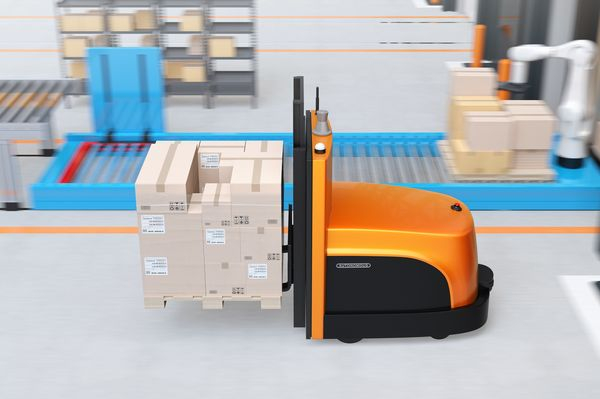
Automotive, electronics, FMCG, and logistics companies recognize the potential of autonomous mobile robots in terms of cost optimization, safety, and quality. The market leader in autonomous mobile robots (AMR), Mobile Industrial Robots (MiR), conducted a study among American automotive, electronics, FMCG, and logistics (3PL) companies regarding their approach to the automation of intralogistics processes (internal logistics). MiR asked respondents, among other things, about the actual timeframe in which AMR robots could be integrated into internal logistics, the impact of autonomous mobile robots on the industry, and the most significant barriers to automation.
– Automation allows for the creation of new opportunities for safer and more efficient work environments. Thanks to it, companies maintain global competitiveness by saving time, reducing costs, and responding more effectively to customer needs. The study confirms what we hear from our customers – autonomous mobile robots can very effectively and quickly automate internal transport – says Jesper Sonne Thimsen, Sales Director for the Central and Eastern Europe region, Mobile Industrial Robots.
Is it time to automate intralogistics with AMR robots?
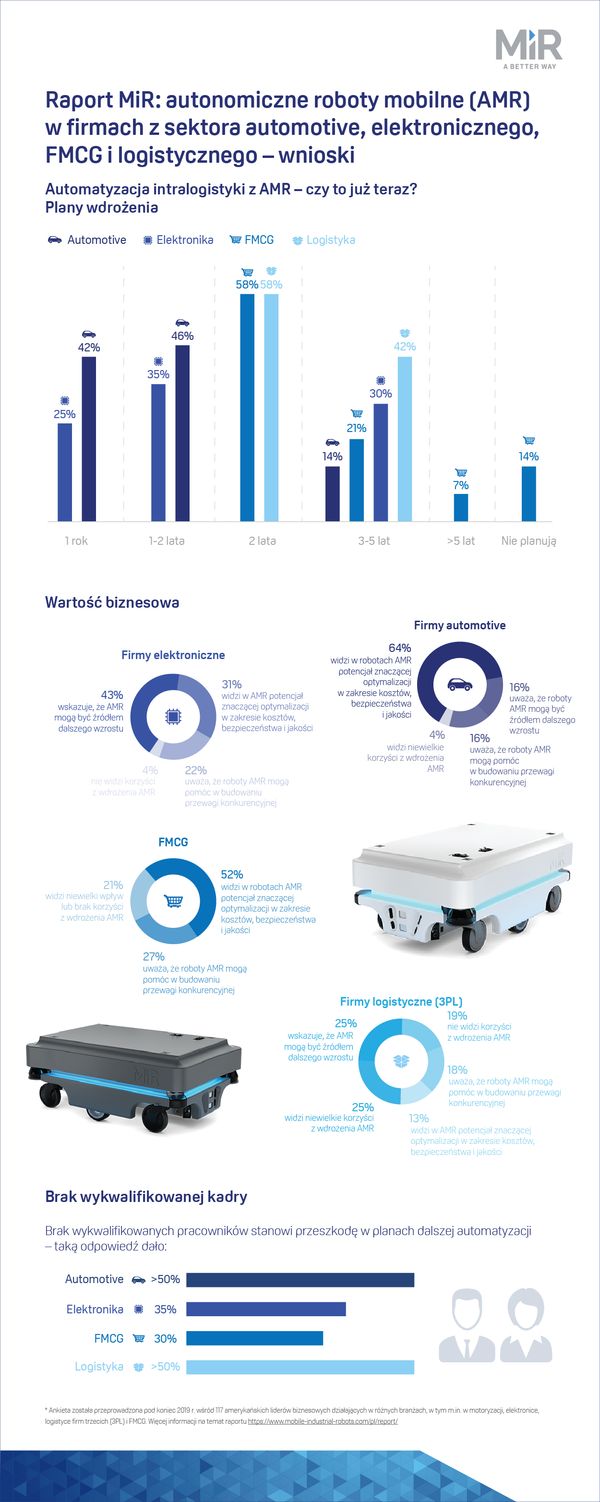
Automotive companies are the most optimistic about integrating AMR into internal transport in the near future. 88% of respondents from this segment plan to implement autonomous mobile robots within the next 2 years. In the electronics industry, 25% of companies indicate a period of 1 year, 35% a period of 1-2 years, and 30% 3-5 years. In the FMCG sector, the responses are as follows: 58% within 2 years, 21% 3-5 years, 7% over 5 years, while 14% do not consider AMR. In the case of logistics companies, 58% of respondents indicate a period of 2 years, and 42% 3-5 years.
Business value
Implementing AMR translates into concrete business value. Benefits include the optimization of labor and operating costs, increased productivity, accuracy, and efficiency. Among automotive companies, 64% see the potential of AMR robots in terms of reducing costs, increasing safety, and improving quality. 16% claim that AMR can help gain a competitive advantage, and the same number indicate that they can support company growth. In the FMCG industry, 79% see the potential for cost reduction, increased safety and quality, and improved competitiveness. 43% of companies in the electronics industry view AMR as a way for future enterprise growth. This answer was also given by 1/4 of 3PL companies.
Lack of qualified personnel
50% of respondents from both the automotive and logistics industries claim that the lack of qualified personnel is a barrier to further automation plans. This problem was also indicated by 35% of representatives of the electronics industry and nearly 30% in the FMCG sector. More than half of the respondents from each segment stated that the return on investment in automation is not fast enough. Nearly 40% of companies in the FMCG and electronics industries rated their processes as too variable or too small in scale to be automated.
– Implementing new technologies such as AMR is often classified as a technology investment. However, it should be viewed as a tool supporting the company as a whole. I am sure that the experiences of our customers, such as the Whirlpool factory in Poland or Visteon in Slovakia, can help other companies see the huge potential of effective intralogistics automation – says Jesper Sonne Thimsen.
About the report
The survey was conducted at the end of 2019 among 117 American business leaders operating in various industries, including automotive, electronics, third-party logistics (3PL), and FMCG. The report was supplemented with 20 interviews with board members of manufacturers and distributors. Further information was gathered after conducting stationary research and analyzing publicly available information relevant to the purpose of the study.
Source: Mobile Industrial Robots