









The European rail transport system is facing increasing pressure to transport goods more efficiently while simultaneously reducing emissions. However, according to data published by the European Commission, rail freight transport performance in the EU, measured in tonne-kilometres, fell in 2024, highlighting the need for further investment in the modernization of rail infrastructure.
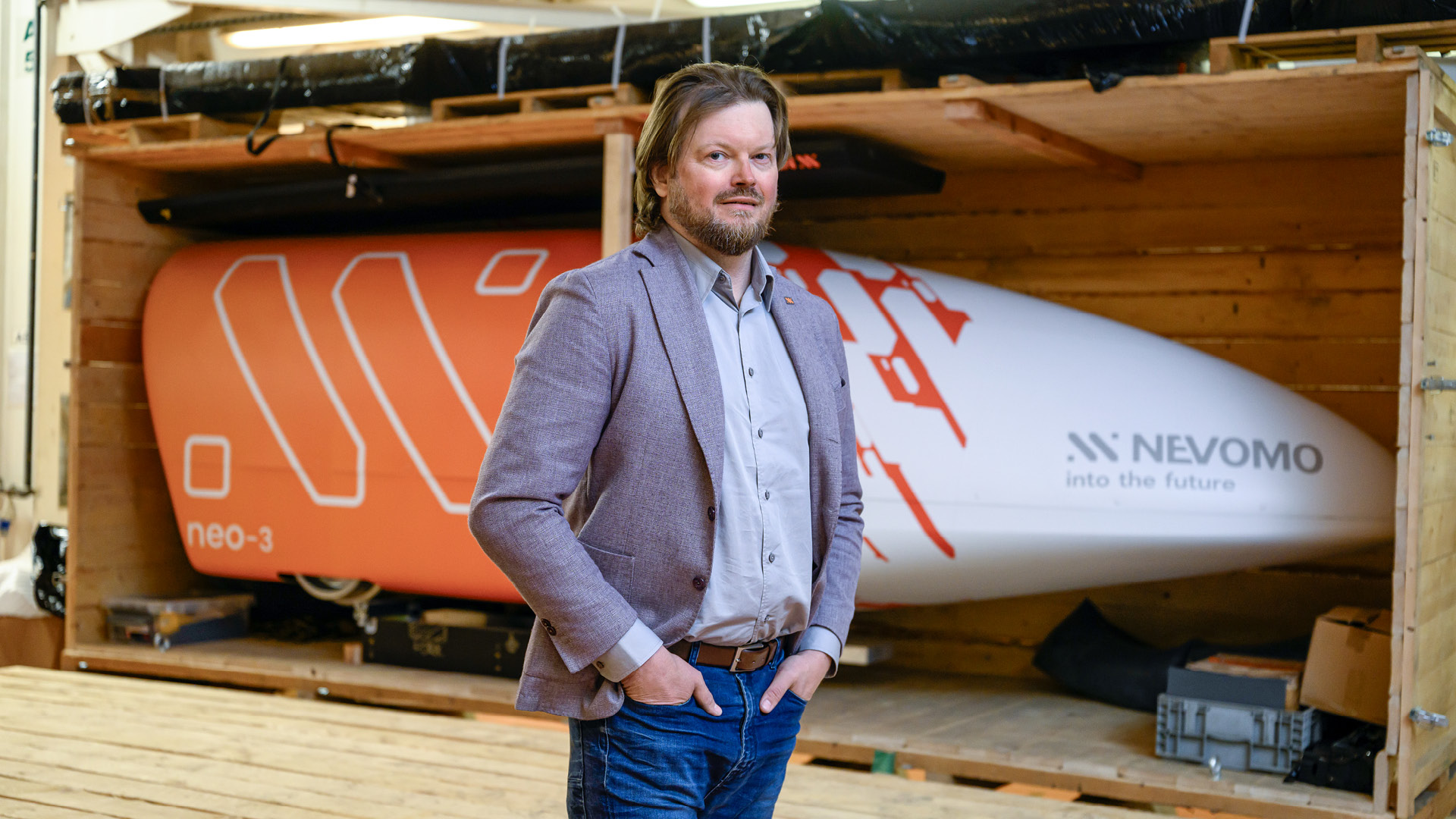
Przemek Ben Pączek, co-creator of the MagRail technology, together with Łukasz Mielczarek, Paweł Radziszewski, Katarzyna Foljanty, and Tomasz Kublin, has developed a solution that uses electromagnetic propulsion to modernize existing railway lines without the need for their replacement. Their technology allows freight wagons to move independently, without a locomotive, increasing the flexibility and efficiency of transport on the conventional rail network. For this work, the team was selected by an independent jury for the final of the European Inventor Award 2026 in the “SMEs” category.
Magnetic propulsion on existing railway tracks
International rail freight transport is often based on long trains, which allow for the transport of large volumes of cargo but are difficult to plan flexibly, slow to accelerate, and generate high operating costs at terminals and sidings. The MagRail technology, developed by Nevomo, addresses these challenges by providing the ability to retrofit existing railway infrastructure and wagons with components that enable contactless electromagnetic propulsion.
The system combines a passive magnetic module, mounted under the wagon bogie, with a so-called “third rail” placed between the tracks. The electromagnetic field generated in this way is used to propel and brake the wagon (including energy recovery) without mechanical contact between the propulsion system components and the rails.
Nevomo’s Cargo MagRail Booster enables individual freight wagons or small groups of them to move independently and autonomously at speeds of up to 160 km/h. The system allows for the automatic coupling and uncoupling of wagons depending on operational needs. In industrial zones, terminals, sidings, and marshalling yards, the system can automate shunting operations that are usually carried out using diesel locomotives. On main railway lines, it can support the starting and acceleration of heavy trains, e.g., after passenger trains have passed, and also enable travel through sections of infrastructure where it is not possible to install an overhead line, such as in some tunnels.
Where would we actually put this infrastructure? That was the moment we decided to stop dreaming about building new vacuum tunnels and start thinking about modernizing the railway we already have.
– said Przemek Ben Pączek.
From hyperloop research to the modernization of existing railway infrastructure
The roots of the technology developed today by Nevomo date back to 2016, when students from the Warsaw University of Technology formed the Hyper Poland University Team to take part in the international SpaceX Hyperloop Pod Competition. Their prototype qualified for the competition final and was tested at SpaceX, which prompted the team to establish a spin-off company that later evolved into Nevomo.
Although the initial vision focused on high-speed transport in vacuum tunnels, discussions with investors in 2017 revealed how challenging it would be to build entirely new infrastructure. Therefore, the team focused on a solution that would allow for the integration of electromagnetic propulsion with existing railway infrastructure, while leaving the possibility of its further modernization towards magnetic levitation.
The first development works included a 48-metre test track with a 1:5 scale vehicle presented in 2019. Subsequent stages of R&D led to the construction of a full-scale track and tests of a two-tonne MagRail vehicle in Nowa Sarzyna. In 2023, the vehicle successfully levitated on the test track, reaching a speed of 135 km/h.
In 2025, Nevomo launched its first commercial project in cooperation with the Deendayal Port Authority in India. Its goal is to create a fully automated freight wagon transport system using existing railway infrastructure.
The biggest challenge was securing funding. When you work on something completely new, without existing points of reference, it is extremely difficult to convince people to invest in it.
– said the Polish finalist.
Przemek Ben Pączek, together with his team, is among the three finalists of the European Inventor Award 2026 in the “SMEs” category. The other finalists in the SME category are Jan Čmelík and his team, who have improved needleless electrospinning technology, enabling the reliable production of nanofibers on an industrial scale.
The final candidate is Franck Zal, who developed a universal oxygen carrier based on hemoglobin obtained from marine worms, used for the preservation of organs and tissues. The European Patent Office will announce the winners during a live-streamed ceremony from Berlin on 2 July 2026. The Popular Prize will also be awarded on the same day, decided by votes cast through a public vote and an independent jury. Voting will begin on 12 May 2026 and will last until the ceremony on 2 July 2026. More information about the technology, its impact, and its creators can be found here.
Source: European Patent Office / European Inventor Award