








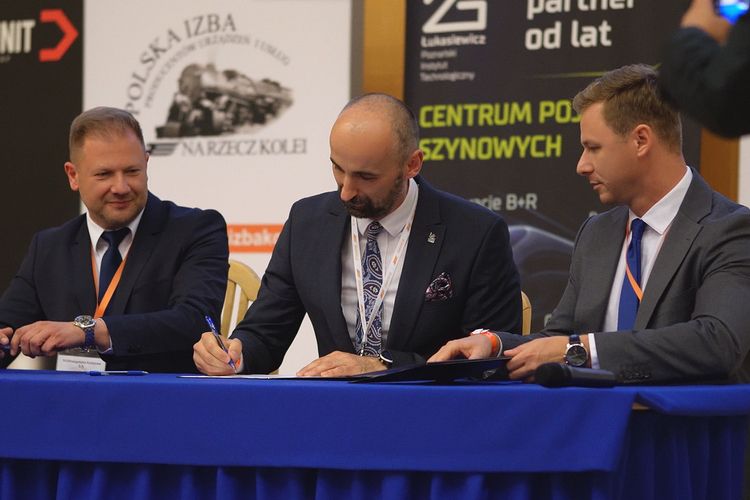
PGE Energetyka Kolejowa SA and the Łukasiewicz Research Network – Poznań Institute of Technology have signed a letter of intent regarding cooperation on the development and dissemination of hydrogen technology in the railway sector in Poland.
The goal of this cooperation is to develop hydrogen-powered rolling stock and railway hydrogen refueling infrastructure. As part of the collaboration, the parties plan to modernize a WM-15A rail vehicle, which includes introducing elements of a hydrogen power system. Hydrogen for powering the modernized train will be supplied by PGE Energetyka Kolejowa.
– Cooperation with the Łukasiewicz Research Network – Poznań Institute of Technology is a step towards the decarbonization of rail transport and the development of railways based on renewable energy sources – says Sylwester Szczensnowicz, President of the Management Board of PGE Energetyka Kolejowa S.A. – PGE Energetyka Kolejowa intends to use the experience gained in this project for the further development of railway hydrogen station projects in Poland.
– At the Rail Vehicle Center, we are conducting numerous research and development projects, including in the area of hydrogen propulsion, but not only. Market needs are currently evolving towards the use of artificial intelligence in railways or the optimization of logistics processes – says Dr. hab. Arkadiusz Kawa, Director of the Łukasiewicz – Poznań Institute of Technology. – I hope that the results of this cooperation will have a positive impact on the development of hydrogen railways in Poland.
PGE Energetyka Kolejowa has already conducted a test launch of a pilot hydrogen production installation as part of a project implemented at the Garbce Traction Substation. The company aims to be a supplier of various types of media for powering the Polish railway – not only green energy from the traction network or charging stations for battery trains, but ultimately green hydrogen.
The development of the hydrogen economy in Poland, including the railway sector, is in line with the Polish Hydrogen Strategy until 2030, the assumptions contained in the National Energy and Climate Plans (KPEiK), the Energy Policy of Poland until 2040 (PEP2040), the Strategy for Responsible Development until 2020 (with a perspective until 2030), and the National Policy Framework for Alternative Fuels Infrastructure Development. The PGE Group actively monitors current progress in research on the use of hydrogen technology in the power industry.
PGE Energetyka Kolejowa currently operates 6 modern traffic control centers in a network monitored by 54,000 smart energy meters (AMI). The infrastructure is complemented by 814 traction substations and cabins, 6,213 power stations, and 79 network trains. The company is the sole distributor of electricity for the needs of the railway traction network and is responsible for the distribution of 4.32 TWh of electricity annually, which accounts for approx. 3 percent of all energy supplied in the country. It uses approx. 21.5 thousand km of power lines for this purpose.
The PGE Group is the largest power company in Poland, a leader in the national energy transition, and the largest producer of energy from renewable sources. After the acquisition of PGE Energetyka, the length of distribution lines in the Group increased to approx. 320,000 km; according to pro forma data for 2022, the total volume of distributed energy is approx. 41.4 TWh, and energy sales are approx. 37.3 TWh.
The Łukasiewicz Research Network is one of the largest research networks in Europe. It is made up of 22 institutes across Poland. It has extensive experience in working with business and is capable of responding to the most complex challenges posed by enterprises. Together with its partners, it is currently implementing over 1,062 research projects worth PLN 7.4 billion.
The Łukasiewicz – Poznań Institute of Technology, through its Rail Vehicle Center, conducts research and development work and projects in the areas of new and modernized rolling stock. Specialists in the rolling stock industry perform work related to the development and simulation, as well as bench and operational testing of various types of rail vehicles, road-rail vehicles, and their components.