









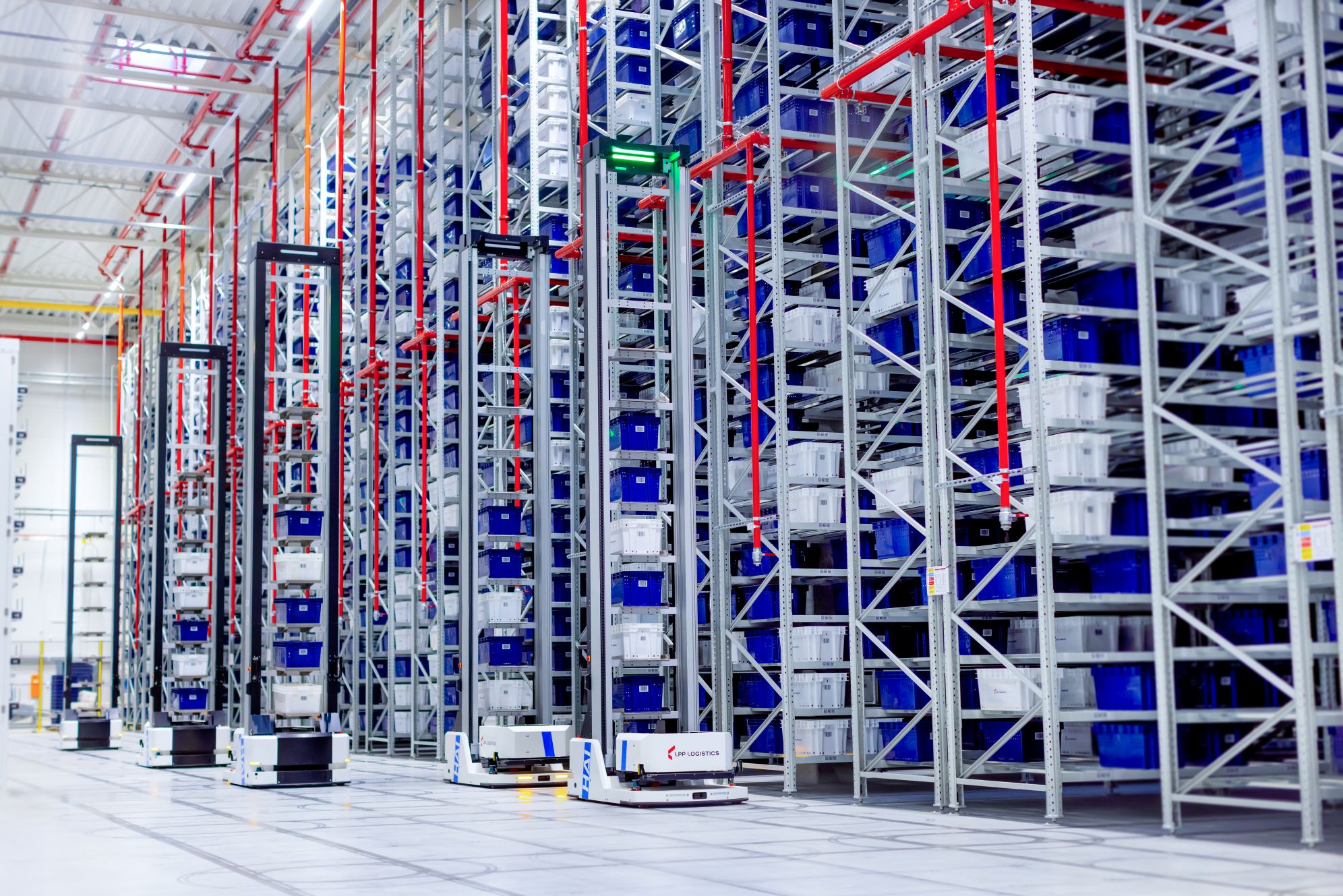
LPP Logistics, the logistics operator of the Polish clothing group LPP, has significantly increased the number of robots supporting e-commerce order fulfillment. Today, more than 3,500 autonomous units are operating in fulfillment centers in Poland – near Bydgoszcz and in the Subcarpathian region – as well as in a recently launched facility in Romania. The expansion of automated infrastructure and the implementation of artificial intelligence-based solutions have resulted in a clear increase in operational efficiency, better utilization of warehouse space, and strengthened scalability of the company’s logistics processes.
Between January and December 2025, e-commerce warehouses belonging to LPP Logistics fulfilled 60 million orders. Such a scale of online sales requires a foundation that ensures not only high efficiency but also cost predictability, operational flexibility, and readiness for further growth. The answer to these challenges is an extensive robotic infrastructure operating in three warehouses located in Poland and Romania, supporting e-commerce operations for brands in the LPP Group portfolio. Over the course of the last 12 months, the fleet of autonomous units supporting picking and sorting processes in these facilities has grown more than sixfold – from 555 to over 3,500 robots.
Warehouse robotization is currently one of the key pillars of LPP Logistics’ development strategy. We are investing in solutions that allow us to continue scaling our e-commerce operations dynamically and flexibly across 35 markets. I am convinced that one of the largest and fastest-growing robotic fleets in the region gives us a significant operational advantage. Thanks to it, we can handle a growing volume of orders without proportionally increasing warehouse space, while at the same time responding even better to the needs of our e-commerce customers. – says Sebastian Sołtys, CEO of LPP Logistics.
Integrated robotic infrastructure
The robotic infrastructure implemented in LPP Logistics warehouses is based on the close cooperation of several types of robots performing tasks within a single, integrated system. It includes robots responsible for transporting, picking, and placing standardized containers with goods on high-bay racks, autonomous units delivering designated containers to picking stations, and robots sorting individual items for specific orders.
The key premise of this solution is the tote-to-person model, in which goods are automatically brought to the employee, eliminating the need to move around the warehouse. In practice, the operator remains at the station, and the system – via robots – delivers exactly the products needed to fulfill the order, ensuring the fluidity and continuity of the entire logistics process.
The implementation of robotization has changed the way work is organized in our warehouses. Operators no longer have to cover several kilometers of picking paths or enter high-bay storage zones – they work at ergonomic picking stations to which robots deliver the goods. This solution reduces physical strain, improves work safety, and allows for a clear separation of operational zones from storage zones. Automation has taken over the most repetitive tasks, which has translated into increased efficiency while improving the comfort of the entire team’s work. – says Michał Moteka, Senior Logistics Process and Automation Development Manager at LPP Logistics.
Efficiency leap in key processes
Automation has brought clear results in the area of high-bay warehouses. While in a traditional, manual model it is possible to store about 65 items per m2, automated systems allow for storing up to 250 items per m2 – more than four times as much. At the same time, the robots ensure stable, repeatable performance and full control over the location of goods, minimizing the risk of errors associated with placing products in the wrong spots.
A significant increase in efficiency is also visible in subsequent stages of warehouse operations. Thanks to robots and modern automation, the picking process can be carried out up to 4-5 times faster. The same applies to sorting, where operational efficiency is up to three times higher than in a manual system.
Implementation in a few months
The execution of automation projects was carried out in stages – from defining business goals, such as cost optimization and maximum space utilization, through market analysis and the selection of proven technologies, to their adaptation to the specifics of LPP’s assortment. Standard system components were modified, among other things, by adjusting the size of containers to the specifics of clothing, which allowed for even better use of available warehouse space.
It was particularly important to plan a smooth transition from manual to robotic operations and to carry out the installation in stages – subsequent areas were put into operational use immediately after assembly was completed, even while work was still ongoing in other zones.
One of the main highlights of this project is the speed of implementation. Traditional logistics automation deployments take on average from a year to a year and a half – it took us just over six months, and in several locations simultaneously. Our priority was to ensure the continuity of operations. Each phase was thoroughly tested before production launch, which allowed us to minimize operational risk. Today, the infrastructure remains under constant monitoring, and we are continuously optimizing its operation together with our technology partners. – emphasizes Piotr Pawlak, Logistics Process Robotization Lead at LPP Logistics.
The execution of robotic projects is the result of close cooperation between LPP Logistics teams responsible for the development of logistics processes and automation, and IT specialists from Silky Coders. The project required precise coordination of dozens of specialists working in parallel in several countries.
Further expansion of robotic infrastructure
In response to the LPP Group’s development plans and the further growth in the scale of operations, the company intends to continue expanding its robotic infrastructure. In the coming months, the fleet will be expanded with additional autonomous units, which will further strengthen the operational potential of LPP Logistics.
Source: LPP Logistics