








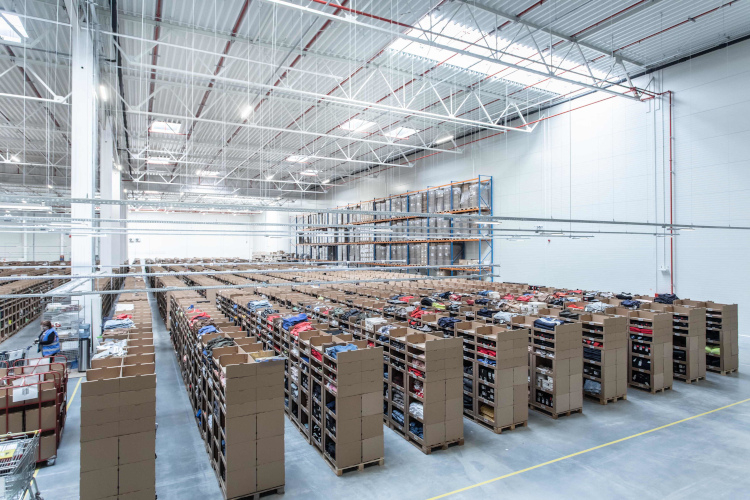
Engineers from PSI Polska are working on technology using artificial intelligence that could revolutionize logistics. The project, named Warehouse Intelligence, received 3 million in funding from the NCBR, and one of its stages has been piloted at LPP. The initial results of the work are impressive.
There are nearly 24 million square meters of warehouse and industrial space in Poland. Although investments are growing rapidly, pressure related to fuel, material, and labor costs is forcing manufacturing and retail companies to seek ways to optimize. The logistics industry has high hopes, particularly for warehouse automation and robotics. A report titled “Logistics in Poland” shows that 75% of companies see the greatest opportunities for logistics development in this area. Until now, however, technologies based on artificial intelligence had very narrow applications. This may change thanks to Polish engineers and scientists. They are working on technology that has the potential to revolutionize warehouse management: artificial intelligence will provide real-time suggestions for optimal solutions to humans. Initial tests show that it does so very effectively.
A game of challenge
Two years ago, engineers from PSI Polska began collaborating with a group of scientists from the Poznań University of Technology and the Wrocław University of Science and Technology, including Dr. Eng. Sławomir Susz from the Faculty of Mechanical Engineering of the Lower Silesian university. The interdisciplinary team began experimenting with artificial intelligence and machine learning. Although these are not new technologies, their use in logistics is still in its early stages.
– There are technologies on the market that support employees very selectively, mainly in the area of picking paths. No one had previously created technology based on artificial intelligence that would be able to optimize all warehouse processes by treating the problem holistically. We decided to take on this challenge – says Jerzy Danisz, Head of the WMS Competence Center at PSI Polska, describing the beginnings of the project.
Work on Warehouse Intelligence was divided into five stages. In the first, a prototype of the WI environment was developed. In the second, PSI Polska engineers began creating simulations, i.e., creating a digital twin of a real warehouse.
– Our idea is to develop artificial intelligence algorithms whose task is to manage the warehouse in such a way as to achieve optimal efficiency of individual processes. The ML model (i.e., the machine learning algorithm) was given a task and had to find the best possible solution. If it succeeded in effectively optimizing a given process, it won. If not, it had to keep trying until it succeeded. In this way, by a method of trial and error, the algorithm arrives at an optimal solution, while the warehouse simulation (digital twin) allows for the quick and practically cost-free analysis of hundreds of thousands of possible warehouse operation scenarios – explains Jerzy Danisz.
The subsequent stages of work on the project are, respectively: training ML models, preparing an application through which the end-user can accept recommendations suggested by artificial intelligence, and finally, the fifth stage involves the pilot launch of the entire system in the LPP warehouse.
The system optimizes picking
The first results obtained are very promising. It turned out that the use of artificial intelligence shortened picking paths at LPP by as much as 30%. How is this possible? The primary task of the implemented algorithm is to effectively solve the so-called “traveling salesman problem” (TSP). It consists of determining the shortest route connecting several points on a map. In the case of a warehouse, the system must determine the optimal route for several dozen picking locations. What seems simple at first glance is, in reality, a significant problem that has challenged mathematicians for years – says Jerzy Danisz from PSI Polska. The first of the Warehouse Intelligence modules broke the established rules and patterns used by pickers in the warehouse, and it was right. The algorithm’s suggestions have already brought measurable savings. It is estimated that more than 1/3 of warehouse logistics costs come from order picking. This process is particularly expensive in spaces with high order volumes, e.g., in e-commerce.
– Elements of individual orders are picked from their storage locations, then packed and prepared for shipment. The costs of picking and packing depend directly on the SKU, i.e., stock-keeping units, and in our case, these are significant numbers. Therefore, optimization in this area is of great importance to us. It directly affects warehouse efficiency and the efficiency of handling our customers’ orders – describes Sebastian Sołtys, Logistics Director at LPP.
NCBR recognized the potential
The effect of the implementation at LPP is only part of the Warehouse Intelligence project. Its goal is to develop an innovative environment for comprehensive analysis, planning, and optimization of intralogistics processes, which will be based on an artificial intelligence algorithm. This effectively means the possibility of optimizing all warehouse processes. The use of reinforcement machine learning mechanisms proved to be such an innovative approach that the National Centre for Research and Development (NCBR) awarded funds for the project. PSI Polska received a grant for research and development in the amount of nearly 3 million PLN.
Currently, the fourth stage of the project is being implemented, the goal of which is the intensive training of artificial intelligence algorithms. It is key in the entire process. There are no shortcuts here. Training the algorithm so that it is capable of operating in the target location takes about three months. Given that the system will support a space containing millions of products and employing hundreds of workers, one quarter for learning is an express pace.
– Creating an algorithm that supports such a complex facility as a warehouse is a very complicated and complex process. Reinforcement learning algorithms are based on interaction with the so-called environment. In our case, the environment is the warehouse, specifically its faithful digital copy. By repeatedly (often hundreds of thousands of times) repeating various variants of warehouse operation in the training environment, the algorithm learns how to deal with specific situations (e.g., selecting the picking method depending on the structure of release orders). Then, by exposing the algorithm to data from the real warehouse, it is able to instantly suggest an optimal solution to the warehouse manager. – explains Jerzy Danisz.
The supplier estimates that the final, fifth stage will be completed at the beginning of next year.
PEAR will suggest investment profitability
The described technology will be an integral part of the PSIwms system, but the supplier is not closing the door to external companies. Warehouse Intelligence will be able to be integrated with any WMS-class system, and any retail or manufacturing company will be able to benefit from its advantages. The technology will be available in two versions: automatic (artificial intelligence algorithms – Warehouse Intelligence) and as an analyzer with human support, referred to as PEAR. This term refers to a logistics process analyzer that allows for simulations and observing them on a three-dimensional model along with its current KPIs. LPP will be able to use this solution in the near future.
– PEAR allows for estimating the profitability of potential or planned investments and changes. The user receives information on whether a specific reorganization, e.g., purchasing a new sorter, will be profitable and to what extent it will affect business operations. In such a situation, it is much easier to make a decision – explains Jerzy Danisz.
Experts from Accenture forecast that by 2035, artificial intelligence will increase efficiency in logistics by more than 40%. It is worth emphasizing that companies that start using AI in logistics operations earlier than their market competitors will receive a first-mover advantage.