









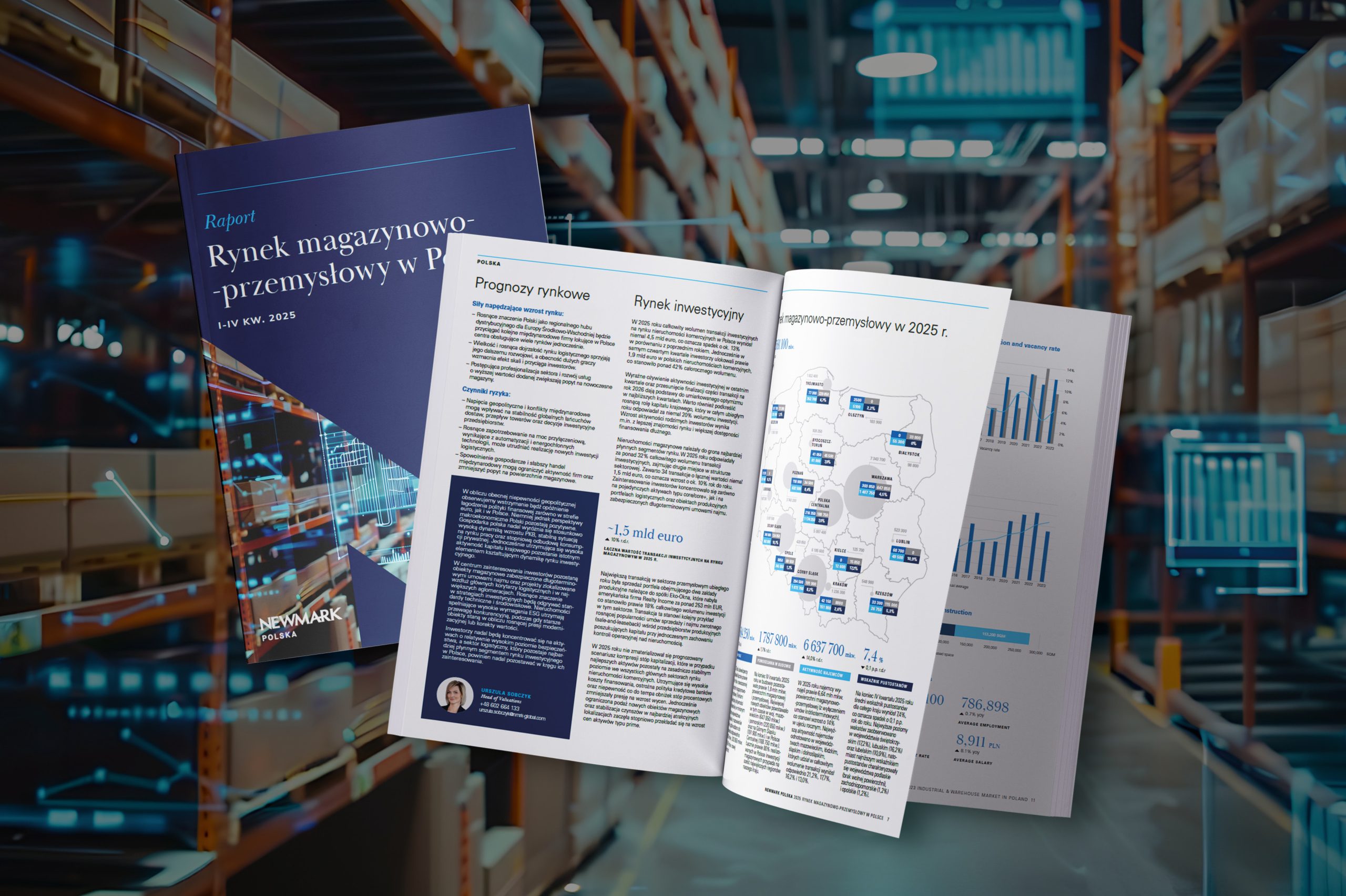
According to the latest report “Warehouse and Industrial Market in Poland,” published by the advisory firm Newmark Polska, the warehouse and industrial space market in Poland entered a phase of stabilization in 2025. Significantly limited new supply and high demand from tenants led to a gradual decline in the vacancy rate and an improvement in market balance. Last year, developers increasingly made the start of new investments conditional on signing pre-lease agreements, and renegotiations continued to dominate the leasing market. Rents for the most attractive spaces remained at a stable level, while incentive packages for tenants varied significantly depending on the location and standard of the facility.
At the end of 2025, the total stock of warehouse and industrial space in Poland reached nearly 36.6 million sqm, which translates into a 5.9% year-on-year increase. Throughout last year, nearly 1.7 million sqm was delivered to the market, i.e., over 35% less than the year before and the lowest level since 2016.
The dynamic development of the warehouse and industrial space market in Poland observed in recent years has contributed to a better balance between supply and demand. New investments are currently being created at a more sustainable pace, and decisions regarding their implementation are increasingly dependent on the actual demand reported by tenants. Throughout 2025, developers started construction of nearly 1.9 million sqm of warehouses in response to current tenant demand. Meanwhile, fully speculative investments remain a rarity. More than 60% of the space in facilities under construction has already been leased, and only a few projects are being built entirely without pre-lease agreements.
– says Jakub Kurek, Head of Industrial and Warehouse Department at the advisory firm Newmark Polska.
The full-year volume of lease transactions in the warehouse and industrial market in Poland amounted to nearly 6.64 million sqm and was 14% higher than recorded a year earlier.
The activity of both tenants and developers focused on the six main warehouse markets (Warsaw and its surroundings, Upper Silesia, Central Poland, Lower Silesia, Greater Poland, and the Tri-City), which together accounted for nearly 83% of all lease agreements finalized in 2025.
Warehouse supply and space under construction
In 2025, developers built a total of nearly 1.7 million sqm of modern warehouse and industrial space. The markets with the highest developer activity last year were the Lower Silesian, Masovian, and Silesian voivodeships, where 349,800 sqm, 303,850 sqm, and 294,500 sqm of new space were delivered, respectively.
At the end of the fourth quarter of 2025, nearly 1.8 million sqm of warehouse and industrial space remained under construction. Most new facilities were being built at that time in the Masovian voivodeship (647,850 sqm) and the Pomeranian voivodeship (220,850 sqm), as well as in Upper Silesia (191,900 sqm) and Central Poland (188,750 sqm). In total, nearly 80% of warehouse investments being implemented in Poland are located in the six largest regions of our country.
Tenant activity in the warehouse and industrial market in Poland
In 2025, tenants leased nearly 6.64 million sqm of warehouse and industrial space (excluding short-term agreements), which represents a 14% year-on-year increase. The highest tenant activity was recorded in the Masovian, Łódź, Silesian, and Lower Silesian voivodeships, whose share in the total transaction volume was 21.2%, 17.7%, 16.2%, and 13.0%, respectively.
In the structure of transactions concluded in 2025, renegotiations dominated, accounting for 52.1% of the total volume. New lease agreements, including those for BTS projects, also marked their clear share in last year’s demand – it amounted to as much as 40.8%. The remaining 7.1% accounted for expansions. It is also worth noting that in 2025, tenants leased just over 213,550 sqm under short-term agreements (up to one year).
Among the selected largest transactions of the past year were, among others, a renegotiation combined with an expansion of the warehouse space occupied by the Agata company in the Mapletree Piotrków II complex to over 128,000 sqm, and a renegotiation and expansion of a confidential tenant from the manufacturing sector in Segro Logistics Park Stryków to 120,150 sqm. In 2025, a total of over 840 lease agreements were concluded, and the average transaction size was approximately 8,000 sqm. Fourteen of them exceeded 50,000 sqm, including four that exceeded 100,000 sqm.
Warehouses for rent
According to Newmark Polska experts, at the end of last year, tenants had nearly 2.7 million sqm of space available in existing facilities and just over 690,000 sqm in investments under construction at their disposal.
At the end of the fourth quarter of 2025, the average vacancy rate for the entire country was 7.4%, which means a decrease of 0.1 p.p. year-on-year. The highest vacancy levels were observed in the Świętokrzyskie (17.2%), Lubusz (16.2%), and Lublin (10.9%) voivodeships, while the lowest vacancy rates were characterized by the Podlaskie (no vacant space), West Pomeranian (1.2%), and Opole (1.2%) voivodeships.
Rents
In 2025, rents for top-class warehouse and industrial space remained at a relatively stable level. However, in regions characterized by a higher vacancy rate, tenants had greater negotiating power, which allowed for lower effective rent rates and more extensive incentive packages. A different situation was observed in the case of modern facilities offering high technical standards and eco-friendly solutions, where owners showed less willingness to make concessions in negotiations. The highest rent rates continued to be maintained in Warsaw (Zone I) and in the Pomeranian voivodeship.
Investment market
In 2025, the total volume of investment transactions in the commercial real estate market in Poland amounted to nearly 4.5 billion euros, which means a decrease of approximately 13% compared to the previous year.
Warehouse properties were among the most liquid segments of the market. In 2025, they accounted for over 32% of the total investment transaction volume, taking second place in the sector structure. 34 transactions were concluded with a total value of nearly 1.5 billion euros, which means an increase of approximately 10% year-on-year. Investor interest focused on both single core/core+ assets and logistics portfolios and manufacturing facilities secured by long-term lease agreements.
In the face of current geopolitical uncertainty, we are observing a pause or delay in the easing of financial policy in both the eurozone and Poland. Nevertheless, Poland’s macroeconomic prospects remain positive. Warehouse facilities secured by long-term lease agreements and projects located along main logistics corridors and in the largest agglomerations will remain in the center of investor interest. Technical and environmental standards will play an increasingly important role in investment strategies. Real estate meeting high ESG requirements will maintain a competitive advantage, while older facilities will face increasing pressure for modernization or value correction. Investors will continue to focus on assets with a relatively high level of security, and the logistics sector, which remains the most liquid segment of the investment market in Poland, should continue to remain in their area of interest.
– says Urszula Sobczyk, Head of Valuation at Newmark Polska.
Poland at the forefront of Europe
An undeniable advantage of the Polish warehouse market is its modernity. At the end of 2025, over 70% of existing stock was less than ten years old, and over 42% was no more than five years old. This is appreciated by developers and investors, as well as tenants.
In terms of modern warehouse and industrial space stock, Poland is one of the largest markets in Europe, second only to countries such as Germany, the United Kingdom, or France. At the same time, the economic growth rate in Poland remains significantly higher than in many mature Western European economies, thanks to which our country is among the leaders in the development of the logistics sector in the Central and Eastern Europe region. Poland is systematically strengthening its position as a key logistics hub in Europe. In the coming years, this sector will continue to develop, although the growth rate will largely depend on the economic situation in Europe and changes occurring in global supply chains.
– concludes Agnieszka Giermakowska, Research & Advisory Director, ESG Lead, Newmark Polska.
The full report, containing a detailed description of all warehouse regions in Poland and access to maps with warehouse space and current road infrastructure in electronic version, is available at: https://www.polskamagazyny.pl.
Source: Newmark Polska