








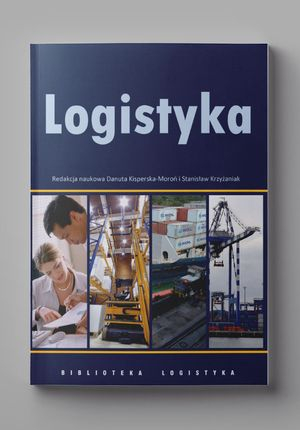
Authors: scientific editors D. Kisperska-Moroń, S. Krzyżaniak
Price: 89.00 PLN
Description:
The long-awaited book titled “Logistics” is now available to readers. This unprecedented publishing project involved 24 authors representing 8 research and academic centers (Institute of Logistics and Warehousing, Poznań School of Logistics, Poznań University of Economics and Business, University of Economics in Katowice, University of Gdańsk, University of Szczecin, Poznań University of Technology, Silesian University of Technology).
The textbook is divided into seven parts, which are further subdivided into chapters. The first part presents the characteristic features of logistics as a component concept of broadly understood goods supply chains in the economy. Based on this, the second part presents customer service issues as a key element in shaping the competitiveness of enterprises in modern markets. The third part concerns the basic areas of logistics process activities, such as inventory management, purchasing and procurement, transport, warehousing, packaging in logistics systems, and logistics aspects of production control. The fourth part is entirely devoted to the issues of logistics services, while the fifth part discusses the processes of creating and operating logistics networks. The sixth part of the textbook concerns complex problems of coordination and integration of logistics processes within supply chains, where, in addition to explaining the essence of these phenomena, many aspects related to the use of logistics information systems, logistics cost accounting, supply chain performance measurement, building organizational structures for logistics needs, and important aspects of human resources in the sphere of logistics are highlighted. The work also includes an overview of contemporary directions in the development of logistics and the challenges that will have to be faced in the future. These issues are the subject of the seventh part of the textbook.
The intention of the authors and editors was to create a textbook that would be a universal aid used in many Polish universities dealing with logistics, would organize basic concepts and issues in this field, and would facilitate the acquisition of knowledge thanks to the attractive form of the presented content. The book has a modern form with keywords in the margins, a thematic index, and a set of questions at the end of each chapter.
Year of publication: 2009
ISBN: 978-83-63186-96-8
Volume: 504 pages
Table of Contents:
Introduction
Part 1 – Conditions of logistics in supply chains
1.1. Development of the logistics concept – M.Sołtysik
1.2. Supply chains and networks – M.Sołtysik
1.3. Strategic management of goods flow processes – M.Sołtysik
1.4. Systemic approach to logistics as an expression of integration trends in goods flow processes – D.Kisperska-Moroń
Part 2 – Customer service as the basis for company competitiveness in supply chains – D.Kempny
2.1. Physical products in flow processes to the customer
2.2. Definition of logistics customer service
2.3. Elements of logistics customer service and service standards
2.4. Basic measures of logistics service level
2.5. Customer service policy and customer segmentation according to expected service level
2.6. Measurement of logistics service costs
Part 3 – Basic areas of logistics activities
3.1. Concepts of material and product flow management – A.Świerczek
3.2. Inventory management – St.Krzyżaniak
3.3. Purchasing and procurement – C.Mańkowski
3.4. Transport – J.Żak
3.5. Warehousing – A.Niemczyk
3.6. Packaging in logistics systems – A.Korzeniowski
3.7. Logistics aspects of production control – M.Fertsch
Part 4 – Logistics services – W.Rydzkowski
4.1 Definition of a logistics service
4.2. Genesis of logistics services
4.3. 3PL + 4PL logistics operators
4.4. Characteristics of the logistics services market
Part 5 – Creating and operating logistics networks
5.1. Supply network strategies – M.Ciesielski
5.2. Configuration of logistics networks – A.Niemczyk
5.3. Transport systems, intermodal transport – J.Długosz
5.4. Logistics centers and their role in logistics networks – I.Fechner
Part 6 – Coordination and integration of logistics processes in supply chains
6.1. The essence of coordination and integration of logistics processes in supply chains – B.Śliwczyński
6.2. Information processing systems as support for logistics in supply chain management – J.Majewski
6.3. Total cost analysis in logistics processes – K.Kowalska
6.4. Supply chain performance measurement – M.Nowicka-Skowron
6.5. Organizational structures for logistics needs – M.Fertsch
6.6. Human resources in logistics – D.Kisperska-Moroń
Part 7 – Contemporary challenges and directions of logistics development
7.1. International dimension of logistics – G.Szyszka
7.2. Risk in logistics – W.Machowiak
7.3. Dynamic logistics concepts – M.Jedliński
7.4. E-logistics – B.Śliwczyński
7.5. Reverse logistics – J.Szołtysek
7.6. Logistics project management – J.Witkowski, B.Rodawski
7.7 Organizations supporting logistics – I.Fechner