









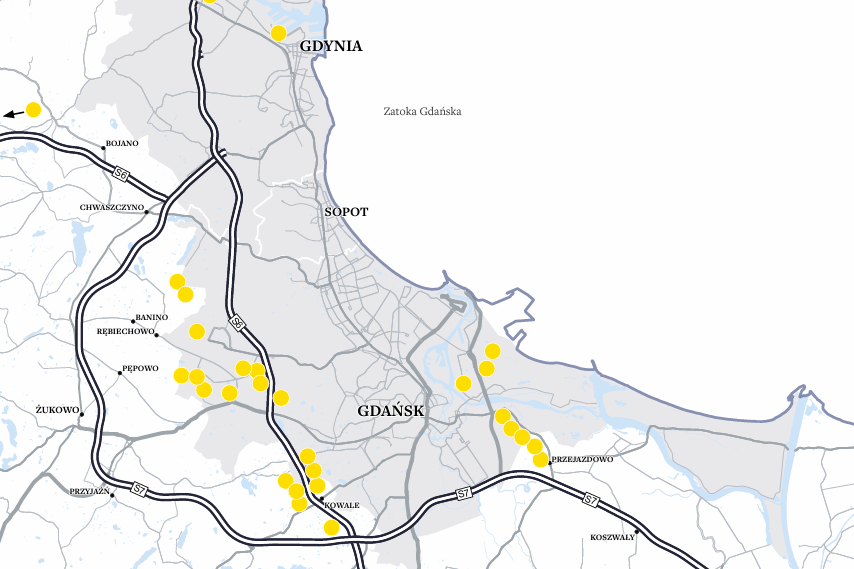
The Tri-City warehouse and industrial market is entering the next stage of development, combining stable demand with the growing importance of the manufacturing, port, and advanced technology sectors. The latest Savills report, “Market in Minutes: Tri-City. Industrial and Logistics Market,” shows that at the end of 2025, total modern space in the region reached 1.82 million sqm, an increase of 4% y/y. Despite a clear decline in new supply, which amounted to 77,300 sqm, tenant activity remained high. Gross demand reached 351,700 sqm, growing by 21% y/y, while net demand increased by as much as 37%, to 273,300 sqm.
Data for 2025 shows that the Tri-City remains a market with solid foundations. Despite limited new supply, we observed a clear increase in tenant activity, especially in terms of net demand. This confirms that the region is no longer perceived solely as a distribution hub for northern Poland, but increasingly as a location for more complex logistics, manufacturing, and technological operations.
– says Piotr Kolmetz, Associate, Industrial, Savills.
Production, infrastructure, and new development impulses
One of the factors that may further strengthen the position of northern Poland is the growing importance of industrial, infrastructure, and energy projects implemented in the region. The development of critical infrastructure, logistics facilities, energy, and investment land may foster further growth in demand for land, production facilities, warehouses, and infrastructure supporting business operations.
Pomerania is also gaining importance as a location for manufacturing and technology companies. Access to ports, maritime sector traditions, expertise in electronics, and active support from regional institutions create conditions for projects related to specialized production, system integration, advanced logistics, and international supply chain management.
Pomerania increasingly strong in the high-tech sector
Pomerania is strengthening its base for high-tech companies, especially those that need efficient supply chains, access to ports, and modern industrial and logistics space. According to the Savills report, the key advantage of the Tri-City is the ability to utilize multimodal transport, based on, among others, the seaports in Gdańsk and Gdynia, including Baltic Hub and GCT. The region also benefits from access to qualified employees, proximity to Scandinavian markets, and local institutions supporting investors.
At the same time, the Tri-City is strengthening its position in the European semiconductor ecosystem. Sopot once again hosted ISS Europe, one of the significant events in the high-tech industry. This development direction reinforces the well-developed industrial and logistics base of the Tri-City, based on access to multimodal transport, the ports in Gdańsk and Gdynia, and proximity to Scandinavian markets. Thanks to this, Pomerania may become increasingly attractive to technology companies that need efficient supply chains and modern operational infrastructure.
Ports and infrastructure strengthen the region’s advantages
According to Savills, one of the key assets of the agglomeration remains its location, which enables efficient multimodal transport handling. The ports in Gdańsk and Gdynia, including Baltic Hub and GCT, create a natural base for maritime logistics, distribution, and export activities. The importance of the location is also strengthened by the A1 motorway, the S7 expressway, and the developing S6, whose key Lębork-Słupsk section is to be fully commissioned before the summer, significantly improving connectivity with the western part of Pomerania and Germany.
Seaports remain one of the most important differentiators of the Tri-City compared to other regional markets. The proximity of container terminals, access to main road routes, and developing transport infrastructure make the region a natural choice for companies handling international trade, distribution, and maritime logistics. We also increasingly see that this advantage translates into decisions by tenants from the manufacturing and technology sectors, who are looking for locations that combine efficient distribution with access to industrial facilities.
– Robert Katzor, Associate Director, Industrial, Savills.
New investments with limited land availability
At the end of 2025, 197,400 sqm of space was under construction, which is 69% more than a year earlier. Importantly, 84% of the projects under construction were already leased, which confirms the sustained interest in the region from logistics operators, retail chains, pharmaceutical companies, and manufacturing enterprises. Among the largest projects under construction were, among others, 7R Park Gdańsk III, 7R Park Gdańsk V, and Panattoni Park Gdańsk West II.
The vacancy rate was 6.4%, which means an increase of 50 basis points y/y, but it remains a level allowing for sustainable market development, and the coming months should bring a decline. Base rents are in the range of 4.20-5.75 EUR/sqm/month, and effective rents are 3.50-4.70 EUR/sqm/month, with the highest levels achievable in the newest projects in key locations, especially near the Baltic Hub and the airport.
As a result, the Tri-City remains one of the most promising industrial and logistics markets in Poland. Its advantage is determined not only by transport infrastructure but also by the growing role of ports, access to qualified staff, and the increasingly strong link between logistics, production, and new technologies.
The report is available at the link.
Source: Savills