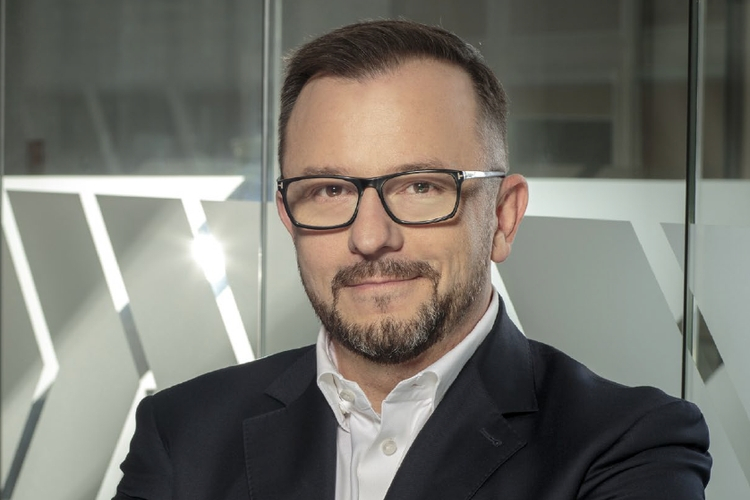
An interview with Tomasz Oczkowski, Commercial Director of FM Logistic Central Europe, about the “Logistics 2040” report.
Editorial: Where did the idea for the “Logistics 2040” report come from?
Tomasz Oczkowski: FM Logistic CE is a future-oriented company; we have long been committed to mutual inspiration and making our practical operations more flexible through broad discussion and theoretical reflection. It is with this intention that we have been organizing the Open Minds Debate conference for several years. We invite experts and scientists from various fields, not necessarily directly related to logistics, who share their knowledge with our guests, and together we consider how new trends and technologies can affect the economy and business. In the same spirit, this year we joined forces with the 4CF company to develop the “Logistics 2040” report. The published future scenarios are intended to challenge previous assumptions, prompt reflection on how the future of trade and logistics might develop, and inspire the search for innovative solutions for the future.
Editorial: Isn’t it risky to publish a report about the future in the era of a pandemic, when we don’t know what the next day will bring?
T. O.: Quite the opposite. Although the pandemic was not the reason we prepared the report, recent events related to it have only confirmed how important speed is in identifying and understanding challenges in order to modify existing assumptions, as well as creating optimal solutions that allow both for the company’s functioning and for increasing its competitiveness. We want to make our thinking about business development more flexible, so as not to focus only on current issues, but to look a little further ahead. The three completely different worlds presented in the “Logistics 2040” report provide an interesting perspective on megatrends and an opportunity to reflect on potential changes. And it is not the choice of the most accurate scenario that is most important here, but rather the inspiration and theoretical considerations. By engaging in this discussion, we can also realize the threats today and try to prevent the version of the future that we would prefer to avoid.
Editorial: Why exactly 20 years?
T. O.: The 2040s are far enough away to expect major changes, and yet close enough for logistics operators and their clients to take action now to prepare for what is to come. On the other hand, what will happen in the short term is not difficult to identify today; it is indicated by trends that are quite easy to identify given the available data. Strategic foresight is not about analyzing events here and now, but about looking at an issue from a broader perspective.
Editorial: Who is the report aimed at, who should be interested in it?
T. O.: We dedicate the report mainly to our clients and partners. We also want it to be an inspiration for our employees and the entire logistics industry. Logistics affects almost all market sectors, and its development is almost synonymous with change in many other areas for which it is an essential part of operational activity and the business model. Therefore, the report is constructed in such a way that it is understandable and accessible not only to specialists, but also to all those for whom the importance of logistics will grow in the coming decades.
Editorial: Indeed, in all scenarios the role of logistics is growing, covering new areas, often encroaching on the competencies of manufacturers. What do the clients think about this?
T. O.: As I mentioned, we are already observing this trend today. The services we provide to our clients go far beyond transport and warehousing. As logistics operators, we often take over the final stage of production; these are services in the field of co-packing and co-manufacturing. For example, we assemble sets that are then sold as a single product, we prepare multipacks, stands that we see in stores, label goods for a given market, etc. Operators also often take over customer service, which is facilitated by the rapid development of e-commerce; I mean, for example, handling complaints or courier services, but not only that. Clients also turn to us, as specialists in this field, for help in organizing their e-commerce channel. This is no longer just a question of fulfillment and delivery to the individual customer’s door, but managing the entire sales administration, creating pricing policy, working on social media, etc. By entrusting these tasks to a logistics partner, our clients can focus on developing their core business. The deepening of this trend is most visible in the first scenario, in which there is a technological race, and manufacturers focus on this, entrusting elements that are less important to them to their logistics operators.
Editorial: Which of the future scenarios in your opinion poses the greatest challenge for both operators and their clients?
T. O.: It is difficult to say unequivocally, because each of them has its own challenges. Certainly, the third scenario, which describes a world we have almost forgotten, in which politics and protectionism enter business, arouses the most emotions. In such conditions, those who show openness and a flexible approach, non-standard thinking, will gain an advantage. However, the second scenario is no less demanding, because the main driving force of the market, i.e., consumption growth, disappears. It is a world of “zero growth,” in which the economy and society are subordinated to the fight against climate change. Such a situation must lead to a modification of entrepreneurs’ attitudes, a focus on cooperation with competitors and partners, and the development of a common approach. The first – seemingly the most optimistic scenario – means a technological race, and thus the allocation of huge expenditures on new technologies and artificial intelligence. However, please remember that the scenarios contained in the “Logistics 2040” report should not be treated as forecasts for the future. Although they illustrate probable futures that could one day become reality, they are not the most likely events and were never intended to be. However, they are variants of the future that pose the greatest challenge for logistics operators and their clients, which is why it is worth discussing them.
Editorial: What do you expect from the “Logistics 2040” report, what should we remember?
T. O.: The report is intended to provide an impulse and prompt reflection. The future scenarios contained in the “Logistics 2040” report are a panoramic view of the world of the future, but they do not provide all the answers. Instead, they should intrigue and encourage the asking of new questions that would not have occurred to us before. They can be treated as a first step in your own analyses and foresight considerations. You can also take this report to a meeting with key partners, give it as a starting point for analysis to the staff of the strategy or innovation department.
The report can be found here: https://info.fmlogistic.com/Logistyka_2040
The article comes from the magazine LOGISTYKA 1/2021.
The e-edition of the magazine is available in our offer!
Stay up to date, subscribe to the LOGISTYKA magazine!