









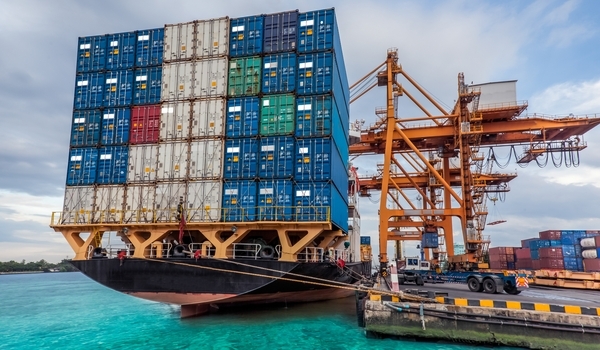
A key factor determining the development of the maritime economy in Poland is the competitiveness of commercial seaports (MPH) in the broadly understood market of port services. The competitiveness of MPH constitutes both a feature and a result achieved through the implementation of specific processes on a macro, mezzo, and microeconomic scale. It is directly influenced by the logistical potential of the MPH, which determines the port’s transshipment efficiency, dependent, among other things, on the port’s ability to cooperate with the transport branches integrated within it in the serviced sea-land supply chains.
This ability to cooperate with other entities, expressed through the offered portfolio of logistics services and its efficient and effective implementation, thanks to mutual adjustment in a procedural, administrative, and technical sense, can be defined as logistical interoperability. If we define competitiveness as the result of rivalry between participants in economic life, the goal of which is to ensure success, development opportunities, and the achievement of a satisfactory economic result, then interoperability is an excellent tool for achieving this. In the conditions of MPH, the level of logistical interoperability depends, among other things, on the size, number, and degree of universality or specialization of maritime transshipment terminals (MTP) that constitute an integral part of every seaport. The purpose of this paper is to present a concept for assessing the logistical interoperability of MTPs and relating it to the competitiveness of MPHs. The working hypothesis that the authors decided to prove is: the competitiveness of commercial seaports is a derivative of the synergistic operation of specialized and universal port transshipment terminals, which determines horizontal integration in the provision of port and logistics services. Solving the research problem involves answering the question of which attributes of maritime transshipment terminals and the processes implemented within them influence the competitiveness of Polish seaports. In connection with the above, the following research tasks were carried out:
- the essence of the integration of sea-land supply chains and its relationship with the concept of logistical interoperability was defined,
- the division of maritime transshipment terminals was identified based on the current logistical potential of Polish seaports,
- a model for the parametric assessment of the logistical interoperability of maritime transshipment terminals was proposed,
- an initial assessment of the impact of MTP logistical interoperability on the level of MPH competitiveness was made.
The essence of the integration of sea-land supply chains
By integration, in general terms, we should understand the search for and implementation of solutions that enable the achievement of a primary goal through the appropriate implementation and configuration of partial goals achieved by the system components involved in a given process. Integration in maritime logistics is a two-dimensional (in a vertical and horizontal sense) and multi-faceted concept. In a vertical sense, it concerns a certain style of controlling the management process through appropriate technological and procedural linking of successive links within the sea-land supply chain. Each link carries out a process appropriate to itself, which is intended to enable the achievement of a common goal or the satisfaction of common needs. Horizontal integration is aimed at ensuring the availability of a product, i.e., goods or services, for the widest possible range of supply chain customers, using various types of procedural and technical solutions. As for the multi-faceted dimension, three essential elements can be distinguished:
- the managerial aspect, oriented towards uniting links with different goals in solving a common problem by seeking optimal and rational solutions based on consensus and mutual benefits,
- the economic aspect, consisting in this case of achieving benefits related to the reduction of logistics costs and capital involved in logistics activities, resulting from the use of logistics standards and the scale effect, which are the result of the joint application of specific solutions in the field of logistics services by the widest possible group of supply chain participants,
- the systemic aspect, consisting of the widest possible cooperation of IT and administrative systems in such a way as to mutually use their resources, e.g., databases, thanks to the use of the same solutions in the area of logistics information exchange, automatic data identification, etc.
The article contains 20,820 characters.
Source: Logistyka Magazine
L3-35_Pac_Miler_Interoperacyjnosc_logistyczna_morskich_terminali.pdf