









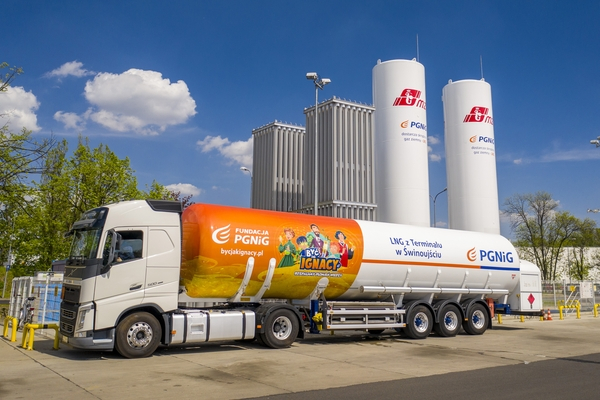
The popularization of alternative fuels in heavy transport is a near future due to European environmental regulations. A solution is available on the market that not only allows for a significant reduction in pollutant emissions but also provides substantial financial savings for transport companies. Liquefied natural gas (LNG), as it is called, is a proven fuel used in transport for several decades, which in recent years has been growing in the eyes of carriers as a cheap and clean alternative to diesel oil.
LNG is natural gas in a liquid state. It is obtained by purifying natural gas from naturally occurring chemical substances and cooling it to a temperature of approximately -162oC. Due to its ecological benefits, low price, and high octane number, LNG is an ideal fuel for long-haul road transport.
Gas is money
– Natural gas is one of the cheapest fuels on the market. Purchase costs are about 30% lower than in the case of diesel oil, which is popular on Polish roads. This is, among other things, the result of the introduction in August 2019 of zero excise duty on CNG and LNG gaseous fuels used for transport purposes, which translated into price reductions. After the announcement of this decision, gaseous fuel at our stations became cheaper by an average of about 33 groszy net per 1 m³ – says Henryk Mucha, President of PGNiG Obrót Detaliczny, the largest gas seller in Poland.
Another important economic aspect influencing the profitability of choosing LNG is the preferential treatment of gas vehicles by the authorities of European countries. Germany has been promoting this solution for years and recently extended the exemption from motorway tolls (Maut) for gas trucks until 2023. Thanks to this, carriers can count on savings of nearly 19 euro cents for every kilometer traveled compared to vehicles with diesel engines meeting the EURO6 standard. Similar preferences for gas vehicles also apply on selected routes in Italy and Austria.
A significant argument is also financial support or tax relief for the purchase of gas vehicles. Subsidies ranging from several to over a dozen thousand euros are offered in Germany, among other places. In Poland, gas vehicles are covered by support under the Low-Emission Transport Fund, the funds of which are being taken over by the National Fund for Environmental Protection and Water Management (NFOŚiGW).
Clean transport of the future
LNG engines, in addition to economic benefits, also guarantee a positive environmental effect because they are much less harmful than those powered by diesel oil. The use of liquefied natural gas primarily enables a significant reduction in carbon dioxide emissions. LNG fuel also ensures a low level of emissions responsible for smog, nitrogen oxides (NOx), and particulate matter (PM dust), in compliance with the EURO6 standard. This is particularly important in the context of tightening EU policy on reducing emissions from transport, which promotes the use of alternative fuels. Furthermore, trucks powered by LNG are characterized by a longer engine life than those running on diesel oil.
– LNG fuel is the only mature solution available on the market that allows for a rapid reduction in harmful pollutant emissions while simultaneously lowering fleet operating costs. LNG trucks guarantee the ability to travel about 1,500 kilometers on a single refueling, which means that they are already a real alternative to diesels. At the same time, experts agree that LNG technology has great potential for further development – emphasizes Henryk Mucha.
Infrastructure expansion
Currently, there are nearly 3,000 trucks powered by gaseous fuels moving around Poland, but this number will grow dynamically in the coming years – partly due to the development of refueling infrastructure for this type of vehicle. According to European Commission guidelines, natural gas refueling points in member states are to be located at a maximum distance of 150 km along the Trans-European Transport Network (TEN-T).
– Currently, there are already over 3,700 CNG and LNG stations in Europe. More and more Polish entrepreneurs want to move towards clean transport powered by natural gas, which is why a dynamic expansion of gaseous fuel refueling infrastructure in Poland is necessary. We want to expand the network of refueling stations in the coming years because we see the potential for the development of the alternative fuel market. We offer our clients, among other things, a comprehensive fuel supply service along with station construction – adds Marcin Szczudło, Vice President of PGNiG Obrót Detaliczny, responsible for the development of the CNG and LNG segment in Poland.
At the end of June, PGNiG Obrót Detaliczny announced plans to build two publicly accessible LCNG fuel stations, located in the immediate vicinity of the TEN-T network. The stations will be built in Suwałki and Szumowo. The station in Szumowo, located by the S8 expressway near the planned junction connecting it with the Via Baltica route, will play a special role for the entire north-eastern region of Poland. Importantly, the LCNG station allows for refueling vehicles powered by both liquefied (LNG) and compressed (CNG) natural gas.
Gas for smaller ones too
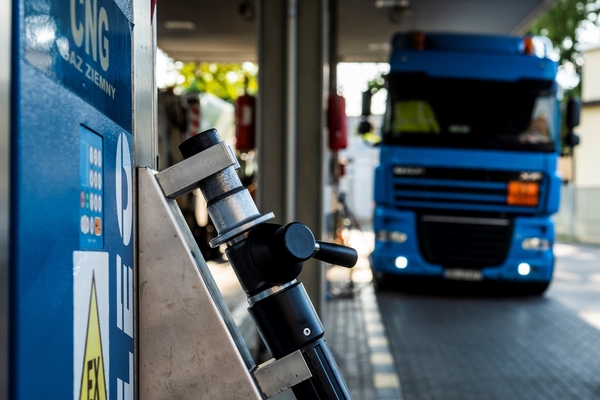
The ability to refuel two types of fuel is important because vehicles powered by compressed natural gas (CNG) are also becoming increasingly popular in Poland. Currently, this fuel is particularly eagerly used in cities: it powers, among other things, city buses or garbage trucks. In large transport companies, it can successfully be the fuel powering smaller vehicles in the fleet, such as delivery vans.
According to PGNiG estimates, in the near future, there will be a total of over 650 CNG-powered gas buses on Polish roads. This means an increase in the number of such vehicles by 75% compared to 2016. In parallel, the number of municipal vehicles powered by compressed gas has increased by over 130% in Poland since 2016. CNG is also a popular choice among business owners, e.g., courier companies.
– CNG gas is used by transport companies, taxi drivers, as well as bakeries, food wholesalers, or laundries. Compressed natural gas, like LNG, allows for a significant reduction in emissions. Besides, it is worth emphasizing that engines running on gaseous fuels operate more quietly than those running on diesel oil, which is why they work better in an urban environment – lists the Vice President of PGNiG Obrót Detaliczny.
There is no doubt that gaseous fuels in the coming years may become the basis for significant changes in Polish and European road transport. Both LNG and CNG meet all the conditions necessary for successfully conducting a transport business – they guarantee a low fuel price, specific ecological benefits, and long-term, trouble-free fleet operation.