









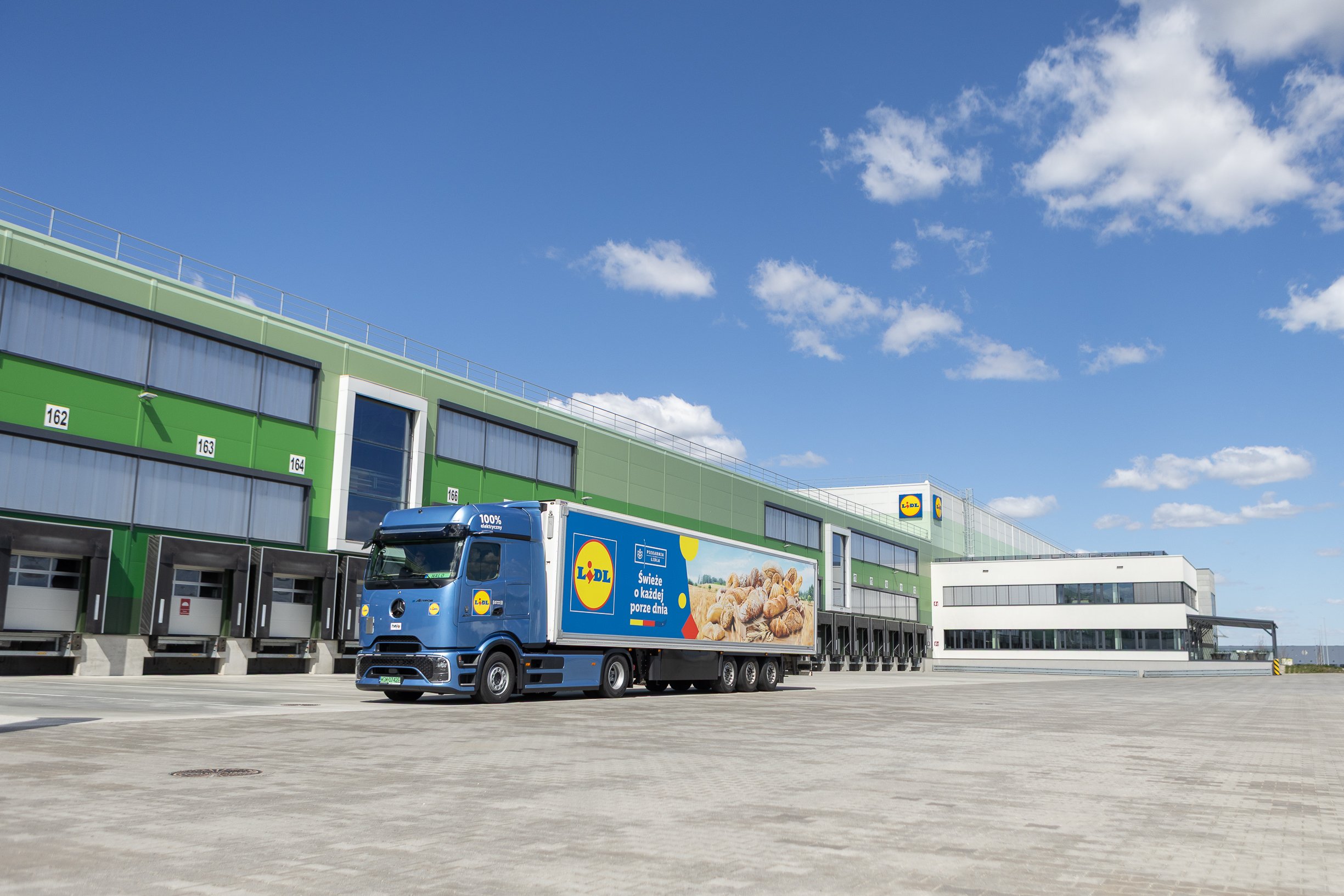
Following the success of pilot projects in Austria and the Netherlands, the Lidl chain is introducing fully electric trucks to further markets. These actions demonstrate that the chain strives to effectively combine ecological solutions in logistics with economic profitability. This is a key element of a strategy aimed at minimizing net emissions. Lidl Poland is already developing this project – the latest electric vehicle joined the national fleet in April 2026.
The transition to electric trucks is one of the foundations of Lidl’s climate sustainability strategy. By 2050, the chain plans to minimize greenhouse gas emissions across its entire value chain. Milestones on this path include: reducing operational emissions (Scope 1 and 2) by 70% by 2030 (compared to 2019) and limiting Scope 3 emissions in agriculture, forestry, and other land use by 42.4%, and in the energy and industry sector by 35% by 2034 (compared to 2022). Lidl’s climate goals are part of the joint strategy of companies belonging to the Schwarz Group. The international Science Based Targets initiative (SBTi) has successfully verified and approved both the short-term and long-term climate goals of the Schwarz Group companies.
Innovation as a driving force for deliveries
The electrification of logistics is an integral part of a modern and efficiently operating supply chain. By implementing solutions proven abroad, Lidl shows how modern e-mobility is becoming a market standard.
The electrification of our truck fleet is one of Lidl Poland’s projects in the area of transport. Thanks to this, we are reducing emissions in the supply chain. As one of the leading retail chains in Europe, we take responsibility for setting new directions. Together with our partners, we are driving the transformation towards lower-emission transport.
– says Ryszard Machoj, Member of the Board of Lidl Poland.
Lidl’s comprehensive approach to low-emission logistics
Replacing vehicles alone is not everything. Lidl’s comprehensive approach also includes building charging stations at distribution centers. Ultimately, they will be powered by energy from renewable sources. At the same time, the company is incorporating electric trucks into a broader e-mobility strategy, which includes photovoltaic installations and electric company cars. Lidl also works closely with its suppliers to support the achievement of climate goals at every stage of cooperation.
For us, sustainable business is primarily the foundation of the company’s stable future. The development of electric transport allows us to step by step achieve the climate goals set for 2030 and 2034. At the same time, we want to inspire other companies to follow in our footsteps.
– emphasizes Ryszard Machoj, Member of the Board of Lidl Poland.
Lidl Poland expands its electric truck fleet
For the Lidl Poland chain, electromobility is already a permanent element of daily operations. Electric trucks regularly travel from the Distribution Center in Błonie to stores in Warsaw and the surrounding area. Since the introduction of the first such vehicles in 2023, they have covered a total of over 500,000 kilometers – that is as if they had circled the globe along its equator 12.5 times. This confirms their reliability in the intensive delivery process.
The latest investment is the addition of an innovative Mercedes-Benz eActros 600 tractor unit to the fleet. It offers a range of up to 500 km, and the durability of its battery allows for covering up to 1.2 million kilometers. Thanks to the use of the pioneering eCool Drive system, refrigerated trailers are powered directly from the vehicle’s battery. This completely eliminates the need to use a diesel engine in the unit. Such a solution not only realistically lowers CO₂ emissions but also reduces noise levels by 6–9 dB. This is of key importance for the comfort of residents during urban and night-time deliveries.
Source: Lidl Poland