








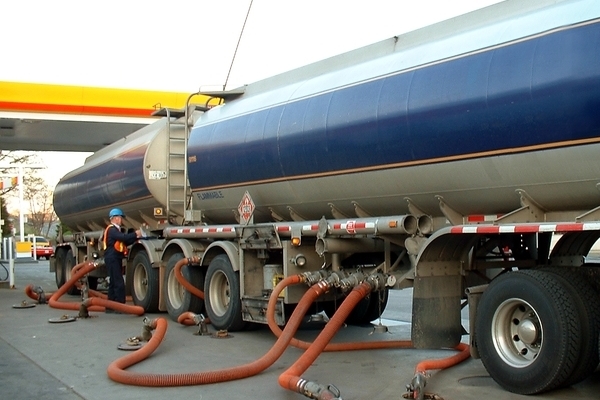
Looking at the modern world, we can conclude that transport services are a phenomenon permanently linked to human life. The number of road freight shipments is increasing year by year, including hazardous materials, which pose an increased safety risk on the roads.
During a collision or road accident, there is a high risk that the transported substance will leak, causing contamination of the natural environment (soil, groundwater, and surface water), or the spread of a toxic cloud or flammable vapors, which would create a threat to the entire environment. The consequences of releasing hazardous materials can be tragic. As a result of these events, there is a need to conduct long-term rescue operations aimed at removing the effects of the spill, which require the commitment of significant financial resources that must be spent in accordance with applicable legal acts. The first stage of legal standards defining the transport of hazardous materials was the publication by the UN Economic Commission in New York in 1949 of the “United Nations Recommendations on the Transport of Dangerous Goods, Model Regulations,” which is a set of basic rules for safe transport and a list of goods that, if transported on a mass scale, could cause a serious threat to people and transport safety. The principles defined in the “Orange Book” (a colloquial name derived from the color of the cover) were subsequently adapted for individual modes of transport, adjusted to their specifics, and adopted as regulations applicable on a global scale. For road transport in Europe, the United Nations Economic Commission for Europe (UN ECE) developed rules for a system of safe transport of hazardous materials by road, based on the recommendations of the “Orange Book.” The result of this work was the preparation of the European Agreement concerning the International Carriage of Dangerous Goods by Road (ADR). The first signatories of the European Agreement published on September 30, 1957, in Geneva, were several countries that were then co-founding the “European Coal and Steel Community,” the predecessor of the current European Union. It consisted of: the Netherlands, Belgium, West Germany, Luxembourg, France, and Italy. The number of signatories gradually increased. Currently, the signatories to the ADR European Agreement are 41 countries in Europe, the Caucasus, the Middle East, and North Africa. In Europe, Iceland, the Vatican, and Malta are not signatories to the Agreement to this day, although the latter respects ADR requirements without ratification.
The specifics of European law provide for the parallel functioning of two systems for the classification of hazardous substances. One of them operates in the field of transport (ADR, RID, ADN, IMDG, ICAO), and the other in the broadly understood field of consumer trade. This system is developing towards ensuring consumer safety and is focused on the long-term effects resulting from contact with a substance or chemical preparation; it is linked to the Act of January 11, 2001, on chemical substances and preparations (consolidated text: Journal of Laws of 2009, No. 152, item 1222). (…)
The article contains 40,861 characters.
Source: Logistyka Magazine 5/2012
Legal conditions for the safety of transporting hazardous materials – PDF file for download