








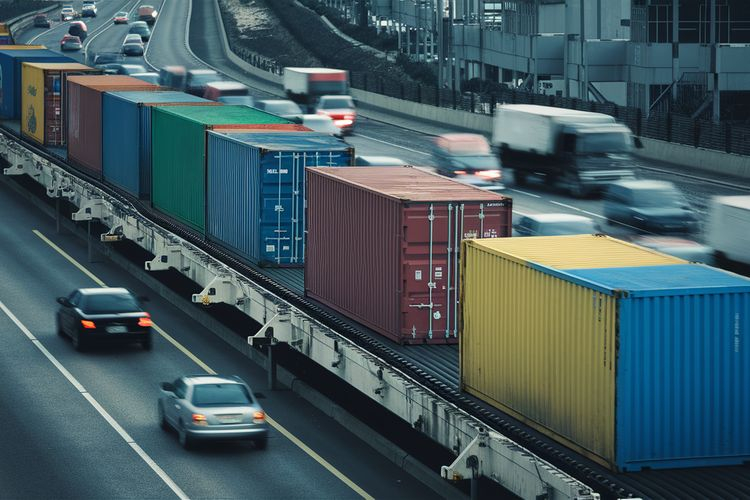
The Japanese Ministry of Economy, Trade and Industry (METI) has announced an ambitious plan to create a conveyor belt system for transporting goods between Tokyo and Osaka. This innovative project aims to significantly increase logistics efficiency on one of the country’s busiest transport routes. The system, tentatively named the “Tokyo-Osaka Freight Conveyor” (TOFC), is intended to consist of a series of connected conveyors with a total length of over 500 km. The belts will run along existing highways and railway lines, thereby minimizing the need for new land acquisition.
According to preliminary METI estimates, the TOFC system will be able to transport up to 100,000 tons of cargo per day, which accounts for approximately 30% of the current road transport volume on this route. It is expected that this will allow for a significant reduction in truck traffic, and consequently, a reduction in CO2 emissions and other pollutants.
Key features of the TOFC system:
- Modular design: The belts will be divided into 50-kilometer sections, which will facilitate maintenance and potential upgrades.
- Automation: The system will be fully automated, using artificial intelligence to optimize the flow of goods.
- Energy efficiency: The conveyor belts will be powered by electricity, largely sourced from renewable energy.
- Integration with existing infrastructure: Transshipment hubs are planned at key points, enabling easy integration with road and rail transport.
The TOFC project is attracting significant interest in the logistics industry. Dr. Hiroshi Tanaka, a logistics expert from the University of Tokyo, comments: “This is a bold step toward the future of freight transport. If successful, it could become a model for other densely populated regions around the world.“
However, the project is not without its challenges. The estimated investment cost is approximately 15 trillion yen (approx. 100 billion USD), which raises concerns about the project’s viability. Critics also point to potential technical issues related to maintaining such an extensive system in working order. METI responds to these concerns by emphasizing the long-term benefits of the project. According to the ministry, TOFC will contribute to a 20-30% reduction in transport costs within 10 years of launch, while significantly reducing the carbon footprint of the logistics sector.
The project schedule provides for construction to begin in 2026, with the planned launch of the first section in 2030. Full system operability is expected to be achieved by 2035.
The TOFC project is part of Japan’s broader strategy to modernize the country’s logistics infrastructure in the face of challenges related to an aging society and a shortage of professional drivers. It also represents a key element of Japan’s strategy to achieve carbon neutrality by 2050.
Sources:
1. Press release from the Japanese Ministry of Economy, Trade and Industry, 15.06.2024
2. Report “Future of Freight Transport in Japan”, Japan Logistics Association, May 2024
3. Interview with Dr. Hiroshi Tanaka, University of Tokyo, “Logistics Today”, June 2024
4. Economic analysis of the TOFC project, Nomura Research Institute, April 2024