








In Poland, we need used and affordable electric cars in good condition. Unfortunately, their market is not growing, and a new report shows why. Despite their dominant market position in registrations and high purchasing power, leasing companies, instead of electrifying their fleets, are promoting old-generation cars – polluting combustion hybrids and large SUVs.
Why this matters:
- leasing companies register large numbers of cars. They are crucial for the rapid decarbonization of transport and the creation of a secondary market for electric cars.
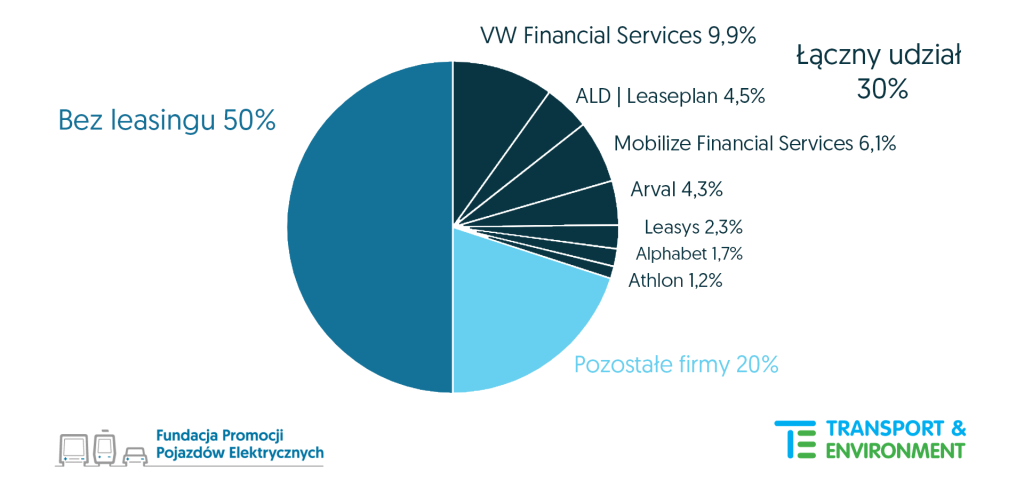
- 50% of new cars in the EU are leased
We are talking about large numbers. In total, the seven largest leasing companies own an estimated fleet of 9.3 million cars in the EU, which accounts for about 30% of the new registration market.
Key findings:
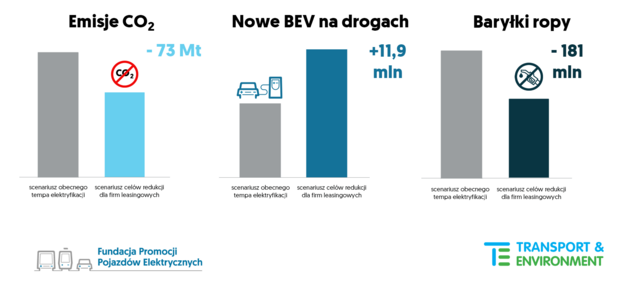
- the analysis shows that if the seven largest leasing companies commit to 100% electric cars by 2028 (new registrations), an additional 11.9 million electric vehicles will enter the market.
- full electrification of key leasing companies by 2028 will translate into savings of 73 million tons of CO2 emissions and 181 million barrels of oil over the same period.
- within 3-4 years in Poland, thanks to faster fleet electrification, a significant market for used electric cars could emerge. This is important, as individual buyers in Poland mainly purchase used cars (individual buyers account for only about 30% of new car registrations in Poland).
Why should I care about the electrification of corporate fleets?
– It will be cheaper. Electrifying leasing company fleets means more electric cars on the secondary market. Prices will drop, and more people will be able to afford more sustainable transport. It is in everyone’s interest – argues Hubert Różyk from the Electric Vehicle Promotion Foundation, a Polish member of Transport & Environment.
Leasing companies can easily accelerate the electrification of transport and quickly create a large market for used electric cars. In Poland, most private buyers purchase used cars, and it is leasing companies that have the primary influence on this market. 50% of new cars sold in Europe pass through them – according to a new analysis by Transport & Environment. The seven largest leasing companies in Europe own about 9.3 million cars. Their purchasing decisions shape the market.
Polish leasing companies mainly sell cars that worsen the situation on the roads. Today, leasing companies only declare rapid electrification. We read about corporate social responsibility on their websites, while in reality, leasing companies in Poland continue to promote mainly combustion cars that exacerbate problems.
We are talking about hybrids, which are as harmful to the climate as traditional combustion cars, as well as large and fuel-hungry SUVs that clog up cities and generate greater demand for expensive oil. This deepens the problem of air pollution and traffic jams, and also makes us vulnerable to economic crises caused by oil price spikes. Meanwhile, the solution, which is smaller electric cars, is already available.
Fleet electrification is moving too slowly
In the EU, the share of private purchases is higher than the share of companies. In Poland, it is no better, although leasing companies have a slight advantage over private individuals.
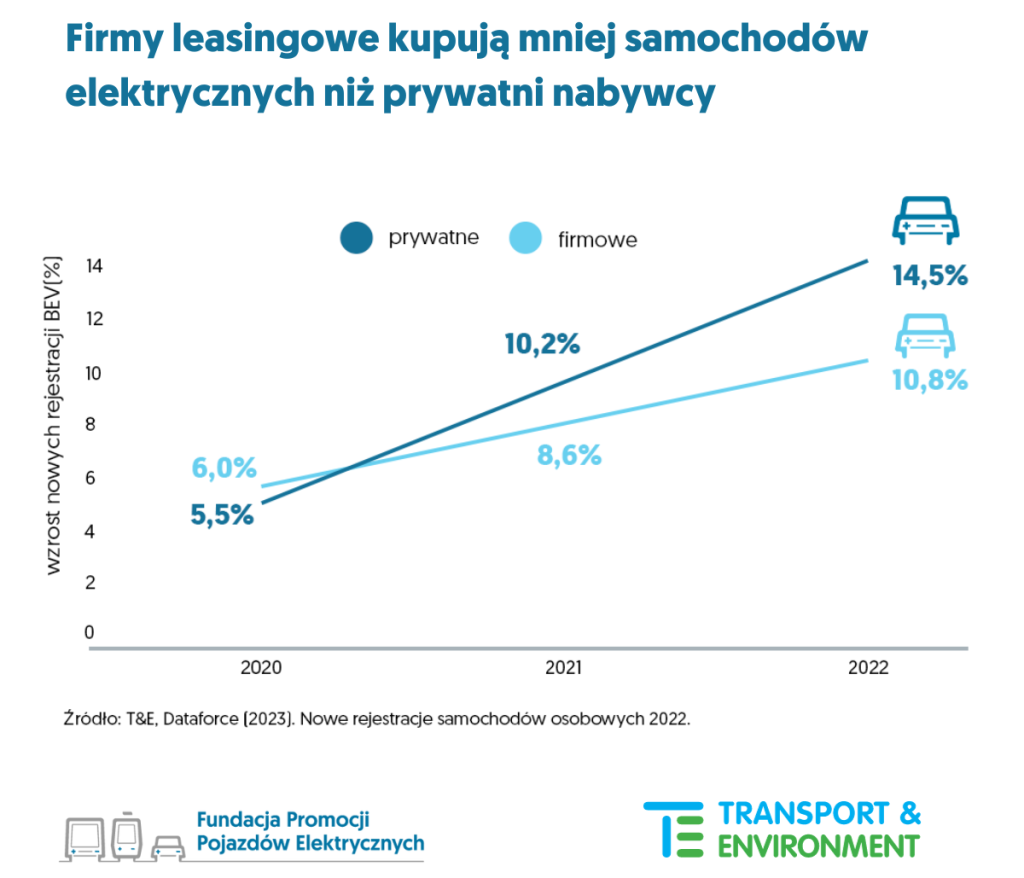
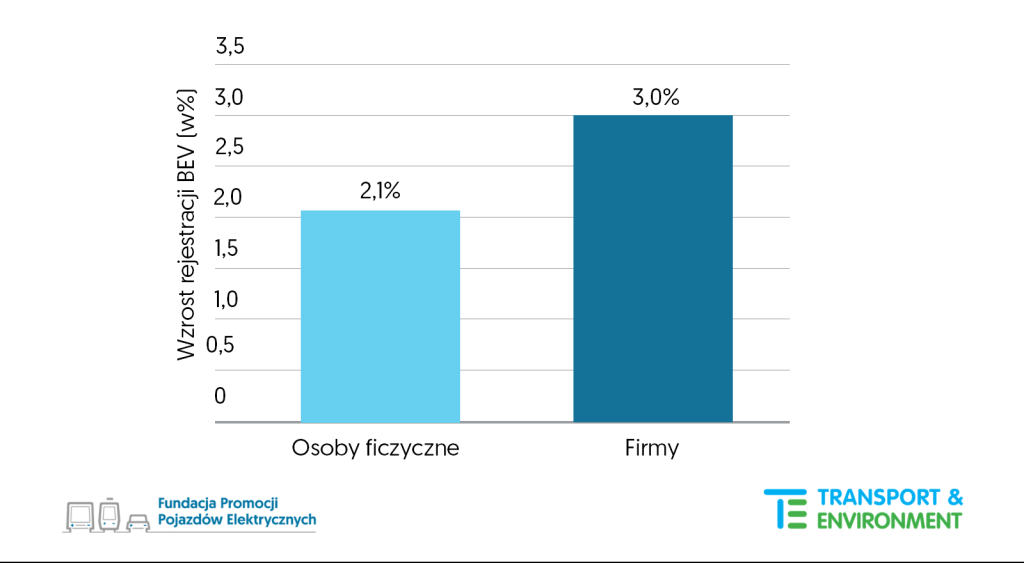
Growth in registrations of battery electric cars in the private and corporate segments. Source: Calculations based on Dataforce (2023). New car registrations in 2022.
In Poland, the difference in registrations is about 1%; this small margin should not be a reason for leasing companies to be proud. Especially if we take into account the structure of new car registrations in Poland – 7 out of 10 new cars are bought by companies, of which 69% are leased. This disparity between leasing companies and private buyers shows that by imposing fleet electrification targets on leasing companies, the situation could improve significantly.
– Leasing companies hold the key to accelerating and creating a genuine secondary market for electric cars in Poland. In 2022, battery electric vehicles accounted for only 2.7% of new registrations. Given the financial capabilities and corporate social responsibility, this result is a cause for shame. Especially since we do not skimp on cars in Poland. The average purchase price of a company car is over 188,000 PLN; you can buy an electric car for that price. The vast majority of new registrations in Poland, 7 out of 10 cars, are company cars. 70% of them are leased – comments Hubert Różyk from the Electric Vehicle Promotion Foundation.
We can have an additional 11.9 million electric cars on the secondary market in the EU. Expert calculations show that the electrification of the fleets of the 7 largest companies by 2028 could result in 11.9 million electric cars appearing in the EU. And we are only talking about companies that have 60% of the market; the growth potential is greater if we take into account smaller companies. This will translate into a reduction of CO2 emissions by 73 million tons and will also save over 181 million barrels of oil. This astronomical number of barrels would allow wrapping around the Earth over 4,000 times along the equator. One could potentially build 418 towers from these barrels that would reach from the Earth’s surface to the moon.
– The electrification of leasing company fleets is within our reach today; companies have the funds, and electric cars are available. Citizens can benefit from a large secondary market for electric cars in a few years. It is time to push car leasing out of the fossil fuel era. It is in everyone’s interest – concludes Hubert Różyk.
Leaseplan changed its name to Ayvens on October 16, 2023. The report uses the old name, ALD Leaseplan. The full text of the report is available via the link.
Source: European Federation for Transport and Environment