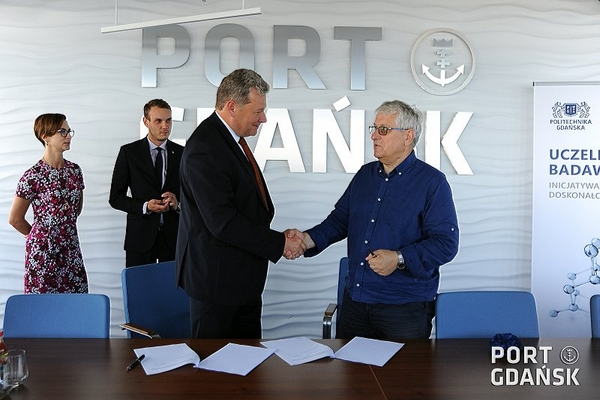
Gdańsk University of Technology and the Port of Gdańsk Authority will cooperate on a pilot implementation of Internet of Things systems to improve efficiency and safety at the Port of Gdańsk.
– One of the significant elements that led to the conclusion of the agreement and, in fact, the start of pilot implementations of new Internet of Things systems at the Gdańsk port are the activities launched by the Marshal’s Office of the Pomeranian Voivodeship. During the competitive selection process for Pomeranian Smart Specializations (ISP), the Marshal’s Office launched an active entrepreneurial discovery process in 2013, engaging various partners from the region representing business, science, business environment institutions, and non-governmental organizations – including the Port of Gdańsk Authority and the Faculty of Electronics, Telecommunications and Informatics of Gdańsk University of Technology – says Łukasz Kulas, PhD, DSc, Professor at Gdańsk University of Technology.
The partners’ agreement provides for the delivery of a range of IoT solutions at a high level of technological readiness, the creation of solutions based on data processing using artificial intelligence (AI) mechanisms, and the development of secure and reliable solutions for industry, with particular emphasis on wireless communication and resistance to cyberattacks. As part of this, an appropriate technological structure will also be created, with particular emphasis on wireless communication and resistance to cyberattacks, as well as a technological structure allowing for the creation of component-based IoT/AI systems.
– By analyzing data collected by Gdańsk University of Technology devices and built by GUT scientists, and based on multi-level analytical reports, we will be able to better manage our assets. Optimizing the use and operation of machines and equipment involved in cargo handling ultimately translates into increasing the attractiveness and market competitiveness of entities that carry out such operations. Concepts such as the Internet of Things, Digital Twin, or Condition-Based Maintenance (CBM) are an integral part of Industry 4.0. The fact that machines have been able to talk to each other in a digital language for several years and transmit operationally significant data is no longer a reality known to us from science fiction books and stories. Having current information on typical traffic routes of wheeled equipment in a given transshipment area, and the use of various equipment on a daily, weekly, or monthly scale should result in an assessment of purchasing strategies or maintenance costs. This data also provides a number of benefits for the person managing the allocation of equipment resources to perform tasks. We cannot ignore aspects related to safety, insurance costs, or the benefits resulting from predicting and preventing equipment failures based on readings from sensors measuring device operating parameters – claims Sławomir Michalewski, Vice President of the Port of Gdańsk Authority.
The proposed concept fits into current trends of building an advantage in port areas through the use of digital technologies.
– One of the key advantages of Gdańsk University of Technology, especially in the context of the recently obtained status of a National Research University, is its proximity to the sea and key Polish entities permanently associated with the maritime economy. After nearly two years of preparations and close cooperation with the employees of the Port of Gdańsk Authority, we managed to include the Port of Gdańsk area in one of the largest European projects in the field of IoT called InSecTT (Intelligent Secure Trustable Things), which will allow for financing previously planned activities – adds Jerzy Wtorek, PhD, DSc, Dean of the Faculty of Electronics, Telecommunications and Informatics at GUT.
Source: Port of Gdańsk
Read more about the Internet of Things:
– Visible supply chains
– Innovative InSecTT project for safe shipping
We wrote more about the Internet of Things in the Logistyka magazine 3/2019.
The e-edition of the magazine is available in our offer!