









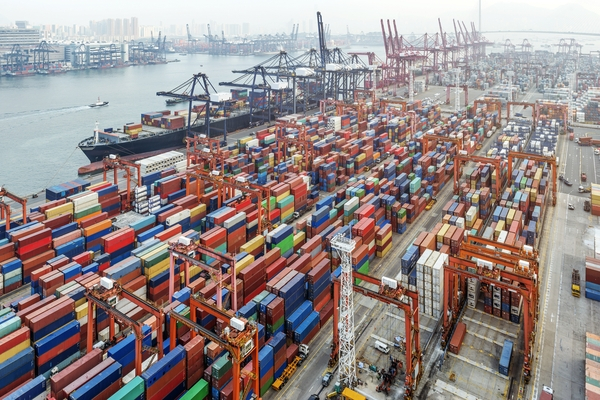
The globalization of the economy, a large increase in the volume of transported goods, and especially the shift of the center of gravity of global production towards Asian countries have caused the dynamic development of such a complex model as intermodal logistics. It is becoming an increasingly important element of the supply chain. Over the last decade, it has been developing at an impressive pace, including in Poland. What is intermodal logistics and what are the prospects for its development, reveals expert Maciej Szczepański, Business Development Manager at Cushman & Wakefield.
The history of this type of logistics is relatively short – the first container ship with a cargo of 58 units left the port of Newark in 1956. It is worth noting that current ships can successfully carry over 10,000 cargo units, which is more than 170 times that mass. It is designated as TEU (twenty-foot equivalent unit) and is a unit of capacity equivalent to the volume of a 20-foot container.
What is intermodal logistics?
Intermodal logistics, by definition, allows for the combination of at least two types of transport into one system, with the assumption that there is no change in the cargo unit during the movement of goods. Most often, this takes place in containers, which are used mainly in sea transport. Similar possibilities are also provided by modern semi-trailers, which can be loaded onto a railway platform.
– The system of semi-trailers that can be loaded onto trains works successfully over shorter distances and is strongly promoted by many European countries, both for ecological reasons and due to the desire to improve road safety – notes Maciej Szczepański from Cushman & Wakefield.
One operator takes responsibility for organizing the entire intermodal transport, which makes extensive experience and efficient organization key elements. Intermodal logistics allows for fast transshipment of goods between different modes of transport that are most effective for each leg of the journey without the need to repack the goods. This allows for significant cost reduction, shorter operation times, and reduced risk of damage.
Intermodal logistics is not just transport
Completing the transport and the truck’s arrival at the warehouse ends the longest stage of the process. The next element is efficient unloading and receipt of goods. It should be remembered that container dwell times are limited, and only efficient organization of handling at this stage will allow avoiding demurrage charges. Of course, the simplest way to unload is to do it manually (arranging goods on pallets and wrapping them), however, with the current labor shortage in the job market and rising employment costs, new solutions must be sought.
One possibility is the use of special sheets under the goods, so-called “slip sheets,” which allow for the quick retrieval of loose goods in a container and placing them on a pallet. Apart from the aforementioned sheet, which is a single-use element, only a forklift equipped with a special gripper is needed. Surprisingly, this technology has not caught on in Poland at all so far – according to data from one of the leading warehouse forklift suppliers, this type of gripper has been installed for only two clients in the last few years.
Intermodal logistics infrastructure
A properly located terminal is a key element of logistics infrastructure, enabling the handling of containerized cargo. The location of terminals should take into account two basic factors: the concentration of industry and urban agglomerations, and the intersection of communication routes (such as road corridors, railways, and seaports).
Development and prospects of intermodal logistics in Poland
Intermodal logistics in Poland has developed at an impressive pace over the last decade. According to data from the Office of Rail Transport, over the last ten years, intermodal rail transport has increased fivefold (from 3.3 million tons in 2009 to 17.0 million tons in 2018). The year 2018 was also the best in history, and data for the beginning of 2019 showed a further upward trend – for the first quarter, the increase was 19%. The engine of development is support from the European Union, which is pushing for the connection of all branches of transport into one network. What may be surprising to us is that, in addition to road, sea, and air transport, the integration is to include inland shipping.
– Technical infrastructure has a major impact on the development of intermodal logistics, so investments are necessary, which in most cases cannot be borne by private entities or even local government units. This means that central authorities have a fundamental influence on shaping the growth trend; a perfect example could be the New Silk Road – says the expert.
The New Silk Road and intermodal logistics
The New Silk Road is a project for the development of rail connections from China to Europe, announced in 2013. In recent years, the volume growth of this route has been calculated at 100% annually (2016 – approx. 1,700 trains, 2017 – approx. 3,700, 2018 – approx. 6,400).
Poland is one of the key partners in this venture, primarily due to its strategic geographical location. In this project, the container terminal in Małaszewicze, for rail container transport, has a chance to become the equivalent of the port of Hamburg for sea transport or Frankfurt for air traffic on the logistics map of Europe.
Source: Cushman & Wakefield
Read also about intermodal transport:
– New international connections of Connect Operator
– Another intermodal train has started from Swarzędz
– First transport of semi-trailers by train on the Germany – Poland – Lithuania route