









Intelligent Automation is currently one of the most popular topics among companies facing the challenges of digital transformation. The catalyst for such sudden interest proved to be the COVID-19 pandemic, which affected almost every sphere of life and business activity. Enterprises are focusing on automation technologies so as not to fall behind the competition. So, what is Intelligent Automation and what will an organization gain from its implementation – you will read about it in our article.
|
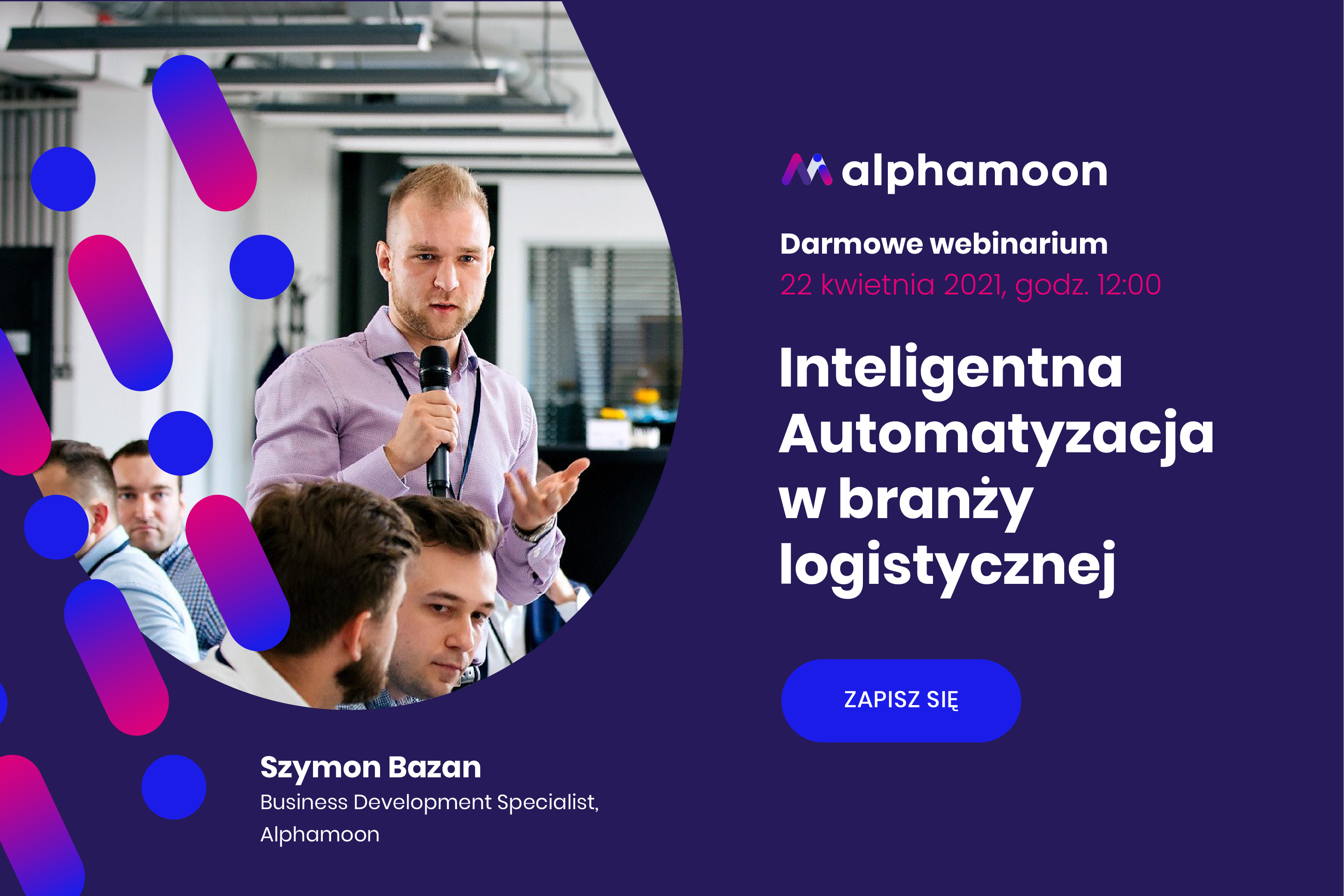
If you want to learn more and discover practical applications of IA in the logistics sector, take part in a webinar organized by Alphamoon – a leading provider of Intelligent Automation solutions for the logistics industry in Poland. The webinar titled “Intelligent Automation in the logistics industry” will take place on April 22nd at 12:00 PM. Registration link: https://alphamoon.clickmeeting.com/698634237/register |
Why is it worth learning about Intelligent Automation?
The above question is answered by analysts from the Gartner Group, who have identified current trends in automation-related technologies. They estimate that as many as 90% of large enterprises will use automation by the end of 2022. Furthermore, by the end of 2021, as many as 4 million robots performing routine tasks will be “hired” in companies around the world.
Even if at first glance it seems to us that we do not feel the need to follow innovation and do not notice shortcomings in the company’s operation, it is worth realizing the hidden possibilities for the company’s development.
An example? As much as 70-90% of financial and accounting processes have the potential for automation, and companies are currently automating about 4%. In turn, specialists from the Everest Group have researched expectations regarding automation. Currently, we primarily expect increased productivity and cost reduction. Improving customer service and experience, as well as increasing competitive advantage, are also important.
What are RPA, AI, and how do these concepts connect with Intelligent Automation?
Automation is not a new concept, however – it has been gaining recognition from companies around the world for at least several years – mainly under the banner of RPA, or Robotic Process Automation.
RPA is a business process automation technology using robots that simulate human work. It is software consisting of a set of algorithms that perform specific actions and integrate various systems.
The goal of RPA is to automate the execution of repetitive, monotonous activities such as copying and downloading data, generating reports, or handling complaints. For example, thanks to RPA, customers will be automatically informed about the receipt of their complaint, and at the same time, the complaint management system will pull the information necessary to serve customers from the submissions.
Artificial Intelligence (AI) is a technology that mimics humans in an intelligent way. It not only performs repetitive tasks, collects data, and processes it, but also learns and gains experience to ultimately improve its operation as much as possible. AI is a collection of techniques, among which we can distinguish:
– image recognition,
– speech recognition,
– natural language processing,
– machine learning,
– expert systems,
– planning and optimization.
What is Intelligent Automation then? Intelligent Automation is a combination of RPA and AI. These technologies complement each other, creating a completely new quality in automation processes.
It is thanks to artificial intelligence that RPA is capable of performing tasks of greater complexity. For example: in the case of handling complaints, RPA alone was capable of informing customers about received complaints and downloading data from them. In combination with AI, it will even be possible to automate the processing of complaints – the system will understand what the complaint is about and will be able to address it.
Advantages of Intelligent Automation over RPA
Robotic Process Automation is based on rigid rules and patterns. Thanks to the use of RPA, we will easily analyze structured data from forms or tables, read content on the screen, and mimic repetitive tasks and activities.
RPA is the automation of only repetitive processes. Intelligent Automation, thanks to elements of artificial intelligence, offers significantly more possibilities in terms of automation. A robot, besides repeating monotonous activities, can also take over the functions of a thinking human – interpreting data and even making decisions.
All this is because Intelligent Automation also includes natural language processing and generation. It not only mimics actions and learns based on observation but also draws conclusions based on data.
Intelligent Automation is also flexible and insensitive to the way data is received – it does not matter whether the data is structured and what type it is. It is able to integrate with information sources, which gives many new opportunities to use its full potential.
Benefits of using Intelligent Automation in an enterprise
Intelligent Automation eliminates many problems associated with human work, e.g., typical errors and mistakes. There is no room for them when a robot is working. In addition to reducing errors, tasks are performed exemplarily and consistently, and above all, much faster.
By investing in a robot, we also benefit from its continuous availability, because it works for us 24/7.
The flexibility of Intelligent Automation contributes to the scalability of processes, making it possible to expand automation to subsequent areas in the enterprise in an uncomplicated way.
All this translates into reducing costs by up to 80%.
The future of Intelligent Automation
Intelligent Automation is finding more and more applications. It works well in both public and private enterprises. Additionally, we will find its applications in practically every industry, regardless of whether we are looking for solutions in the field of finance, production, or medicine.
Due to the multitude of applications and increasing technological progress, automation and robotization are inevitable. We are witnessing a transformation, and it is worth realizing this in order to move in this very direction.
|
If you want to learn more and discover practical applications of IA in the logistics sector, take part in a webinar organized by Alphamoon – a leading provider of Intelligent Automation solutions for the logistics industry in Poland. The webinar titled “Intelligent Automation in the logistics industry” will take place on April 22nd at 12:00 PM. Registration link: https://alphamoon.clickmeeting.com/698634237/register
|