








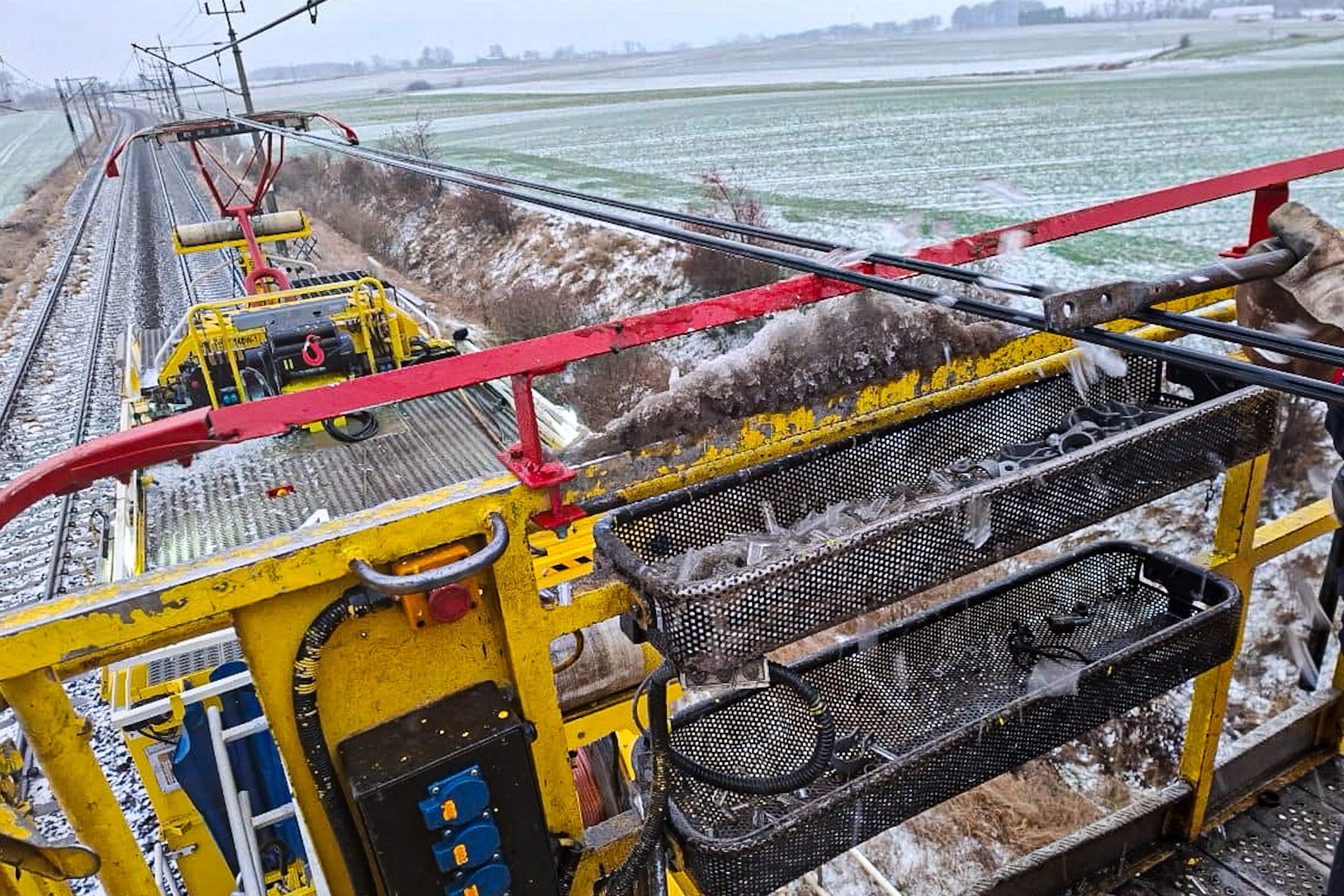
There is no perfect system for protecting the overhead contact line from icing. Or is there? PKP Polskie Linie Kolejowe S.A. and PGE Energetyka Kolejowa S.A. are working on an innovative heating system for electrical circuits. The project is entering the testing phase at a research site – this is another step toward revolutionizing railway energy and maintaining train operations in the most extreme conditions.
Winter on the railway is one of the most critical periods in the transport calendar. Due to the fluctuating weather conditions in our country, both carriers and the infrastructure manager must be prepared for various scenarios. Therefore, for years, even before temperatures drop, PLK SA has been verifying procedures and gathering the equipment and resources necessary to ensure efficient transport during winter. The most difficult moment during this period on the railway is when the temperature crosses 0 degrees Celsius. It is precisely then that the overhead contact line is most vulnerable to faults or icing. To prevent such situations, the contact wires are coated with a special anti-icing agent that reduces ice adhesion to the wires, preventing failures and traffic disruptions.
Last year, 2,700 km of overhead contact lines on main routes were secured in this way. When conditions become extreme, i.e., there is heavy or prolonged freezing rain or ice storms, as was the case on January 14-15 of this year, the ice must be removed mechanically. In such difficult conditions, even the protective locomotives ordered each time do not always succeed; for example, on the evening of January 14 on the Warsaw – Gdańsk line, on the Działdowo – Iłowo section, after the successful passage of train 5104 Gdynia Gł. – Warszawa Zach., just 7 minutes later, train 5122 Olsztyn Gł. – Łódź was dispatched, which stopped on the track due to rapidly forming icing on the overhead contact line.
Soon, a completely different solution may help railway workers in the fight against the effects of winter weather.
Innovations against icing
PLK SA is planning tests for an innovative system to prevent icing on the overhead contact line. The system converts alternating current to direct current via a suitable converter and then sends it in a loop through cables over both tracks. In this way, the overhead contact line safely heats up to 4-5 degrees Celsius and melts the ice. The system can be activated automatically upon detecting black ice on the wires or manually when needed. The system was designed by the company PGE Energetyka Kolejowa S.A. and has already been installed at the Kostów traction substation (Opole Voivodeship). Soon, an observed operation test site will be launched to examine it. Subsequently, it may be possible to authorize its use on railway lines managed by PLK SA.
Two days last week showed that there is not yet a perfect way to protect the overhead contact line from icing. The new system being tested by PLK SA and PGE Energetyka Kolejowa S.A. could be groundbreaking and could ensure the maintenance of train traffic in extreme weather conditions.
Over the course of two days, January 14 and 15, due to very difficult weather conditions, 781 trains were delayed by a total of over 19,000 minutes.
Source: PKP Polskie Linie Kolejowe S.A.