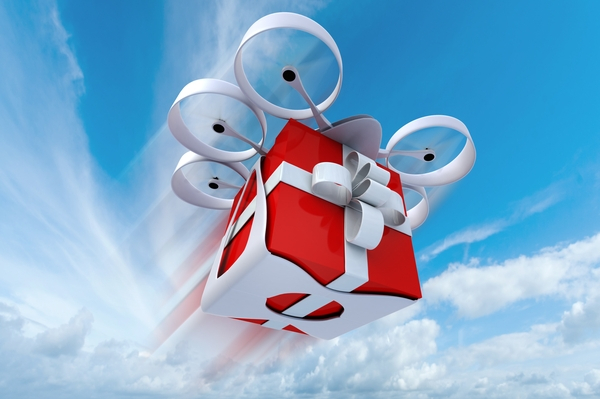
The article presents an innovative project for a book distribution network in Warsaw using transport drones and the collection of the National Library. It also outlines the specifics and legal limitations regarding drone transport.
Nowadays, it is difficult to find a person who is not in a hurry and has time for everything. Due to the widespread availability of online shopping, more and more people are using services where goods are delivered directly to their homes or to collection points. Modern solutions we reach for include ordering shipments online, sending parcels, and shipping or receiving letters.
Delivery process
With the proposed distribution network using drones to transport books between the library and the reader, it would be possible to borrow a book without leaving home. A user could obtain a book through one of three available borrowing channels: online borrowing, ordering via an app, or by phone.
The telephone and online ordering channels are widely used and well-known. It is worth taking a closer look at the possibility of ordering via a mobile app. The book ordering process could take place using the Flybook mobile app. Flybook is a prototype of a book ordering application. It would be programmed for the Android system and – in the free version – available for download from the Google Play store. A reader with an account in this app could order books and request pickup from a parcel locker. The app would be connected to the National Library server and an online book borrowing account. Using a mobile phone, the reader could order books with a specified date and place of delivery.
The ubiquity of mobile apps, combined with the speed and simplicity of operation, could ensure the success of the investment. From the list of available parcel lockers in Warsaw, the reader could choose their preferred location. In the case discussed in the article, intensive distribution is used, with InPost SA parcel lockers acting as the “intermediary.” These “intermediaries” were chosen because, in the author’s opinion, they are the most widely recognized parcel locker company. InPost parcel lockers have a huge market reach and very good customer reviews. After a book is borrowed by the reader through one of the three mentioned channels, the shipment enters the packing process. A dedicated library employee receives a signal in the system that an order has been placed. Once the employee reads the order, the fulfillment process begins. At this stage, there is a problem related to the weight of the volumes intended for transport. A relatively inexpensive drone model, such as the Matternet One, is capable of carrying shipments weighing 1 kg over a distance of about 10 km. Therefore, assuming that the weight of the shipment cannot exceed 1 kg and the average weight of a book is 250 g, the drone could carry a total of 4 books. For this reason, it would be advisable to weigh each book and assign it the appropriate weight in the system. Then, at the time of ordering, the library system could inform the user whether it is possible to add another book or if the quantity and weight limit has been reached.
After the weight analysis, the logistics label is printed. This label has many benefits, including identifying goods in a unique way, and the information on the label is described in a clear and unambiguous manner. The label is mainly used for marking and monitoring cargo flows. It is usually designed in an A6 paper format, which conveys information such as:
– logistics unit number,
– production series,
– place of delivery,
– mass, dimensions (width, height, and length), and volume.
The full article is available below in PDF format.
We wrote more about transport in Logistyka magazine 4/2018.
The e-edition of the magazine is available in our offer!