









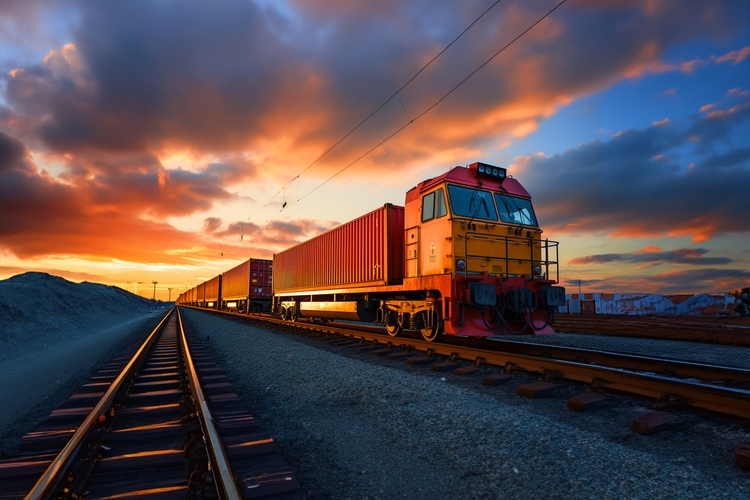
Rail freight transport is highly popular not only within individual countries but across Europe and beyond. However, to maintain investor interest, it is necessary to constantly improve the freight transport offer using innovative solutions. We present a selection of them.
Advantages of rail freight transport
Interest in rail freight transport stems from the undeniable advantages of this solution. These include financial savings when transporting goods over long distances. The size of the cargo, which is almost unlimited and can also include oversized items, is also significant.
In the context of rail delivery, it is also worth mentioning that safety statistics are much more optimistic than in the case of road transport. Accidents involving trains are extremely rare, and properly secured cargo should not be damaged in transit. The chances of everything arriving at its destination intact are therefore high.
Rail also seems to be an option relatively resistant to weather conditions that delay delivery for other modes of transport. A train can take to the tracks even in freezing weather, snowstorms, or gusty winds – without compromising its safety or that of the transported goods.
The only major limitation is that a train can only move on tracks, which do not reach everywhere. Nevertheless, the rail network in Europe and Asia is very well developed and includes many medium and large cities that are important from a logistical point of view.
Investors can handle the organization of rail freight transport on their own or use the support of specialists in the field of rail transport, e.g., AsstrA. Thanks to this, the entire process will run smoothly and almost hands-free, and most importantly – the goods will arrive on time and without damage.
What innovations can improve the quality of transport services provided by rail?
The intensive development of rail innovations is largely due to the European Union, which sees this solution as the next step towards more sustainable, green freight transport. The FFL4E project, funded by its funds, plays a special role here. What is worth knowing about it?
The goal of the international team gathered within the project was to develop technologies that would not only improve rail freight transport but also make it more environmentally friendly. The project concluded in mid-2019 and brought a number of important changes for the entire industry.
Of particular note is the radial steering bogie created within the project, which minimizes wheel and track wear while reducing the noise level generated by rail transport. Another important discovery was the development of a hybrid propulsion system that allows energy to be stored and then used to overcome non-electrified sections of railway tracks. In the context of increasing train efficiency, the remote radio control system for distributed power is also important, thanks to which trains can be longer and carry heavier loads than before.
Planned changes also concern the construction of catenary networks, namely the use of silicon carbide in this process. Modular train design, new safe driving control systems, and finally, innovative traffic management systems aimed at improving safety are also on the agenda. We must not forget about zero-emission fuel cell trains. Work on the first vehicles of this type is already at an advanced stage. This, in turn, could prove to be a real revolution in the industry and completely change the perception of rail freight transport.
The FFL4E project is just a fraction of a much larger program operating under the name Shift2Rail. Its goal is to enrich the rail industry with solutions in the field of digitalization, automation, Big Data, and cybersecurity. The aim is to increase the share of rail transport in the overall freight market by improving its efficiency and safety. The issue of reducing exhaust emissions and the carbon footprint is also significant, which is intended to make trains one of the most ecological means of freight transport.