One of the industries that poses the greatest challenges for logistics companies is the automotive industry. The high diversity of loads and tight delivery deadlines mean that transport and storage processes must be planned in every detail. A key element of these is properly selected transport packaging. The new Komebac® containers made of very light and durable EPP material allow for accelerating and optimizing logistics processes at every stage.
Producing an average car requires several thousand different parts, from sensitive electronic components to entire large-scale mechanical sub-assemblies. Furthermore, automotive groups offer one model in various equipment versions. Producing and storing such a large quantity of components in one factory would be economically irrational and even physically unfeasible. It is estimated that car manufacturers produce only 15% of the final vehicle, while the vast majority of car parts and sub-assemblies are supplied to them by external subcontractors according to a precisely agreed schedule. To ensure the continuity of serial production, all logistics processes must be strictly synchronized, both outside and inside the factory. Returnable packaging used in inter-company trade plays an important role in the “just in time” supply chain. Not only must it meet the requirements applicable in industrial production, but also those resulting from specific standards relating only to the automotive industry. All these issues have been taken into account in the innovative Komebac® containers from Knauf Industries. Packaging produced from very light foamed material is a new, attractive alternative to popular plastic solutions.
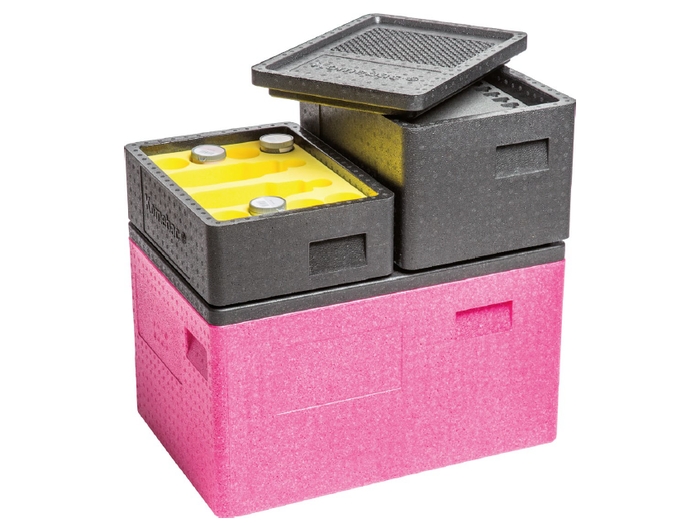
Komebac® packaging can be adapted to the contents
Fewer kilograms – more benefits
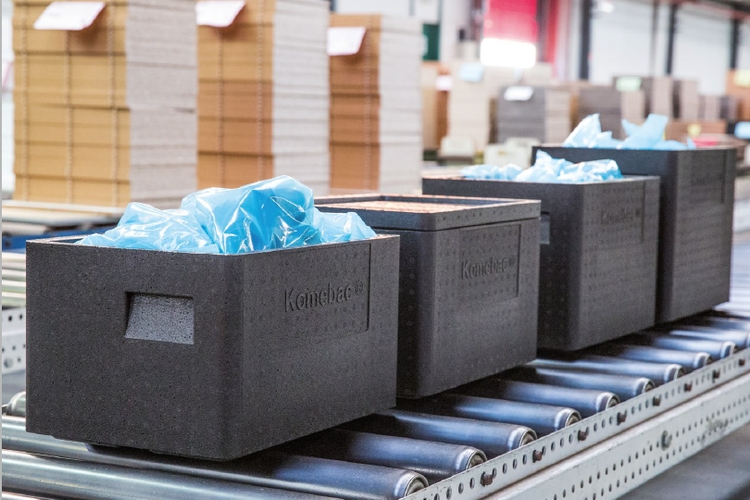
In the logistics industry, there is a constant drive to optimize costs and transport conditions, while transport companies must be able to guarantee their customers reliability and timely deliveries. In the automotive industry, these last two issues are critical, as any deviations from the approved delivery schedule or damage to parts during transport can result in the shutdown of the entire production line and costly downtime. Komebac® containers are the answer to these challenges, as they allow for simplifying some stages of the logistics chain, and thus accelerating the entire process. This product, unique on a market scale, is the result of combining the rich physical properties of expanded polypropylene (EPP) with the experience of Knauf Industries in plastics processing for the automotive industry. Its primary advantage is its minimal weight, which results from the structure of the foam material. As much as 95% of its volume is air, thanks to which the Komebac® packaging produced from it is 65% lighter compared to traditional plastic containers. This translates into a lower total load weight, reduced fuel consumption, and consequently, lower transport costs. The low weight of the packaging also means that it can be carried by one person, which affects better handling logistics. At the same time, the transported goods are well protected against damage. Expanded polypropylene has excellent damping properties and absorbs impacts, while not undergoing permanent deformation. Its mechanical strength is evidenced by the fact that it is used in the production of car bumpers. Due to the air content, it is an effective thermal insulator, creating a barrier against extreme temperatures that could harm, for example, electronic components. Packaging produced from it is already performing perfectly in the transport of, for example, batteries for electric cars.
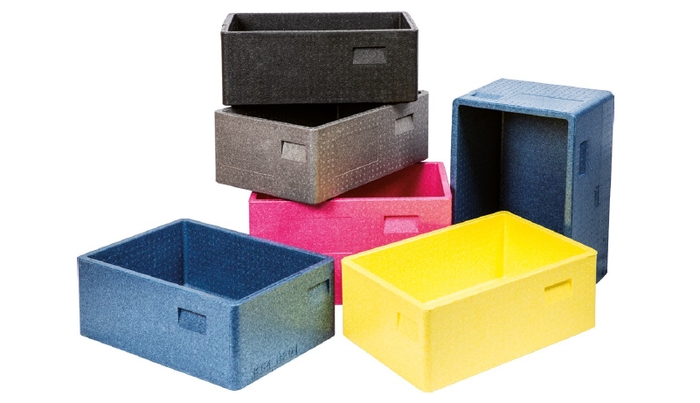 Komebac® packaging can be produced in various colors
One material – numerous possibilities
Komebac® packaging is entirely produced from expanded polypropylene in a pneumatic molding process. The standard offer includes solutions in four sizes corresponding to the dimensions of transport pallets. However, the production technology used at the Knauf Industries plant allows them to be easily and economically given individual features. Komebac® containers can be precisely adapted to specific needs resulting from transport conditions, the specifics of the transported goods, or even a specific production line. The rich production capabilities include various versions, from traditional closed boxes with ergonomic handles for small parts, to more complex containers with individually designed compartments and special protective inserts that can also match the shapes of the contents. In the case of transporting sensitive electronics, there is also an option to use electrostatic material. However, the list of possibilities does not end there, as the molding technology allows for personalizing the container in the smallest detail. On its outer side, you can emboss the company logo, the name of the transported goods, or even give an individual color to the entire packaging or its individual elements. Such a procedure has not only aesthetic but also practical significance, as it allows for easier sorting of products in the warehouse. The manufacturer has also thought about other facilities in terms of product identification. In addition to a special field for traditional, adhesive labels, the containers can be equipped with sensors that record transport parameters and send them in real-time to the forwarder or transport company. All this makes them a strong link in the modern logistics chain.
About Knauf Industries
Knauf Industries is one of the largest plastics processors in the world. It produces high-quality molded parts, packaging, and insulation from EPS and EPP foamed materials, as well as plastic elements made by thermoplastic injection molding. For over 20 years, it has been providing automotive solutions for the world’s largest original equipment manufacturers (OEMs) and direct suppliers (Tier 1). 41 modern production plants around the world flexibly adapt their capabilities to the needs and requirements of customers in the automotive industry. Innovation is guaranteed by a specialized R&D Center. Both Polish Knauf Industries plants hold IATF 16949:2016 certificates, which are a guarantee of the highest production quality and continuous improvement. In Poland, parts for the automotive industry are created in production plants located in Mszczonów (near Warsaw) and in Nowa Wieś Wrocławska. More information at: www.knaufautomotive.com/pl
The article comes from the magazine LOGISTYKA 1/2021.
The e-edition of the magazine is available in our offer!
Stay up to date, subscribe to the LOGISTYKA magazine!