









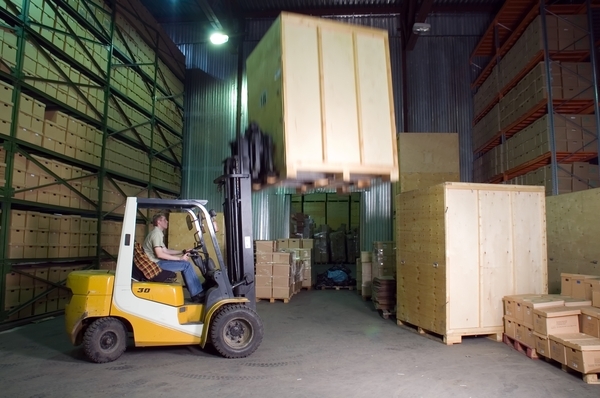
On August 10th of this year, a new regulation regarding health and safety at work when operating industrial trucks will come into force, replacing the old regulation from May 1, 2002. What changes and doubts does this document bring?
Expert response: The previous regulation had many loopholes and caused a lot of legal ambiguity, especially regarding operator qualifications. Consequently, many operators used trucks inadequately to their qualifications or based on invalid documents. Let us recall how it looked:
Until recently, we had three ways to obtain qualifications for operating industrial trucks: the first, most obvious, was the WJO I, II, or III qualification issued by the Office of Technical Inspection (UDT). The second option was internal qualifications issued by the employer based on a certificate of completed training for industrial trucks, while the third option was obtaining an operator’s logbook issued by the Institute of Mechanized Construction and Rock Mining (IMBiGS). As you can see, there were many of them, and this needed to be organized. This process began on April 1, 2017, when the regulation of the Minister of Development and Finance of January 11, 2017, came into force, which transfers to the UDT full responsibility for granting qualifications to operators of industrial trucks with variable reach. Thus, since April 1 of last year, we have only two ways of granting qualifications for operating industrial trucks, namely those granted by the UDT and those obtained through written authorization. And it is with this second method that major changes are associated.
In the new regulation, a significant role will be played by the distinction between pallet trucks and lifting trucks, because for pallet trucks, i.e., those that lift up to 30 cm, it is sufficient to possess documents confirming qualifications to drive motor vehicles. Of course, to allow such a person to work, they must be trained as part of on-the-job instruction. Such training results directly from the provisions of the regulation of the Minister of Economy and Labor of July 27, 2004, on training in the field of occupational health and safety (Journal of Laws No. 180, item 1860, as amended) and applies to all mechanical devices regardless of the qualifications and authorizations held. If a person does not have the above qualifications, they must be trained in the operation of specific trucks based on the curriculum issued by the UDT, as was the case until now, but the basis for operating the device will be a certificate of course completion. Thus, there will no longer be a requirement to issue internal authorizations, unless it involves particularly dangerous work that threatens life and health; in that case, the employee will have to be trained and receive a written order to perform the work, i.e.:
• order number,
• first name, last name, and job position of the persons responsible for the organization and execution of the work,
• indication of the scope and place of the ordered work,
• specification of conditions and protective measures necessary to ensure safe preparation and execution of the ordered work, including personal protective equipment,
• designation of the start and end date of the work and breaks in its execution.
The second category is lifting trucks, i.e., those that lift above 30 cm. According to the new regulation, to be able to operate these trucks, one will need to have appropriate qualifications issued by the Office of Technical Inspection, which will thus remain the only form of granting qualifications to operators. We have three qualifications issued by the UDT:
- III WJO – Pedestrian-controlled and remotely controlled lifting industrial trucks,
- II WJO – Lifting industrial trucks excluding specialized ones,
- I WJO – Lifting industrial trucks, including specialized ones with an operator lifted with the load or with variable reach.
So – if we have qualifications for trucks from the WJO I category, we can operate trucks from the WJO II and WJO III categories. Regarding the truck from the WJO I category, it should be noted that by obtaining qualifications for, e.g., variable reach trucks, we cannot use trucks that lift the operator with the load and vice versa, so to be able to operate all trucks, one must complete the WJO I category twice for trucks with an operator lifted with the load and those with variable reach.
Above, I have presented the most important implications resulting from the new regulation on health and safety at work when using motor-powered industrial trucks, which does not apply to the Act on Technical Inspection, thus causing several complications such as the obligation to have a certificate of operator training in safe cylinder replacement or the placement of a pedestrian-controlled lifting truck in the WJO III qualification, and as we know – to use it, one will need to have the appropriate qualifications – at least for the WJO II qualification. I believe that in some time, we should expect corrections in the Act on Technical Inspection.
Article prepared by Łukasz Chmielarz – Instructor for operators of material handling equipment.