








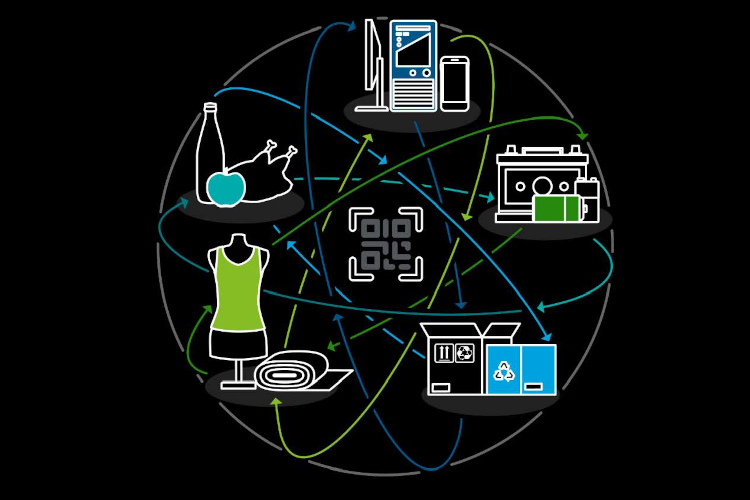
Work on the Digital Product Passport began in April 2022. Thanks to this solution, in the future, everyone will be able to track detailed information about a purchased product: its composition, origin, and recycling methods.
As part of the EU Green Deal, the European Commission adopted the “Sustainable Product” regulation draft at the end of March 2022. It introduces the idea of a Digital Product Passport. GS1 in Europe has been actively involved in the work on this solution.
The new EU legal requirements will affect the global economy, as they oblige all economic operators to share appropriately structured product data. Furthermore, they prohibit the destruction of unsold products and promote goods produced in accordance with sustainable development principles.
Product passport: all knowledge about a product at your fingertips
The idea that every product should have its own digital passport is not new, but it is only now being implemented as part of the green and digital transformation.
The Digital Product Passport is a set of essential data (specified in the regulation) enabling the identification of a product, its composition, and its origin throughout its entire life cycle. It covers not only data on finished products but also on components and semi-finished products. The passport applies not only to goods produced in Europe but also to those imported into the EU from other markets. Only certain types of food, feed, and pharmaceutical products have been exempted from having one. Initially, the Passport will apply to: batteries and textiles from 2024, construction materials from 2024, and subsequently electrical and electronic equipment from 2026.
– The product passport provides consumers, companies, and organizations with access to product information important to them regarding composition, the production process, the manufacturer, and the place of production, including the specific building. This will allow recipients, both business and individual, to make informed purchasing decisions and take action for sustainable development – says Marta Szymborska from GS1 Poland.
The product passport improves product traceability in the supply chain and makes it easier for supervisory authorities to verify compliance with regulations. In this way, it increases control over raw materials or components.
– The costs of implementing this solution depend on the model that is finally deployed. A report prepared by the consulting firm Deloitte shows that the estimated cost of introducing a global, open standard could range from EUR 3 billion to EUR 7.1 billion. However, if competing standards were created, the financial outlays would have to be several dozen times higher and could range from EUR 63 billion up to EUR 152 billion – says Julia Patorska, partner associate, expert in economic and environmental analysis at Deloitte.
Cooperation network
EuroCommerce and GS1 in Europe have developed and published a joint position supporting the concept of the Digital Product Passport. Both organizations recognize the potential of the product passport in empowering companies and consumers to make good investment and purchasing decisions aimed at sustainable development. This potential will work if the product passport uses open global product standards already used by companies and enables simple access for consumers
to data by scanning codes or in-store. The Polish Chamber of Commerce and Distribution and GS1 Poland will jointly support the published assumptions of the Digital Product Passport
and promote its concept among their stakeholders in the region. By using an appropriate data structure, the Digital Product Passport can enable more effective implementation of EU policy goals and the industry’s own goals, which will translate into benefits for the consumer. The passport may allow for better management of product data and more effective sharing within global supply chains.
When will the product passport become common?
The regulations adopted by the European Parliament trigger a legislative procedure that requires the involvement of the European Parliament and the Commission. This process can take
up to 16-18 months.
The Deloitte report on the challenges and benefits of the Digital Product Passport is available here: https://cutt.ly/xX55NYd