










The global contract logistics market saw a jump in momentum in 2025, even though a decline had been predicted as late as mid-year. Despite the lack of significant volume growth and a difficult situation in international trade, the sector still found a way to increase revenues. The same is expected this year, with the market gaining 4.1% to reach a value of over 320 billion euros. Growing uncertainty, escalating geopolitical tensions, and tariffs will not help, but there are also favorable factors and product categories that will ensure development.
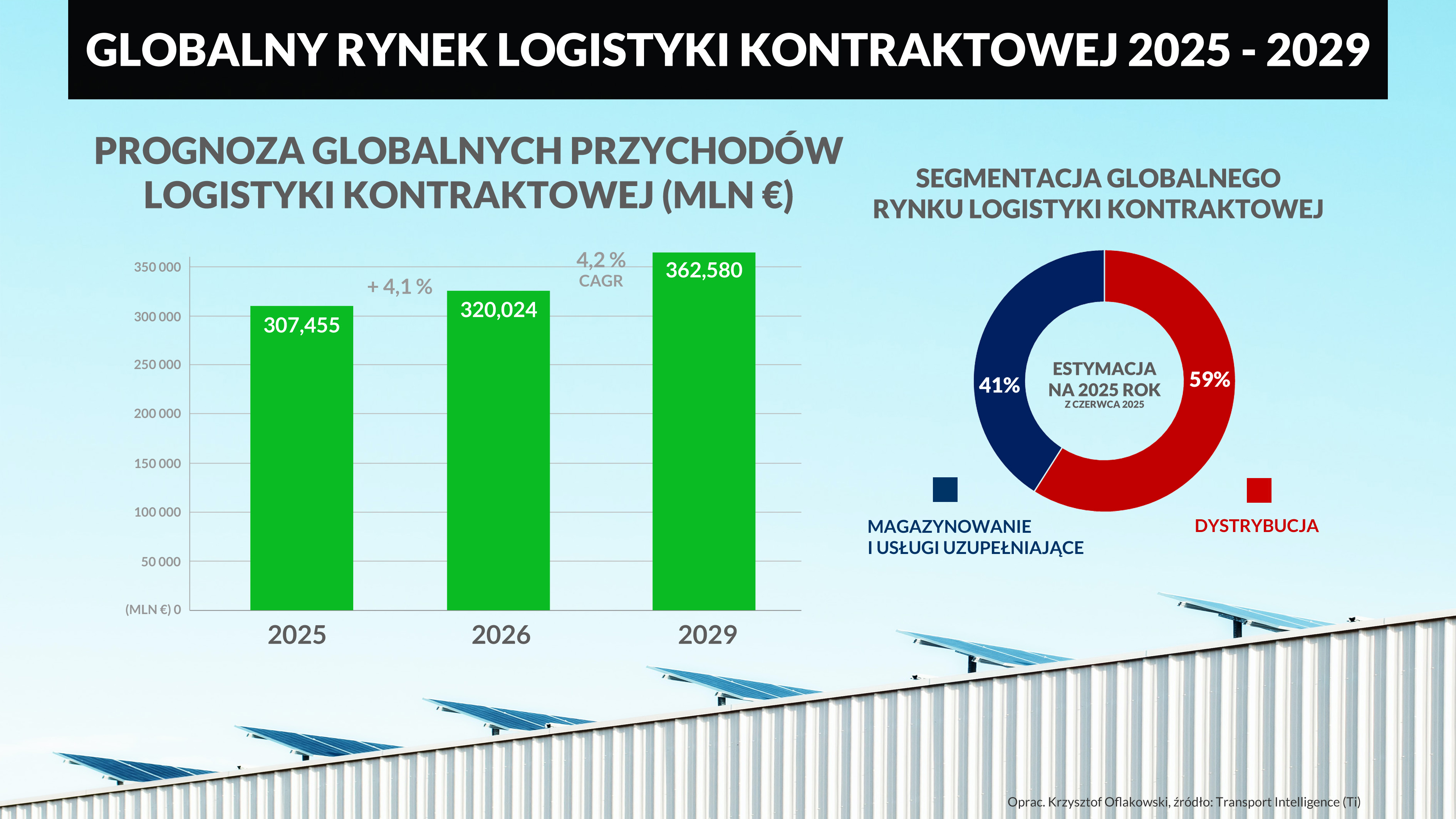
According to the latest data from Transport Intelligence (Ti), the value of the global contract market in 2025 will reach approximately 307.5 billion euros, representing a 4% increase compared to 2024, when revenue exceeded 295.6 billion euros. According to Ti, this growth deviates slightly from the standard scenario reflecting the weakening or recovery of the economic cycle and is rather the result of structural factors, such as the growing trend of outsourcing warehousing and order fulfillment services. It is also a result of increasing operational complexity in omnichannel distribution and associated costs, as well as rising demand for automation and value-added services, including inventory management and e-commerce returns handling.
A standard characteristic of last year’s results, however, is the uneven growth between major regions and served sectors. Market segments related to consumers and healthcare performed better, creating better conditions than the industrial and discretionary goods sectors, such as luxury items, where demand is determined by economic conditions.
Results better than mid-2025 forecasts
It is worth noting that new estimates pointing to 4% growth in 2025 are better than those forecast in June, when full-year contract market development was assumed to be 3.3%. This was supposed to be weaker momentum than the 3.6% in 2024, but growth was ultimately recorded.
The regional balance of power on the podium has not changed. First place still belongs to Asia-Pacific, which also remains the growth leader. In the middle of the year, revenue growth in this market was estimated at almost 6%, clearly above the global average. In the same simulations, Europe remained stagnant, with growth slightly exceeding 1%.
Throughout 2025, the distribution of revenue in individual segments of the contract market also changed little. The largest share, exceeding half of the sector’s value, belonged to distribution (59%), and in June 2025, its growth was estimated at 3.5% year-on-year. Slightly lower in terms of growth rate were warehousing (3.2%) and value-added services (2.5%).
What to expect in 2026 and beyond?
The latest Ti analysis indicates that 2026 is expected to bring growth in the value of the contract market of approximately 4.1% to about 320 billion euros. In the longer term, i.e., by 2029, the global market will reach revenues of 362.6 billion euros, which means an average annual growth rate between 2025-2029 of 4.2% (CAGR). This will maintain a single-digit growth trend supported by service outsourcing, the reconfiguration of global logistics and supply networks, and investments in technologies supporting logistics processes.
However, the data suggests that we are dealing with an increasingly mature market environment, and growth in the coming years will result more from service development, consolidation factors, and efficiency-increasing investments rather than directly from volume growth. Operators, especially in stagnant developed markets, will continue to face price discipline and high costs, which will exert pressure on margins.
The global forecast for 2026 (4.1%) and the average annual growth through 2029 (4.2% CAGR) is a result that outperforms global GDP growth, but at the same time, development is slightly weaker than in the 2020-2024 period, when a cumulative average rate of 4.6% was recorded.
There is no doubt that the contract market has returned to factory settings after the strong pandemic rebound. However, current market circumstances are creating new factors enabling development, including in Europe. In the opinion of experts, geopolitics, the ongoing evolution in global trade flows, trends in the contract market, and the ability to scale and multiply operational capabilities will create opportunities for the Old Continent.
Geographically, the logistics market in Europe naturally has less growth potential because its economy is developing more slowly and the contract logistics market is already more mature than in other regions of the world.
Although the growth potential of European contract logistics is lower than in other regions, it remains promising because long-term trends (outsourcing, modernization, and supply chain reorganization) will remain active. We also believe that geopolitical changes will lead to new needs and opportunities in contract logistics. For example, Chinese retailers are likely to launch very large warehouses in Europe – and in Poland in particular – to adapt to new restrictions and obligations regarding imported goods.
Opportunities for development are also present in other markets outside Europe, but they require an appropriate strategy. In the case of ID Logistics, a key element is the proximity to our global clients and providing them with solutions based on a “core model” that can be easily replicated, adapted to each country, and monitored on a global scale. I am referring to international clients with whom we started cooperation in one country, who are satisfied with our services and cooperation, and are then willing to open new operations with ID Logistics in other countries, thereby reducing risk and benefiting from capitalized best practices.
Furthermore, for several years we have been developing our transport, distribution, and value-added services as a standalone or complementary offer for our clients to provide them with comprehensive solutions. Although such services still account for a smaller part of our sales, we see value in them for contractors and significant potential for further development.
At the ID Logistics Group, our core business remains warehouse and inventory management, where we still see great potential for development. This is a market far from saturation, where an innovative approach and close relationships with clients allow us to gain shares in every geographical area. This segment also remains quite fragmented, which is why we are still actively looking for potential acquisitions that could accelerate our growth and increase the value of our offer.
– says Yann Belgy, Managing Director at ID Logistics Poland, providing comprehensive logistics and transport solutions.
Uneven development of regional markets
Analysts from Transport Intelligence also point out that the contract market is quite clearly divided into mature regions with low growth and emerging markets characterized by structurally faster momentum. Among the key areas, i.e., Asia-Pacific, North America, and Europe, it is unfortunately the Old Continent that has been recording the weakest results for several years, which results not only from the mature contract segment but also from the protracted macroeconomic problems of major economies. The result is low growth, fueled primarily by contract renewals, automation, and value-added services, rather than direct volume growth.
North America performs better in this respect, with its moderate growth profile supported by greater structural resilience. It is also helped by economic growth and support from the e-commerce sector. According to Forrester analysis, the share of e-commerce in total retail trade in the USA in 2030 will reach 29%, which will correspond to revenue of 1.8 trillion dollars. Forecasts for 2025 indicate a 24% share and e-commerce sales value at 1.2 trillion dollars.
This is certainly an important piece of the puzzle that also helps in Europe, but the contract market in North America will also face certain limitations, resulting, among other things, from susceptibility to the cyclicality of macroeconomic conditions and the high level of penetration of logistics operations outsourcing, which narrows the possibility of dynamic development. One cannot forget about the unpredictability of customs and trade policies.
The Asia-Pacific region consistently maintains its position as a leader and acts as a global engine for contract market growth, supported by good GDP growth, the trend of production relocation, decent consumption indicators, and the accelerating trend of logistics outsourcing. Leading positions in this part of the world are held by China and India, which drive both regional and global growth.
Contract market dynamics reflected in global GDP and trade
A special sign of contract logistics is its dependence on macroeconomic trends, hence the moderate pace of global GDP and trade growth, in both cases around 3%, affects volumes in sectors key to the industry, including industrial and consumer goods. Sustained weaker momentum will continue to moderate demand for logistics services, the development of new distribution networks, and value-added services. This impact will be visible especially in developed economies.
However, conditions favorable to GDP growth, and thus also to contract logistics, are appearing on the horizon, including melting inflation and interest rate cuts, which ease operating costs while promoting investments in, among other things, automation and process digitalization.
The industry’s dependence on GDP and trade well reflects the macroeconomic climate announced by major international institutions. The January forecast of the International Monetary Fund (IMF) assumes global GDP growth of 3.3% in 2025 and 2026, and 3.2% the following year. These are results slightly better than data from October, when momentum in 2026 was estimated at 3.1%. Among the key positive factors driving growth, the Fund mentions, among others, potential benefits resulting from investments in AI and better availability of financing. This partially balances the negatively affecting escalation of trade and geopolitical tensions, which, according to numerous analyses, constitute the main growth barrier in the entire supply chain.
Economic forecasts for 2026 confirm regional dependencies
Momentum in regional markets is well reflected by, among others, IMF data for China, which is expected to grow at a rate of 4.5% and 4% over the next two years. India is expected to maintain a pace reaching 6.4%. In both cases, these are growth engines in the contract logistics market not only in Asia but also globally. On the other side of the Pacific, growth in the USA was estimated at 2.4% and 2%, which is also visible in forecasts for contract logistics. Problems still dominate in the eurozone, which is reflected in economic growth at the level of 1.3% and 1.4%. Poland, however, performs clearly better than the eurozone, with GDP expected to grow at a rate of 3.5% in 2026 and 2.7% in 2027. For the current year, these are estimates 0.4 percentage points better than the assumptions from October, but next year, according to the IMF, will see a slight decline of 0.2 percentage points.
As can be seen, the regional arrangement of indicators almost exactly corresponds to the situation in the contract sector. Economies located in Asia are developing the fastest, followed by North America and Europe. With the current unpredictability of geopolitical conditions, the situation in the coming years may still change dramatically, but for now, taking into account the high probability of sudden turns of events on the international stage, the condition of global trade looks quite good in the IMF forecast. Its growth is estimated at 2.6% in 2026 and 3.1% in 2027. Developed economies will grow at a rate of 1.9% and 2.4%, and this will be momentum clearly weaker than in emerging markets and among developing economies, where trade this year is expected to gain 3.6% and 4.4% in 2027.
Announced growth does not mean a lack of serious challenges
In January, the World Bank also published its trade data, according to which it is expected to grow at a rate of 2.2% and 2.7% in 2026-2027, respectively, which is a clear slowdown from 2025, when trade gained 3.4%. The Bank, however, draws attention to GDP, whose growth this year was assumed at 2.6% and 2.7% in 2027, emphasizing that if such a forecast holds, the current decade is expected to be the weakest since the 1960s. According to World Bank analysis, while in 2025 the global economy was driven by trade gains resulting from fear of tariff introductions and the reconfiguration of global supply chains, this mechanism is unlikely to occur in 2026, when both trade and domestic demand are expected to slow down.
The United Nations Conference on Trade and Development (UNCTAD) also has concerns regarding economic conditions, according to which global growth will remain sluggish, which will cause a slowdown in trade prospects and investment flows. UNCTAD estimates that global GDP will remain at 2.6% in 2025 and 2026, despite potential benefits flowing from AI. The organization is worried about growing protectionism, calculating that the weighted average tariff rate in 2025 in manufacturing increased by 4.7%, and governments, especially the USA, will continue to use tariff barriers as a tool for achieving industrial and strategic goals. Such significant changes in trade policy will trigger an avalanche of adverse phenomena, increasing uncertainty, discouraging investment, and disrupting the functioning of supply chains, which contract logistics will certainly feel.