








ID Logistics Poland, an international logistics service provider, has begun testing innovative technological solutions to support internal transport management in distribution centers. Their goal is to optimize operating costs and increase process efficiency and workplace safety.
Currently, remote control systems for forklifts, warehouse fleet monitoring, and lithium-ion batteries are being tested in ID Logistics warehouses. A dedicated ID Logistics team, working with external partners, is responsible for their preparation.
– The tests are being carried out in various warehouses, which allows us to thoroughly check the functionality of individual solutions. During our work, we also utilize the global experience of the ID Logistics Group. We adapt solutions used in serving clients in various countries around the world to our specific needs and the expectations of clients in Poland – said Piotr Krasoń, project manager at ID Logistics Poland.
Remotely controlled forklift
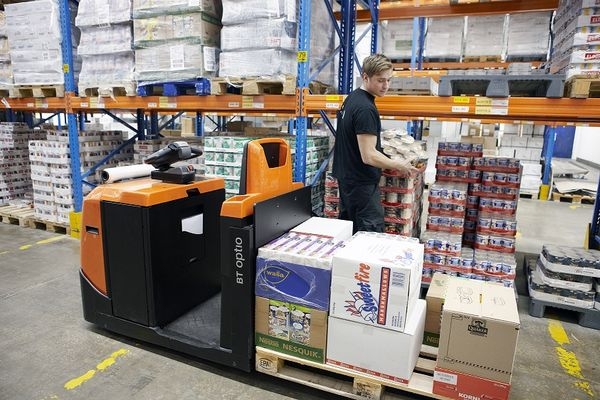
In cooperation with Toyota Material Handling, ID Logistics has started tests checking the possibility of using a remotely controlled Toyota BT Optio OSE250 forklift in warehouse activities, designed for order picking from low rack levels. These are the first tests of this type to be carried out on the Polish market by both companies. A similar solution is already used in ID Logistics warehouses in France and the Netherlands, which allows for the use of experience from other countries in the tests. The task that the ID Logistics team has set for itself is to check the functionality of the remote forklift control system while working in large-area warehouses and during various warehouse operations. The greatest emphasis is placed on increasing the efficiency of operational processes, as well as productivity and workplace safety.
The tested forklift is remotely controlled via a remote control. This easy-to-use device, attached to clothing or the wrist, allows the operator to quickly and efficiently direct the vehicle’s movement. The operator walks right behind the truck, stopping it at subsequent order picking points. They do not have to get on and off the vehicle every time, as is the case with traditional forklifts. This significantly speeds up and facilitates their work. The remotely controlled forklift is intended to increase the safety of the operator and other warehouse employees. This role is performed by a mounted safety scanner and a motion sensor with light signaling. When the scanner detects an obstacle, for example, another truck or a passing person, it automatically stops the vehicle at a safe distance. It also allows for maintaining an appropriate distance from the racks and, as needed, corrects the travel route. In turn, the motion sensor uses light signaling to warn other employees about an approaching vehicle. ID Logistics is also checking what impact the tested solution will have on the environment. It is already known that smooth driving significantly reduces energy consumption.
Warehouse fleet monitoring systems
ID Logistics has also started testing IT solutions supporting the management of forklifts in distribution centers. Their operation is based on similar principles and technological solutions (online transmission via GPS or 3G cellular network) as passenger car fleet monitoring systems. The greatest emphasis is placed on efficiency, workplace safety, and reducing service costs associated with equipment and infrastructure. ID Logistics specialists are checking functionalities such as operator work management (e.g., working time registration, access control, and validity of qualifications), forklift operation monitoring (e.g., battery charge status, speed, driving time, routes, and distance traveled), and reporting (e.g., service and financial data). As part of the tests, possible solutions for monitoring forklift collisions with obstacles are also being checked (e.g., recording the time of the event, measuring the force of the impact, and the vehicle’s speed at the moment of collision, as well as the possibility of slowing down or completely blocking the drive).
Forklift with a lithium-ion battery
Another project implemented by ID Logistics is testing forklifts equipped with lithium-ion batteries. ID Logistics is checking how they can be used during work in warehouse conditions and how this compares to traditional lead-acid batteries. The tests are carried out in terms of the functionality of lithium-ion batteries, the impact on reducing operating costs (which is associated with simple operation, short recharging time, and longer battery life), and workplace safety in the warehouse. From the point of view of ID Logistics, one of the benefits of using this type of battery may be an increase in warehouse space. The batteries can be safely charged anywhere in the warehouse. This means there is no need to separate a part of the warehouse for a battery room, where, due to the emission of harmful fumes, acid batteries must be charged. The additional space obtained in this way can be used for operational processes. The environmental aspect, related to the reduction of carbon dioxide emissions, is also taken into account in the tests.
– The main goal of ID Logistics is to conduct tests checking new technical, IT, etc. solutions that create potential for application in one of our areas of operation and can bring added value. This does not mean, however, that we will implement them immediately. We want to know how what suppliers offer will work in warehouse conditions. On the other hand, we also want to cooperate with suppliers, helping them develop innovative solutions that meet our needs. Only then can we be sure that the solution we propose to current and future clients is verified from a practical point of view. We are always ready to provide clients with the most beneficial solutions for them – summarized Sergiusz Pałubski, technical manager at ID Logistics Poland.
– Toyota Material Handling Poland has been cooperating with ID Logistics for over a dozen years; we always try to be close to our clients and their needs. Together, we observe changes in the logistics market, and that is why we are very happy to conduct tests of innovative products that can support logistics processes, increase their efficiency, and ensure maximum safety during the work of people and forklifts. Toyota is a leader in the industry, offering innovative and safe products all over the world. The Polish market is no exception, which is why such projects are very valuable to us – said Maciej Pessel, Strategic Business Director at Toyota Material Handling Poland.