








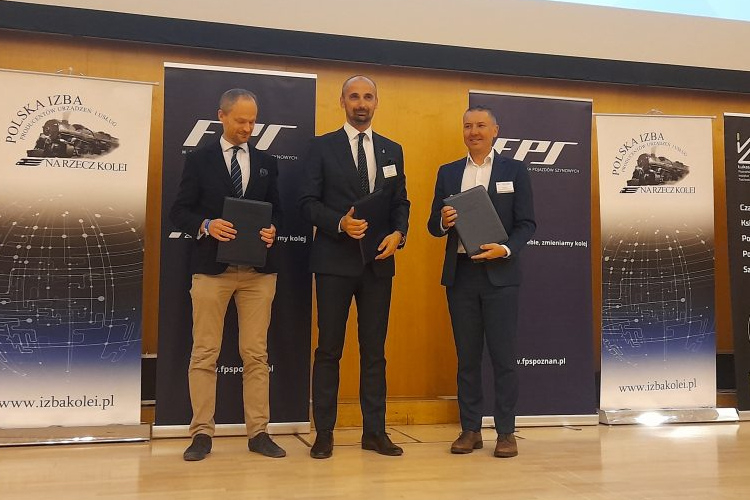
Impact Clean Power Technology S.A., a leading supplier of battery systems for transport in Europe, together with H. Cegielski – Fabryka Pojazdów Szynowych and the Łukasiewicz – Poznań Institute of Technology, are launching a joint project on the application of hydrogen fuel cells in rail vehicles. A letter of intent regarding this matter was signed on September 7th in Poznań. All three entities already have practical experience in hydrogen solutions.
“We have over 10 years of experience in providing solutions for hydrogen vehicles worldwide,” said Bartłomiej Kras, CEO of ICPT S.A. “We view hydrogen as the energy carrier of the future. The profitability of hydrogen as a fuel and storage medium requires scale, meaning it must be produced by electrolyzers from renewable sources so that the economy can shift to using hydrogen as much as possible. The transition from natural gas to hydrogen is a 10-15 year process, unless integrated EU actions taken as a result of the war in Ukraine shorten this period. A joint project on the application of hydrogen fuel cells in rail vehicles can significantly accelerate the growth of this promising industry.”
Last year, FPS Cegielski and Impact began work on a Polish hydrogen train based on the new “PLUS” platform. Impact’s UVES Energy GEN 2.0 batteries meet the train manufacturer’s requirements and, with a total capacity of 800kWh, will successfully provide a 100 km range on electricity alone. The vehicle was first shown during last year’s TRAKO 2021 trade fair in Gdańsk. In turn, the Łukasiewicz – Poznań Institute of Technology has been conducting innovative scientific research and development for many years in the field of new and modernized rolling stock, as well as work related to the development and simulation, bench, and operational testing of various types of rail vehicles, including work on a complete control system for a hydrogen vehicle.
“Łukasiewicz has been working on hydrogen energy solutions for many years. I believe that the intention we expressed in the letter today will soon become a revolution in the railway market, which is so necessary, especially in the context of the climate crisis and energy market crises,” said Arkadiusz Kawa, Director of the Łukasiewicz – Poznań Institute of Technology.
Impact has been supplying its battery systems to rail platform suppliers such as Stadler and Siemens for many years. Hydrogen vehicles with Impact batteries are operating in Europe and, among other places, in Auckland, New Zealand. The company has also completed its first implementations in the stationary traction market. As part of a consortium with the company Mysoft, Impact completed an energy storage project for PKP Energetyka, which was built near the Garbce railway stop in Lower Silesia.
“Now we want to use our experience in a hydrogen fuel cell project,” says Filip Jankun, Sales Director at IMPACT. The company has been preparing for the hydrogen revolution for a long time and is developing systems for hydrogen fuel cells, which will dominate the zero-emission vehicle market over the next 10–20 years.
When deciding to enter the railway market, Impact took many factors into account, including analyses of the profitability of using trains with different propulsion systems. According to a Bloomberg NEF report, which compared the operating costs of various types of passenger train propulsion, battery-electric drives were historically the most cost-effective, followed by diesel, then hydrogen fuel cells, and finally electric traction. Changes in fuel price and energy production markets have significantly altered this calculation, increasing the attractiveness of hydrogen. However, everything depends on the route the unit will travel. While battery trains may be more cost-effective on short routes, hydrogen propulsion has a distinct advantage over others for long routes.
For IMPACT, the CO2 emission reduction factor is also important. In this case, there is no doubt that hydrogen trains, which are completely emission-free, will be the future of green railways. The joint project with H. Cegielski – FPS and the Łukasiewicz Research Network fits perfectly into the philosophy of the new economic order, in which eliminating CO2 emissions has become a priority goal. It is estimated that by 2030, one in ten trains in Europe will be powered by hydrogen fuel cells, and the value of this market will reach approximately EUR 20 billion by that time.