









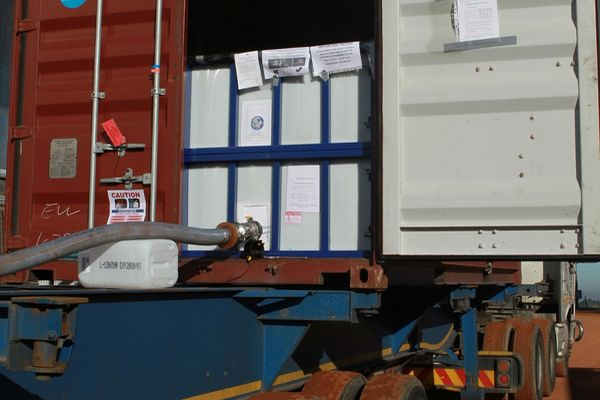
The Hillebrand Group, specializing in serving the beverage market, is constantly striving to minimize costs and maximize quality. The operator has just designed and implemented a new solution – flexitanks installed in 40-foot refrigerated containers, which reduce the costs of transporting juices and beverages by sea by up to 25 percent, while maintaining the quality and freshness of these products.
The largest suppliers of fruit concentrates and juices, as well as other fruit beverages, usually transport their products in their own packaging. They mostly use barrels or IBC containers in refrigerated containers for transport, or flexible tanks packed into 20-foot containers. The first solution is quite expensive, as the cost of shipping such a container can be as high as 6.5 thousand dollars, and the second did not provide full cost optimization due to the limited volume of such a tank. While there was no problem with transporting bulk quantities that occupied an entire ship, where costs are distributed much more favorably, the problem arose when smaller volumes of juices or beverages had to be transported.
Hillebrand – as a global leader in innovative logistics solutions for the beverages market – has found a solution that met significant expectations in this regard. The Hillebrand Group’s technical team designed and thoroughly tested the concept of delivering juices in newly designed flexible tanks – flexitanks – using refrigerated containers, testing them for several months. Successful trials led to the completion of work on the design and production of a larger flexitank with a loading capacity of up to 26,000 liters (depending on product density), which is adapted to a 40-foot refrigerated container. Until now, standard flexitanks were transported exclusively in 20-foot containers, having limited volume. The use of a flexitank adapted for larger refrigerated containers can reduce the costs of transporting juices or beverages by sea by up to 25 percent. In order to minimize fluid movement in the flexitank during the voyage, special technology was used inside, and the tank shell was additionally reinforced with multi-layer material.
– The success of implementing a larger flexitank is very good news. It will certainly help producers of juices or other fruit beverages in their pursuit of optimizing the costs of deep-sea deliveries of their products, while ensuring the preservation of their quality – said Bartosz Mierzejewski, Sales Manager, Hillebrand Poland.
Hillebrand engineers also thought about additional protection against potential contamination of liquids transported in flexitanks and the possibility of using gamma radiation, which allows for maintaining aseptic conditions during tank loading. Hillebrand also has the ability to equip its flexitanks with a unique automatic venting system, ensuring transport safety, especially in the case of goods such as wine or fruit concentrates – which ferment and release gases during transport. Furthermore, to support transport quality, especially with smaller and dry containers, VinLiner thermal insulation is used, mainly utilized in wine transport to maintain the most favorable temperature for the transported product.