








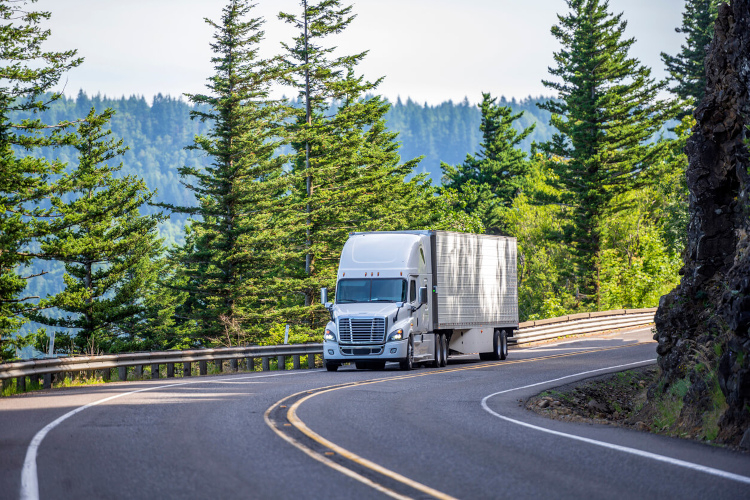
Winemakers and distributors often face the choice of a fast and proven transport option that will give them the certainty that the wine will reach consumers on time and in excellent quality. This is of particular importance during periods of increased goods traffic, such as traditional pre-Christmas or New Year deliveries. One option is road full truckload transport, adapted for wine carriage. What is worth paying attention to, using the example of Hillebrand Gori, a global logistics operator for beverages?
FTL in wine deliveries
Full Truck Load (FTL) transport involves filling a truck trailer with the cargo of a single sender. It is the opposite of LTL (Less Truck Load) groupage delivery, where the trailer’s cargo space contains goods from multiple customers. Fees are charged for the space occupied by a pallet. Why is it worth choosing the full truckload transport option for wine deliveries? First of all, it is more convenient and faster than groupage. Cargoes are transported directly to the destination, bypassing the stage of consolidating pallets from different senders. This ensures greater control over the transported wine and the way it is handled. FTL, when shipping multiple pallets, can be a more profitable and cost-effective solution.
Various types of trucks are used in FTL transport, including those with a tail lift, curtain-side trailers, and platforms. Which one is chosen depends on the quantity of wine being shipped. Alcohol can also be transported in containers. In that case, loading takes place in warehouses from which pallets are collected, in transshipment zones, or at ramps. Containers can also be loaded onto a truck with wine pallets on Slip Sheets or loose.
Risk and protection
Full truckload transport is a good option for organizing large quantities of wine, but as Hillebrand Gori experts point out, one must remember the risks involved. These include the possibility of theft or exposing sensitive cargo to extreme temperatures. Large temperature fluctuations are cited among the most common causes of wine quality loss and can also lead to the destruction or damage of packaging. Therefore, it is crucial to maintain appropriate precautions, thanks to which wine senders can reduce risk and ensure safe delivery to the destination.
First of all, the appropriate type of container should be selected. For protection against sudden temperature changes and thermal shock, the best option is a container with an insulation liner. A refrigerated container (reefer), on the other hand, will ensure a constant temperature (positive or negative) is maintained for deliveries that require temperature control with an accuracy of up to 1 degree. Hillebrand Gori specialists also advise that when planning a shipment, one should remember to check with the freight forwarding company regarding the type of trailer that will be used for transport. For example, curtain-side trailers do not have containers, so they will not allow for the use of insulation or a cooling system. It is also necessary to draw the driver’s attention to the possibility of additional cargo securing using beams and straps. It is important to work with a proven freight forwarding company that already has experience in organizing wine deliveries. An experienced forwarder will propose appropriate transport solutions. It is also worth insuring the shipment, which will help avoid serious financial losses in the event of potential theft or damage to the cargo.
In containers on pallets and in flexitanks
One of the commonly used methods in FTL wine transport is shipping wine in containers on pallets. Pallets made of wood or plastic are used to transport crates of wine bottles, cans, and kegs. Standard pallets have dimensions of 1m x 1.2m, and Euro pallets are 0.8m x 1.2m. Wine is usually stacked in four layers, and 56 crates can be placed on a pallet. A standard 20′ container holds 11 Euro pallets or 10 standard pallets. A 20′ refrigerated container can be loaded with 9 standard pallets (1m x 1.2m) or 10 Euro pallets (0.8m x 1.2m). Another popular method is shipping loaded wine crates (non-palletized) on a Slip Sheet or bulk transport in flexitanks. These are flexible tanks that are placed inside containers, both standard and refrigerated, and then filled with wine.
Source: Hillebrand Gori