








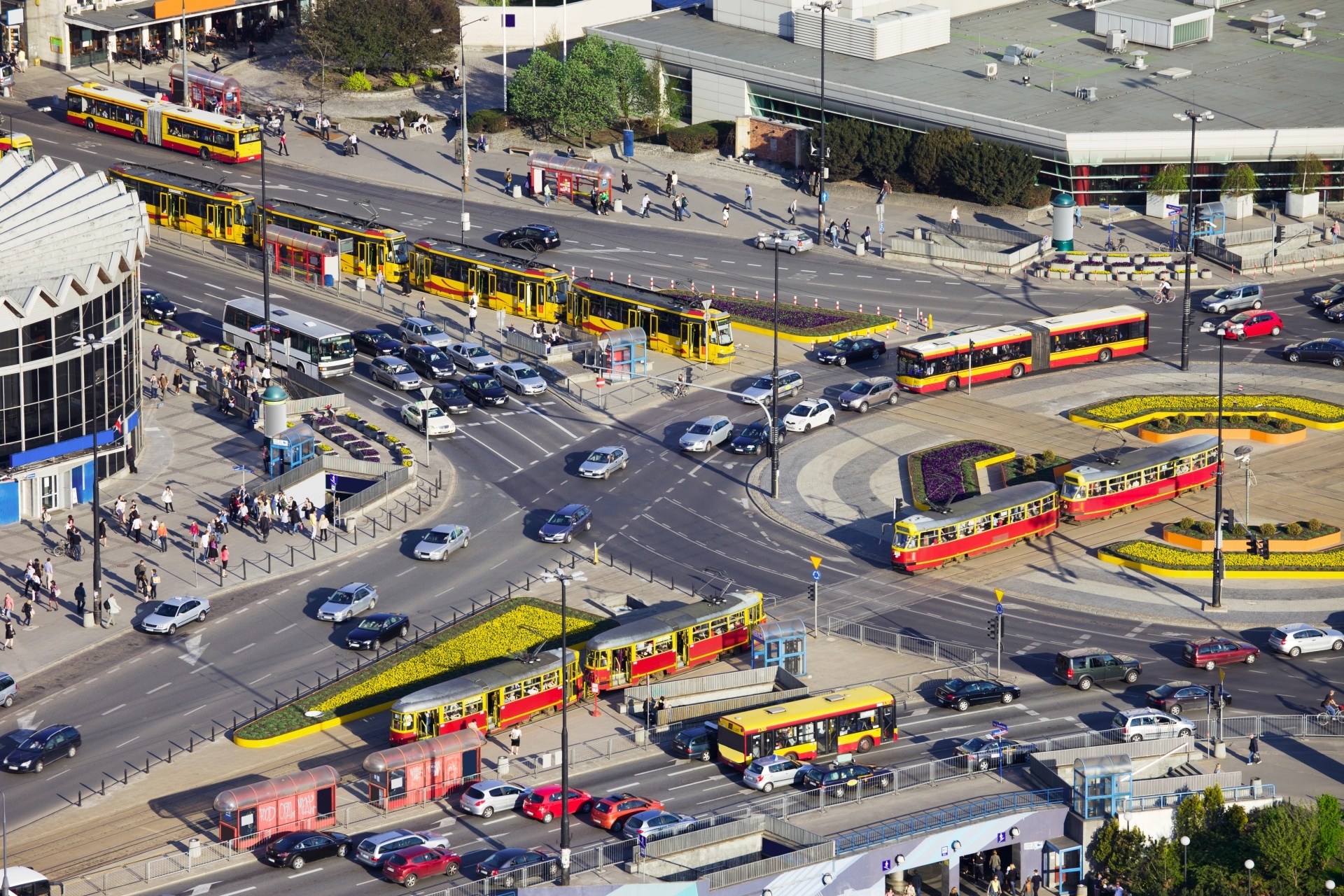
Warsaw residents on their way to work do not drive, but stand in traffic jams. They lose an average of 70 hours a year in them[1]. This is not surprising when looking at the statistics: there are 1.5 cars per inhabitant of the capital, and almost 700,000 cars take to the city streets every day[2]. Bus passengers are also trapped in traffic jams, which is a major problem because it is the most popular means of public transport in Warsaw[3] and, for some residents, the only option to get to the center from more distant districts. The authors of the report “Free the Buses” present proposals on how to free buses from traffic jams and appeal to the ZTM and the authorities of Warsaw to create a plan to speed up buses in the capital.
Bus lanes – a way to reduce traffic jams and encourage Warsaw residents to use buses
More than half (51%) of the capital’s residents choose public transport to get to work every day[6]. Most opt for the bus[7], which rarely gets priority treatment. This is a problem because for some, the bus is the only means of public transport connecting distant districts with the city center. This applies, for example, to the area from Białołęka through Gocław to Stara Miłosna and Ursus. Buses can be a fast, comfortable, and attractive means of public transport, but there is an important condition. They cannot be stuck in traffic. Therefore, it is best when they can move along dedicated lanes.
We know that bus lanes work. The bus lane on Puławska Street reduced bus travel time during peak hours by 40%, and the number of passengers increased by 18% over the year[8]. Bus lanes on a two-kilometer section in Dolina Służewiecka and Al. gen. W. Sikorskiego, which are used by up to 40 buses per hour in both directions during peak hours, eliminated several-minute delays while increasing the number of travelers by 70%[9]. Warsaw needs more such implementations and a long-term strategy that ensures priority for buses in public transport. The one implemented in Dublin shows how important a systemic approach to bus transport planning is.
In the capital of Ireland, buses are the basis of public transport. In 2000, the city created a comprehensive plan for the creation of extensive bus networks – a total of 16 routes ranging from approx. 5 km to approx. 19 km, connecting the city center with the suburbs. Bus lanes were designated along the entire length of each corridor (except for sections where it was not possible). Care was taken to ensure the proper location of stops, to which travelers would have easy access, and the use of low-floor buses with air conditioning ensuring travel comfort. The program brought the desired results. Data from 2007 show that buses were faster than cars on 12 of the 16 analyzed routes, and on selected sections, the car journey took even more than twice as long. In the corridor along Stillorgan Road, between 1997 and 2007, car traffic decreased by approx. 43%, and the number of bus passengers increased by approx. 176%. In 2017, further work was started, resulting from the adopted plan.
The share of public transport in traveling around Warsaw is relatively high, but to maintain it, its attractiveness must be constantly increased. The changes we propose would help create a real alternative for people who currently travel around the city by car. The more people switch to public transport, the less competition there will be for space on the road and in parking lots among other drivers. Today, bus lanes are designated somewhat ad hoc, where a traffic jam is created as a result of roadworks. The city lacks a vision, an idea. We advocate for the creation by ZTM of a multi-year investment plan to speed up buses. Many of the solutions we propose are not expensive, and they allow for improving this key means of transport for Warsaw residents
– comments Nina Józefina Bąk, director of the Clean Cities Campaign in Poland.
How to return buses to the capital’s residents – 5 recommendations
As the authors of the report point out, the basis is to treat buses on an equal footing
with trams. – A well-thought-out, multi-year strategy for the development of the bus corridor network in Warsaw should be developed, with bus lanes at the forefront and other solutions. Thinking about this in the long term, it is worth ensuring priority for buses in public transport in our city – emphasizes Nina Józefina Bąk. Secondly, the planning of bus lines and infrastructure in the capital should take place in parallel and influence each other. Thanks to this approach, individual lines will be able to achieve the shortest possible travel time, and bus lanes will be used most effectively.
Thirdly, existing and planned bus lanes should be intended exclusively for bus traffic and emergency vehicles. When other cars also move along them, using the bus lane to turn right and/or parking next to it, they slow down buses and reduce traffic safety. This can be avoided by prohibiting parking next to bus lanes and installing separators separating them from general-purpose lanes. Such a solution would be particularly advisable, for example, on Al. Jerozolimskie from Chałubińskiego to Marszałkowska, where entry into bus lanes by private cars is rampant.
Fourthly, it is worth taking care to designate bus corridors not only where there is space for it, but everywhere where such a solution is needed. This goal can be achieved by using one-way car traffic and modal filters (also known as bus gates), which allow only selected road users to pass through a given street – in this case, buses – and block the movement of individual vehicles.
It is also worth implementing unusual technical solutions when local conditions favor such an approach. An example is the separation of a lane of a one-way street intended for the movement of buses that move in the opposite direction to that applicable to other vehicles. Such a contraflow lane or reversible bus lane is used on roads with a large difference in traffic volume between individual directions.
Proposals for changes for Warsaw
Can this work? The above recommendations have been tested by many cities in Europe. The experiences of, among others, Dublin, Milan, Amsterdam/Haarlem, Brussels, Lyon, Cambridge, but also Krakow and Gdynia described in the “Free the Buses” report show how to effectively give buses priority. Based on good practices and current transport problems in Warsaw, the authors of the study present several proposed solutions for the capital, noting that it is ZTM – the unit responsible for planning bus routes, that should propose its own ideas.
Bus lane to Wilanów. One of the proposals is to prioritize buses along the entire length of the 20 km route from Bemowo to Wilanów. The solution would allow for reducing bus transport costs during peak hours, because extending the travel time increases the number of bus brigades needed to service the line from about 20 to 30 vehicles. The daily commute of passengers traveling this route would be shortened by 10 minutes in each direction.
Bus priorities in Kamionek and Grochów. Adding bus lanes in the northern part of Kamionek and Grochów would be expensive and not entirely effective. Allowing traffic only for buses would make life difficult for residents. An alternative would be to introduce “2+1” layout lanes on key sections: two lanes for bus traffic in both directions, and the third would allow car access, but only in one direction. The direction of car traffic could change on different sections to maintain priority for buses.
Modal filter on Globusowa Street. The sequence of Dźwigowa, Globusowa, Chrobry, and Kleszczowa streets is a popular connection between the north-western and southern parts of Warsaw. Despite alternative roads, the route through the middle of Włochy remains the shortest connection from Bemowo towards southern Mokotów, Ursynów, and Wilanów. Car traffic bothers the residents of Włochy, and buses have to push through traffic jams. The problem could be solved by banning the passage through the Globusowa Street viaduct for vehicles other than city buses and emergency vehicles. Eliminating the passage between districts would not only improve traffic safety but also air quality and reduce noise levels in the area.
Bus lane to Łomianki. Another proposal is to implement a bus lane on the route to Łomianki. Specifically, it concerns Pułkowa Street, which is part of national road No. 7 and connects Warsaw not only with Łomianki but also with: Dziekanów Leśny, Łomna, and the town of Czosnów. On the strategic section of Pułkowa Street (from Brukowa Street in Łomianki to Dzierżoniowska Street in Warsaw), heavy traffic affects delays in bus service, especially towards Warsaw. They move up to 60% slower than those traveling in the opposite direction. It is therefore worth implementing bus lanes on the route between Łomianki and Warsaw. The one in the southern direction would be added to the existing general-purpose lanes.
Benefits of freeing streets from cars
Will the changes proposed in the “Free the Buses” report be expensive? This question arises almost always when it comes to changes in public transport. – Bus lanes and other measures giving priority to buses are relatively inexpensive and easy to implement, especially compared to expanding the metro or building new tram lines. They allow you to save time, but also money – comments Nina Józefina Bąk and adds that one should remember that in bus transport, carriers have had major problems with recruiting drivers in recent years – and those who are there often work overtime. As the society ages, this problem may grow, which is an argument for organizing public transport in such a way that the demand for employees is as low as possible. This is served by giving buses priority in city traffic. When buses are not stuck in traffic, the same network of connections can be serviced by fewer brigades (i.e., vehicles and drivers)
– explains Bąk.
Bus lanes allow not only to solve the problem of traffic jams. The aforementioned report, as well as earlier analyses by the Clean Cities Campaign Poland[10], show that there are more benefits. The network of bus lanes improves the efficiency of the entire public transport system in the city, increases the number of public transport users (shortening the bus travel time by only 10% can increase the number of passengers by 4-6%)[11], and reduces car traffic. In turn, making buses an attractive means of transport for more residents than before will contribute to reducing air pollution and limiting noise and the number of accidents in the capital. – And everyone traveling around Warsaw would benefit from it. Car drivers would also feel greater driving comfort
– adds Nina Józefina Bąk, director of the Clean Cities Campaign in Poland.
The report “Free the Buses! Faster, cheaper, more comfortable public transport. Recommendations for Warsaw” is available for download at the link.
Summary:
- Warsaw leads in the number of cars per person. There are as many as 647 cars per 1000 inhabitants, twice as many as in other European capitals, e.g., Berlin, London, or Paris[4].
- Among those who choose public transport to move around Warsaw, over 47% use buses[5]. To make them work quickly and efficiently, it is necessary to free them from traffic jams.
- The solution is to create complete bus corridors (bus lanes) in the city, connecting distant districts with the city center, as well as a number of improvements giving buses priority.
- Examples of implementations in European cities and proposed solutions for Warsaw have been published in the Clean Cities Campaign Poland report.
[1] Source: INRIX, 2024 Traffic Scorecard Report.
[2] Estimated data from the PLANKOM Transport and Spatial Planning Research Center.
[3] ZTM Annual Report for 2023, Public Transport Authority, 2024, https://www.ztm.waw.pl/wp-content/uploads/2024/03/Raport-Roczny-ZTM-za-rok-2023.pdf
[4] Source: Eurostat. https://ec.europa.eu/eurostat/databrowser/view/tran_r_vehst$defaultview/default/table?lang=en, last edition: October 2024.
[5] ZTM Annual Report for 2023, Public Transport Authority, 2024. https://www.ztm.waw.pl/wp-content/uploads/2024/03/Raport-Roczny-ZTM-za-rok-2023.pdf
[6] [Report No. 2 from the diagnosis of transport behaviors of residents, for the needs of the “Sustainable Urban Mobility Plan for the Warsaw Metropolis”, Trako/PBS, 2022, accessed 01.09.2024 https://omw.um.warszawa.pl/wp-content/uploads/2022/09/Raport -nr-2-glowny.pdf
[7] ZTM Annual Report for 2023, Public Transport Authority, 2024.
[8] “A year with bus lanes on Puławska Street”. ZDM Warsaw 2023: https://zdm.waw.pl/aktualnosci/rok-z-buspasami-na-ulicy-pulawskiej/
[9] “Cleaner air in Warsaw. Buses and bus lanes make a difference”, “iZTM Monthly of the Public Transport Authority” 01/2023: 16–17: https://www.wtp.waw.pl/wp-content/uploads/sites/2/2023/01/iZTM_01_2023.pdf; “Buses more punctual and popular, traffic smoother. Bus lane improved the Siekierkowska Route”, ZDM Warsaw 2022: https://zdm.waw.pl/aktualnosci/autobusy-punktualniejsze-i-popularniejsze-ruch-plynniejszy-buspas-usprawnil-trase-siekierkowska/
[10] Clean Cities Campaign, With a vision Urban transport policy in shaping the quality of life Recommendations for Warsaw, Warsaw 2024.
[11] Ibid.
Source: Clean Cities Campaign