








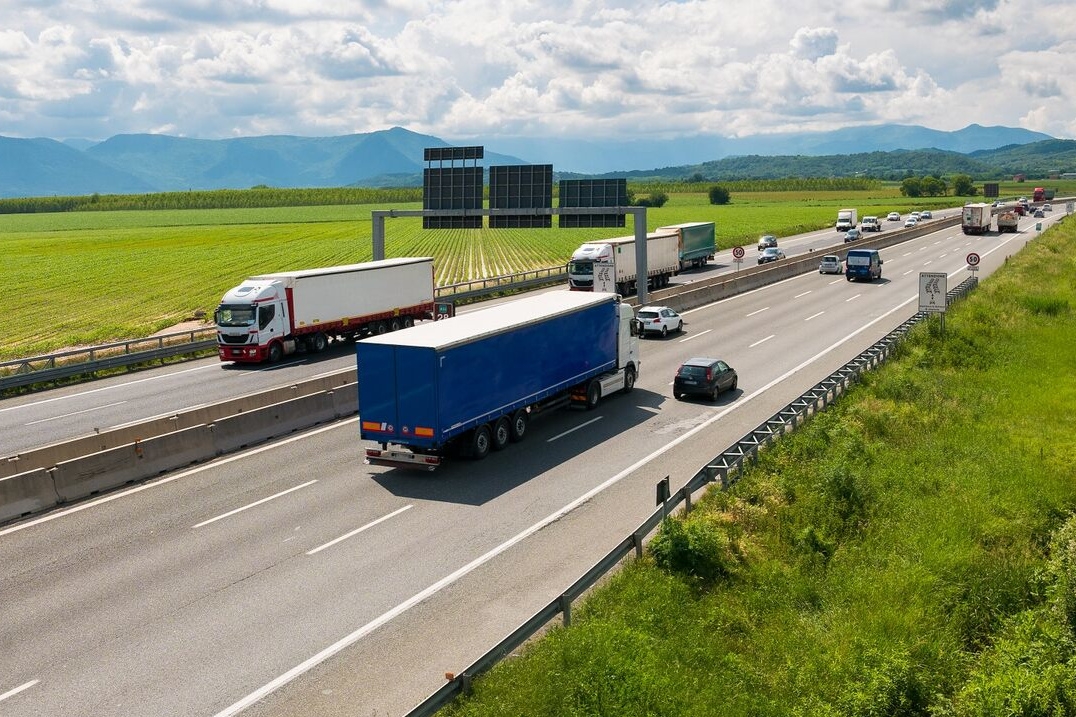
Although the Schengen area rules still apply, in recent years some EU countries have decided to reinstate checks at their borders. Germany, Italy, Austria, the Netherlands, and Sweden have taken such steps so far, mainly due to concerns related to illegal immigration. Restricting traffic at borders is particularly burdensome for professional carriers and increases the risk of penalties associated with incorrect inspection results.
During a border check, the identity of drivers is verified (especially the legality of stay in the case of non-EU drivers), as well as transport documents regarding the cargo and the vehicle (such as a Community license), and compliance with cabotage regulations or driver working time rules. Any violations in this regard expose carriers to high penalties and severe consequences.
High penalties for missing or incorrect transport documents
A border check begins with verifying the accuracy of transport documents, and their absence or irregularities in their content can lead to very high penalties. The details are discussed by Mateusz Pernak, a lawyer at TC Kancelaria Prawna:
For example, if a carrier fails to present a consignment note for inspection or if the document contains errors, they will pay a fine of 500 euros in Germany and up to 750 euros in France. Local authorities may also request documents confirming the compliance of the cargo, such as an invoice, cargo specification, or transport order. This is particularly important if there is any doubt regarding the legality of the goods. In Belgium or the Netherlands, administrative penalties for the lack of documents confirming cargo compliance reach 1,800 and 1,500 euros, respectively.
Every international carrier must possess a Community license and a certified copy for each vehicle performing transport, and the lack of a license discovered during an inspection is associated with high penalties. In Poland, the administrative penalty for this is 12,000 PLN, in Germany 5,000 euros, and in the Czech Republic, for example, 500,000 korunas.
Permits for the transport of goods subject to special conditions are also subject to inspection. An example could be the transport of dangerous goods or cross-border waste transport, which requires meeting the requirements set out in Regulation (EC) No 1013/2006. If a carrier does not have the appropriate permits, they face a fine of up to several tens of thousands of euros and the detention of the vehicle.
– adds Mateusz Pernak.
Although there are no customs checks within the European Union, international transport may extend beyond its borders (e.g., to the United Kingdom). In such a situation, customs documents are also subject to inspection, and their absence is a serious violation. A carrier who fails to present them risks vehicle detention, high fines (reaching several thousand pounds in the UK), and failure to clear customs may even result in criminal proceedings.
Violation of driver working time regulations
Adherence to driving time, break, and rest period standards is another area monitored by officers at borders. To avoid penalties in this regard, the driver should have a driver card and correctly enter manual data into the tachograph, as well as take regular daily and weekly rest periods in accordance with Regulation 561/2006.
Penalties for violations of driver working time regulations are particularly high in Spain, Italy, or Germany, where they reach up to several thousand euros.
Technical condition of the vehicle and mandatory equipment under the scrutiny of inspectors
A vehicle performing international transport of goods should be maintained in impeccable technical condition. During an inspection, officers may check, among other things, the condition of tires, lights, or the braking system, the tachograph for proper calibration and legalization, the presence and validity of the technical inspection, as well as mandatory equipment such as reflective vests, a warning triangle, a fire extinguisher, or a first-aid kit.
In some countries, additional vehicle equipment is required. For example, in Scandinavia, it is required to have tire chains that meet the requirements specified by specific countries.
Penalties for the improper condition of a vehicle vary depending on the inspecting country. In Poland, they reach up to several thousand zlotys, and in Germany up to several thousand euros. In addition to a financial penalty, we can also expect the retention of the registration certificate, a ban on further driving, and charges for storage or towing costs. An additional inconvenience is the inclusion of the penalized party in risk assessment systems such as OCRS in the UK or Scorecard in Germany.
– says Mateusz Pernak from TC Kancelaria Prawna.
Penalties for transporting illegal immigrants
The main reason for increased border checks is the increased influx of illegal immigrants. It is worth noting that the transport of illegal immigrants (even unknowingly, e.g., in a semi-trailer) is treated in many countries as a crime or a serious administrative violation, for which both the driver and the carrier are held responsible. The penalties are very severe and may include high fines and the seizure of the vehicle.
The United Kingdom leads in inspections and the frequency of imposing penalties for this reason. For every illegal immigrant that the “Border Force” finds in a semi-trailer, there is a fine of 6,000 pounds for both the driver and the carrier. If the situation repeats, the fine increases to 10,000 pounds. The British government provides guidelines on securing the vehicle before crossing the border, and including these procedures is necessary if we want to apply for an exemption from such a penalty. In France, the transport of illegal immigrants is punishable by a fine of up to 75,000 euros, and the Italians impose fines of 15,000 euros for each immigrant detected in the vehicle.
Therefore, a very important element is the proper securing of the vehicle and checking the security status by drivers after every stop.
Only strict compliance with regulations will allow avoiding penalties
To avoid financial penalties during cross-border inspections, carriers should adopt a policy of full compliance regarding documentation, employment, equipment, and adherence to customs regulations. Regular driver training and the implementation of internal control procedures in the company significantly reduce the risk of violations.
In case of doubts or problems during an inspection, it is worth consulting a law firm specializing in transport law. Proper reaction and quick legal intervention can not only limit the amount of potential penalties but also protect the company from more serious consequences, such as a ban on performing transport operations, which is crucial for their functioning.
– advises Mateusz Pernak
Source: TC Kancelaria Prawna