








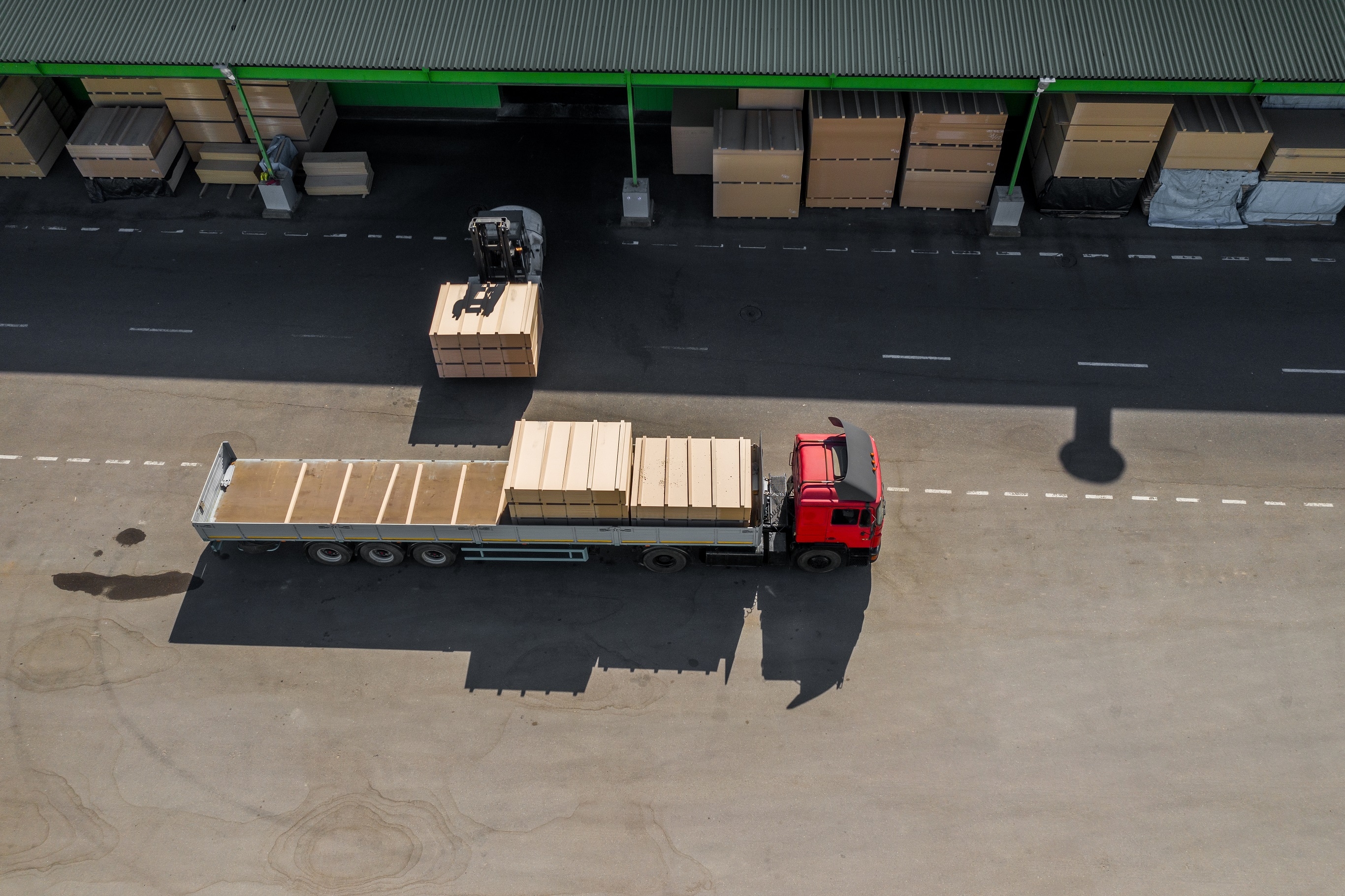
Every year, incidents and accidents occur on European Union roads caused by improper placement or securing of cargo. In some member states, detailed regulations are in force in this regard, which must be followed to avoid severe penalties. Detecting irregularities in this area can cost even several thousand euros and result in a driving ban until the cargo is properly secured.
Most member states require that cargo be placed on the vehicle in such a way that it does not endanger people or goods. It must not remain outside the vehicle (for example, attached to the rear) or fall off it. It is also recommended to regularly check cargo fastenings during transport whenever possible. The first check should ideally be performed after a few kilometers of travel at a stop in a safe place.
– explains Maurycy Kieruj, a lawyer at TC Kancelaria Prawna.
How to safely secure cargo on a vehicle?
Fastenings must be checked after emergency braking or any other extraordinary event during the journey, as well as after partial loading or unloading along the transport route. After loading or unloading general cargo, as is often the case in distribution transport, the fastenings of the remaining goods must be restored.
Solutions regarding cargo securing, forces and structural strength of load-bearing structures, and requirements for fastenings and equipment can be found in the following ISO and EN standards:
- EN 12195-1 – Calculation of securing forces
- EN 12195-2 – Cargo securing straps
- EN 12195-3 – Lashing chains
- EN 12640 – Lashing points
- EN 12642 – Securing of cargo on road vehicles
What are the penalties for improper vehicle securing?
Failure to comply with the conditions for securing cargo on a vehicle exposes the driver and the carrier to serious consequences. This refers not only to the obligation to pay compensation in the event of damage to the shipment but also to administrative penalties, the amount of which varies in individual countries.
Germany takes the most restrictive approach, where a penalty for improper cargo securing can cost the carrier up to 5,000 euros, and the driver a 120 euro fine. In most countries, however, both parties bear joint liability, which means a fine of several hundred euros for the driver and the company, and additional problems with completing the transport until the cargo is secured in accordance with the regulations.
– says Maurycy Kieruj from TC Kancelaria Prawna.
Sanctions for improper cargo securing in selected EU countries
|
Country |
Legal basis |
Fine/penalty for the driver |
Penalty for the company/carrier |
Other sanctions |
|
Germany |
§22, §23 StVO; §31 StVZO; OWiG |
35 – 120 € |
up to 5,000 € |
Penalty points; driving ban |
|
France |
Code de la route art. R312-19; Arrêté 1999 |
135 – 750 € |
Joint liability with the driver |
Driving ban until corrected |
|
Italy |
Codice della Strada art. 164; Circolare MIT |
85 – 338 € |
Administrative penalties for repeat offenses |
Driving ban until corrected |
|
Netherlands |
RVV1990; Directive 2014/47/EU implemented |
370 € |
Possible liability |
Driving ban until corrected |
|
Romania |
Codul Rutier; OG nr. 43/1997; HG nr. 69/2012 |
approx. 290–580 lei (~60–120 €) |
from 1,000 to 4,000 lei (~200–800 €) |
Driving ban until corrected |
Specifics of cargo inspections in EU countries
In Germany, BALM (Federal Office for Logistics and Mobility) is very active in terms of cargo inspections. Authorities check calculations according to the EN 12195-1 standard and require proof of securing calculations during an inspection (it is recommended, but not always formally required).
In France, one must expect inspections not only on the road but also in parking lots, and they are conducted by several different units, including the local gendarmerie, police, and DREAL (Regional Directorates for Environment, Planning and Housing). In some regions, inspections are particularly meticulous, and the EN 12195-1 standard is often used as a benchmark for assessment.
In Italy, cargo inspections are the responsibility of the Polizia Stradale and Motorizzazione, which are increasingly stopping vehicles on main routes as well. Having securing documentation (e.g., securing force calculations) is recommended. In Romania, cargo securing inspections are carried out by the Traffic Police (Poliția Rutieră) and ARR (Autoritatea Rutieră Română). Stops for this purpose are increasingly occurring at border crossings and on major transport corridors.
How to avoid penalties for improper cargo securing?
Knowledge of local regulations regarding cargo securing is crucial to avoid sanctions during inspections. It is also worth keeping in mind that the condition of fastenings in individual countries can be checked by various services.
Irregularities in this area can disrupt transport and expose the carrier to contractual penalties, for example, in connection with delays. If the carrier suspects that a penalty has been imposed groundlessly, they should appeal to the appropriate authority, in which a specialized law firm can help.
– warns Maurycy Kieruj from TC Kancelaria Prawna.
Source: TC Kancelaria Prawna