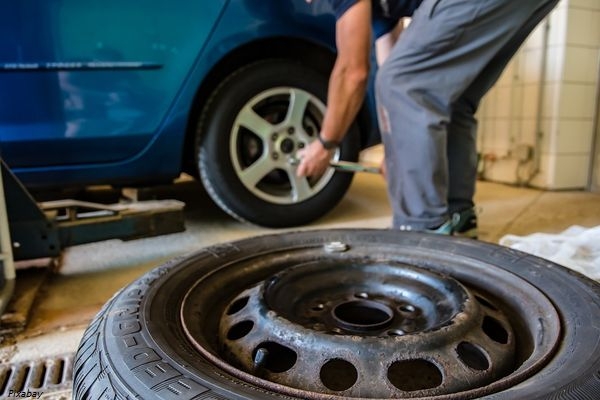
The risk of a flat tire exists all year round, but by being properly prepared, you can significantly reduce or even completely eliminate it. A flat tire, usually caused by nails, screws, or sharp stones lying on the road, is the most common type of tire damage.
– Particular caution should be exercised when driving near areas where various types of construction or road works are being carried out. Sharp stones appearing in their vicinity can easily lead to a flat tire, and during rain on a wet surface – even to damage to its steel belt – explains Martin Dražík, Product Manager at Nokian Tyres.
Too low tire pressure also increases the risk of sidewall damage, for example, when driving onto a curb if you hit the edge of the curb with the tire.
– Insufficient pressure causes the tire to deform, making its sidewall more susceptible to damage when it encounters an obstacle. In such a case, the tire is beyond repair: repairing passenger car tires that have suffered sidewall damage is not only inadvisable but also dangerous – explains M. Dražík.
The fact that a flat tire is one of the most common types of damage is confirmed by recent studies* conducted by Nokian Tyres among European drivers. About 40% of drivers from the countries covered by the study admitted that they had experienced a flat tire in the last 5 years. In some cases, even twice. Germany performed best in this regard, where as many as 69% of drivers managed to avoid this type of tire damage.
Although a flat tire cannot be completely avoided, the risk of it occurring can be significantly reduced. In addition to careful driving, maintaining proper tire pressure is very important. Newer car models are usually equipped with a TPMS (Tyre Pressure Monitoring System), which monitors tire pressure and informs the driver of any drop. If your car does not have a TPMS, remember to check your tire pressure at least once every three weeks. Maintaining proper tire pressure significantly extends the life of the tires. Many car manufacturers have their own recommendations for optimal pressure to ensure good handling and proper driving comfort.
– The importance of maintaining proper tire pressure is evidenced by the fact that a drop below the recommended level by just 20% shortens the tire’s lifespan by half. Generally speaking, the pressure in winter tires should be 0.2-0.3 bar higher than in summer tires. Also, in the case of a car with an increased load, the tire pressure level should be higher. Otherwise, the tire sidewall will start to flex, making it more susceptible to damage – advises M. Dražík.
As studies* conducted by Nokian Tyres have shown, most drivers do not regularly check the condition of their tires. In Germany, only 36% of drivers check their tire pressure every month. The situation is similar in many other European countries, including Poland, France, the Czech Republic, and Italy. Drivers from Bulgaria and Romania are much more diligent in this regard. The study also showed that at least 1/4 of European drivers check their tire pressure before setting off on a long journey.
Another key element is maintaining a safe distance from other vehicles on the road, which, for example, in the event of a flat tire, can save the life of the driver and passengers. Therefore, maintaining an appropriate distance is crucial for road safety. Unfortunately, most drivers do not pay enough attention to this. The results of the study* show that, on average, half of the drivers in Europe remember to maintain a safe distance while driving. Drivers from the Czech Republic (37%) perform the worst in this regard, while those from Bulgaria, Italy, and Poland perform the best. Regardless of the circumstances, remember that if you find yourself in a situation you cannot handle, or if changing a flat tire could put you in danger, you can always call for roadside assistance.
It is also important to use patented technologies. The Aramid Sidewall technology developed by Nokian Tyres uses extremely durable aramid fiber to reinforce the sidewalls of tires designed for SUVs. The Nokian Tyres Aramid Guarantee covers accidental sidewall damage during normal use and provides a free replacement with an identical new product.
Tire damage – a short guide
When?
Tire damage can occur at any time of the year, but it happens most often in the summer season, a period of increased travel and road works. In spring and autumn, however, frost can damage the road surface. Poor road conditions contribute to an increased risk of a flat tire.
Why?
A puncture is the most common type of tire damage. Both worn and brand-new tires are at risk of being punctured by driving over a sharp object, which can get stuck in the tire or even pierce through its outer layer. Low pressure can easily lead to sidewall damage if you hit an obstacle.
How to avoid it?
Maintain proper pressure. If the car is loaded more than usual, the tire pressure should be increased. Furthermore, try to drive carefully, especially in difficult road conditions or in areas where road works are being carried out.
What to do?
If you feel you are losing control of the vehicle, try to stop in a safe place as soon as possible. Learn how to use a tire repair kit or make sure your spare tire is in good condition and that your car has the tools necessary to change it. In case of problems, first ensure your safety and that of other road users, and then contact roadside assistance. Remember to keep warm clothes in the car in case the tire damage occurs at a low temperature.
* Data obtained in a study conducted on European drivers by the Ipsos agency on behalf of Nokian Tyres CE, 4/2017.