









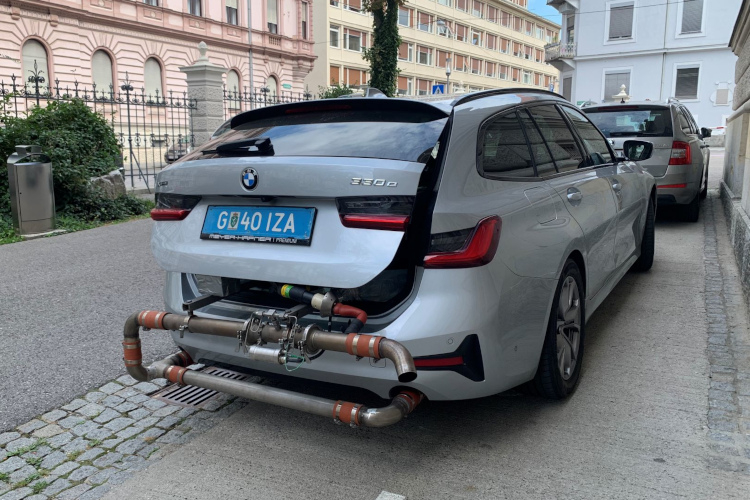
New tests show that both on urban and suburban roads, plug-in hybrids generate more pollution than declared. After road tests revealed that three models (BMW, Peugeot, and Renault) emit more CO2 than their manufacturers claim, it is high time to look at PHEV vehicles through the lens of their actual emission levels.
Plug-in hybrids are still presented as a climate-friendly solution. However, tests of the latest generation of PHEV vehicles show that they pollute significantly more than declared on urban and suburban routes. The organization Transport & Environment (T&E) demonstrated two years ago that the technology combining a battery and an internal combustion engine produces much more pollution on longer routes than promised. New tests confirm beyond any doubt that lawmakers should set vehicle taxes for PHEVs based on the actual level of pollution they generate and stop subsidizing their sales.
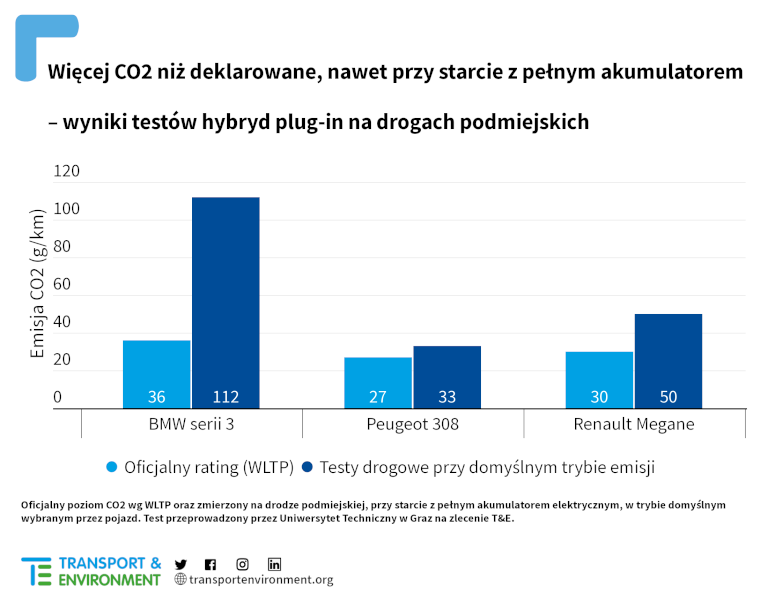
Field tests of three of the latest plug-in hybrid models – the BMW 3 Series, Peugeot 308, and Renault Megane – showed that each of them emits more CO2 while driving than their manufacturers declare, even when starting with a full battery. Tests conducted by the Graz University of Technology on behalf of T&E showed that the BMW, when driven on a typical suburban route, exceeded its official rating by as much as three times. The Peugeot 308 and Renault Megane plug-in hybrids achieved better results, but the level of pollution they generated was still 20% and 70% higher than declared, respectively – and this despite the relatively short distance covered (55 km).
During city driving, the Peugeot managed to cover just over half (53%) of its declared range on a single charge, and the BMW only 74%. Only in the case of the Renault Megane did the real-world range match the declared one. However, with a range of only 50 km on a single charge and no fast-charging capability, the potential for zero-emission driving for the Renault on European suburban routes will remain limited.
– Plug-in hybrids are promoted as the perfect combination of a battery car that meets all city driving needs and a combustion engine car for long trips. However, real-world tests show that this is a myth. In city tests, it is clear that only one PHEV car is able to cover the declared range on electric power, but on suburban terrain, all three models emit more than their manufacturers declare. Therefore, lawmakers should look at plug-in hybrids through the lens of their actual emissions – said Rafał Bajczuk, senior policy analyst at the Foundation for the Promotion of Electric Vehicles (FPPE).
BMW has introduced new geofencing technology, which is intended to automatically switch PHEV cars to zero-emission electric driving in cities. However, during tests in the city of Graz, the BMW 3 Series switched to the internal combustion engine twice. The tests also suggest that BMW saves battery usage outside of cities in case of entering virtually fenced areas. T&E argues that geofencing technology does not guarantee zero-emission driving in cities and potentially even threatens to increase CO2 emissions outside of these zones.
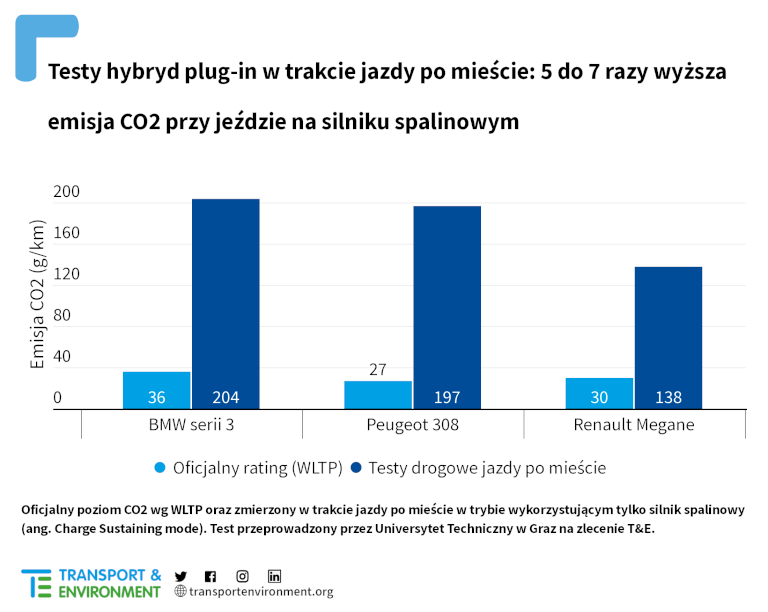
Company cars account for 71% of new plug-in hybrid sales, and studies show that they run on the engine for the vast majority of the time and are rarely charged. During tests with an empty battery, the BMW, Peugeot, and Renault emitted 5 to 7 times more CO2 on the road than declared. According to T&E, governments should cut subsidies for fleet plug-in hybrids and tax them based on the actual level of pollution generated.
– PHEV vehicles should not be treated as zero-emission, even if they have a geofencing system. Taxes on passenger and company plug-in hybrids should be set based on their actual reduced CO2 emissions. In Poland, hybrid cars are exempt from excise tax (0% instead of 3.1% and 9.3% instead of 18.6%). Such a policy is incomprehensible because we are supporting the purchase of cars that do not bring us closer to the goal of reducing CO2 emissions or becoming independent of oil. The government should stop subsidizing the purchase of PHEV vehicles and instead encourage the use of electric cars (BEVs), which are truly zero-emission – said Rafał Bajczuk.
More information: Report: Plug-in hybrids 2.0: A dangerous distraction, not a climate solution