









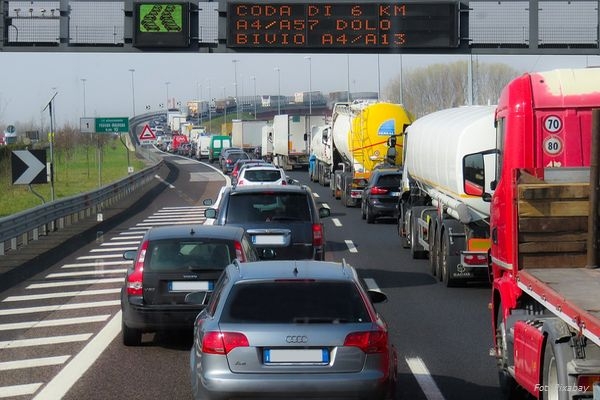
Last year, Poles made over 70 million trips, 80 percent of which were domestic trips, and the remainder were trips abroad1. Those who spent their holidays in Poland most often traveled by their own car. According to an SW Research report, nearly 70 percent of respondents chose this mode of transport. Everything indicates that it will be similar this year. If we add to this foreign tourists, who are coming to Poland for holidays in increasing numbers, and the traffic bans and restrictions related to ongoing renovations of national roads and motorways, Polish routes are becoming crowded and dangerous. Who might lose out on this? Professional drivers who cover hundreds of kilometers every day to deliver goods on time. What difficulties do truckers face during the holidays?
July and August are definitely the most intense holiday months for Poles, and the direction of travel is largely seaside resorts, the Polish mountains, or the Masurian Lake District. When choosing trips abroad, countries such as Croatia, Bulgaria, or Italy still often appear. What do these destinations have in common? The mode of transport, as Poles most often decide to travel by their own car, and the route, which often runs along a transit trail. The result? Increased traffic on the roads, traffic jams, and the loss of valuable time, which is particularly noticeable for the transport industry.
– The summer period, and in particular July and August, is an intense and stressful time for the Polish transport industry. There are significantly more cars on the roads, and people inexperienced in long journeys, who rarely or never travel by car on a daily basis, often take to the road. An additional challenge is foreign tourists, especially those from Western countries, who are increasingly willing to come to Poland for their holidays. These seemingly insignificant issues are of great importance to the industry, which has to deal with stagnation on main transit roads, the task of delivering cargo on time, and the intensification of traffic, and consequently, a greater number of potentially dangerous situations involving holiday, often inexperienced drivers – says Kamil Wolański, an expert at OCRK.
Renovations on holiday routes
The biggest problem concerns routes leading to holiday resorts on the Polish seaside. This includes, among others, the S6 expressway under construction, which is the most important route in Pomerania, connecting cities in Northern Poland from Szczecin to Gdańsk. At the same time, it serves as a connection for Polish seaports, as well as an access route to roads serving tourist areas in this region. The new route is intended to be a key change on the map of this region, and the travel time from Szczecin should be reduced by almost an hour. This route will enable transit traffic to be diverted from many towns located close to the DK6, while at the same time helping to clear traffic jams, especially during the summer period. However, before that happens, Polish drivers must still face road difficulties during these holidays.
– The A6 motorway is one of the most important national communication routes. It is part of a transport corridor that connects the Kaliningrad Oblast with Western Europe. For Polish carriers
from northern Poland, this is one of the main roads enabling the transport of goods to the West, to Germany. In the summer period, due to increased traffic and ongoing renovations, truckers have a real challenge to travel this route – explains Wolański.
Similar difficulties await Polish drivers on expressway No. 7, which is only expected to become the longest expressway in Poland in a few years, or on sections of the A1 motorway leading from the seaside to holiday resorts in the Polish mountains. Poles travel through there to foreign countries such as Croatia or Bulgaria. If we add to this the ongoing renovations on the Tuszyn – Piotrków Trybunalski section and the new traffic organization in force, travel in these areas can cause many problems.
Traffic jams on the route vs. tachograph
Polish transporters really dislike traffic jams on the road. Difficulties in transporting goods on time, delays, and often the associated penalties imposed on Polish carriers, or the subject of recording driving time and downtime using a tachograph are just a few of the problems that truckers have to face, especially in the summer months, when so-called traffic jams are an everyday occurrence.
– During holiday periods, a standard 400 km route, which usually takes about 4.5 hours at a speed of 90 km/h, is often covered by a driver with a 2-3 hour delay. A battle against time begins, on the one hand, to deliver the goods by a specific deadline, and on the other hand, not to exceed working hours, and also to correctly report downtime on the road – says the OCRK expert.
Race against time
We often wonder why trucks with cargo decide to overtake other heavy goods vehicles. If we take into account the 90 hours of work that drivers have at their disposal in two consecutive weeks, as well as the difference in speed between two vehicles, for example 3-6 km/h, it turns out that one of the carriers can lose from 270 to 540 km due to this difference – that is, from 3-6 hours of driving. Some can afford such a loss or are simply obliged to move at a speed of 84 km/h; for others, these few km can determine whether they return home on time or make up for the period when they were stuck in traffic jams.
During the day in the parking lot, at night on the road
Another difficulty that Polish carriers have to face is the truck traffic bans in force during the summer period throughout Europe. In Poland, every holiday Friday, vehicles with a permissible total weight exceeding 12 tons will not be able to move on the roads from 6:00 PM to 10:00 PM. On Saturdays, this ban will apply from 8:00 AM to 2:00 PM, while on Sundays from 8:00 AM to 10:00 PM. One should also remember about public holidays, such as the upcoming August 15th. The truck traffic ban is then in force from 8:00 AM to 10:00 PM, while on the day preceding the holiday – these vehicles cannot move from 6:00 PM to 10:00 PM. If drivers do not comply with the specified requirements, the carrier may pay a total fine of up to PLN 3,500.
– The most problematic from the industry’s point of view is not only the restriction on transport traffic but also the fatigue of the driver, who is forced to stay in the truck cabin during the day in the greatest heat, not always equipped with a functional air conditioning system. In such circumstances, drivers, tired by the extreme heat, set off on a night route. Perhaps it is worth considering a correction of existing bans so as to also minimize the danger of a road accident in this area – signals Kamil Wolański.
In Germany, the holiday ban is in force from July 1 to August 31 on certain motorways and federal roads. During this period, trucks cannot be driven on Saturdays from 7:00 AM to 8:00 PM. Traffic bans cover the entire road network also on all Sundays and public holidays from midnight to 10:00 PM. The restrictions apply to heavy goods vehicles with a permissible total weight of over 7.5 tons, as well as all cars with trailers, regardless of weight. Traffic bans in France, similar to Germany, apply to trucks and vehicle combinations with a GVW of over 7.5 tons. When traveling through this republic, one must take into account that the rule there is no possibility of driving on Saturdays from 10:00 PM and on the eve of a holiday – also from 10:00 PM until Sunday or the holiday until 10:00 PM, although there are also exceptions. In France, the next traffic restrictions will appear on August 14 and 15.
Holiday season, accident season
Holiday weather and high temperatures often lull drivers’ vigilance, and although from a statistical point of view it is better, because in recent years the number of serious road accidents involving trucks has decreased by almost half, this problem is still visible. It is estimated that every year there are about 26,000 road incidents on EU roads, of which 15 percent involve heavy goods vehicles. In Poland alone, according to data from the National Police Headquarters, truck drivers are the perpetrators of only 6.5 percent of all accidents. More than half of the accidents are caused by passenger car drivers.
Undoubtedly, the summer period is a challenge for the TSL industry, which must be prepared for possible traffic difficulties, bans, and restrictions occurring not only on Polish but also on foreign roads. Renovations and reconstruction of road infrastructure are intended to improve movement on routes and eliminate congestion in critical places on the map of Poland.
1 GUS, Tourism in Poland 2018.