









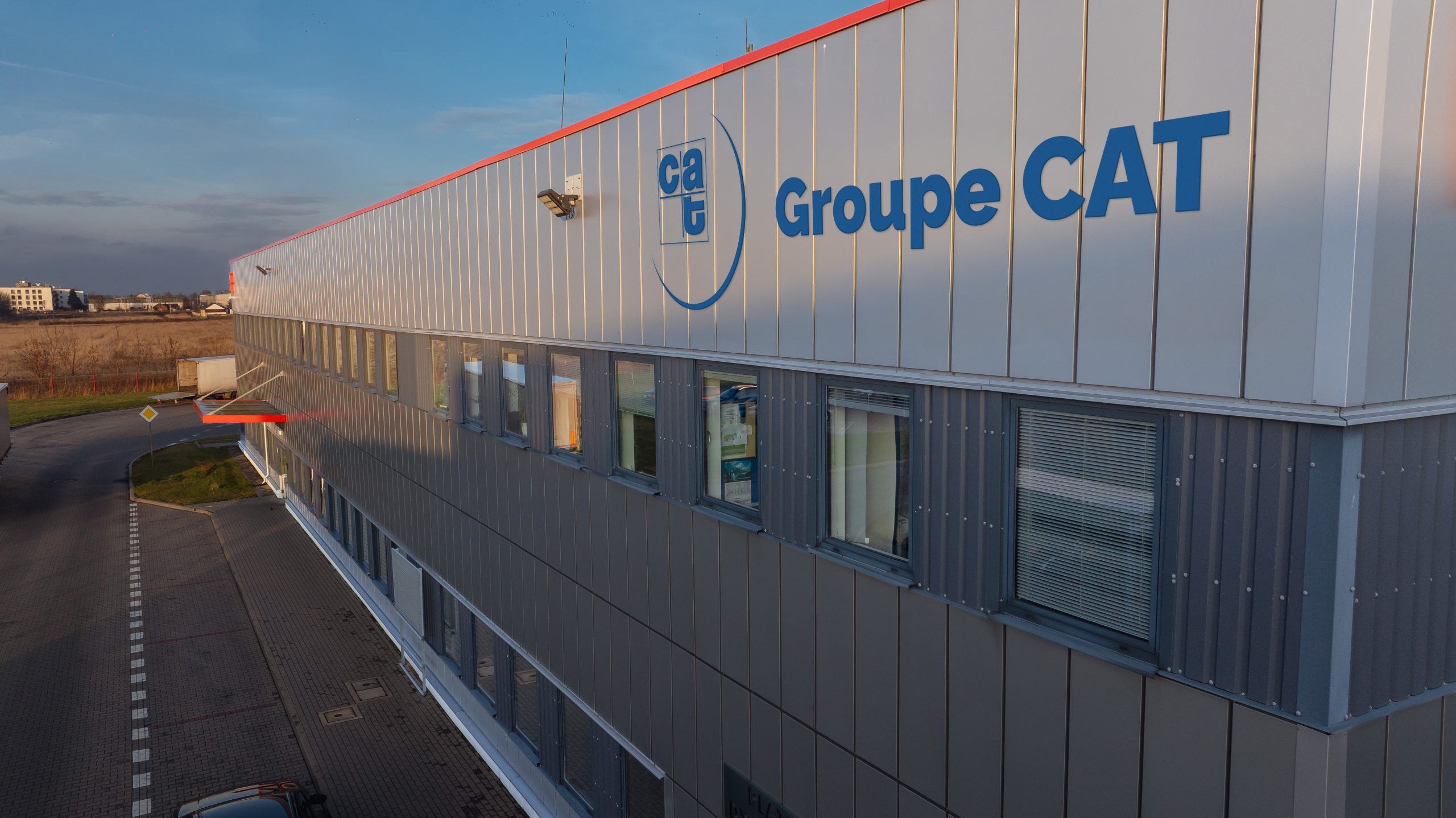
Groupe CAT, one of the leading logistics operators in Europe, has successfully completed the implementation of the Hardis WMS warehouse management system provided by Hardis Supply Chain. The new solution has allowed the company to significantly increase operational efficiency, shorten the onboarding time for new clients, and optimize logistics process costs.
Thanks to the standardization and digitization of key warehouse processes, Groupe CAT has gained greater flexibility in serving diverse industries and is better prepared for further expansion in European markets.
Comprehensive warehouse management in a new standard
The implemented Hardis WMS system is a modern tool for comprehensive management of goods movement – from receiving, through storage, to shipping. The software also enables real-time monitoring and optimization of processes, inventory management, integration with transport management systems (TMS), and automation of operations. Thanks to LMS functions, it also supports employee management and allows for full personalization without the need for advanced IT knowledge.
We have a powerful tool that standardizes warehouse processes across the entire Groupe CAT and communication with external systems, including our TMS. This allows us to efficiently serve various industries – from e-commerce warehouses to FMCG. – emphasizes Dariusz Zaleś, Warehouse Department Manager at CAT LC Polska.
Process standardization and greater autonomy
The decision to implement Hardis WMS was a strategic step in the development of Groupe CAT. Previous local systems in individual countries required costly and time-consuming adaptations when serving new clients. The goal of the new solution was to create a single, integrated tool that would enable rapid process adaptation, lower integration costs, and greater autonomy for local teams.
As part of the project, a so-called Core Model was developed – a universal standard for warehouse processes that can be easily implemented in subsequent locations and for new clients. As a result, the implementation in Spain, which followed the pilot in Poland, took only 8 weeks.
Implementation process – from workshops to team self-sufficiency
The first “Go live” of the project took place in May 2025. The process was carried out in accordance with the RIM (Reflex Integration Methodology), covering four main stages: design, implementation, testing, and launch.
A key part of the implementation was workshops involving Groupe CAT and Hardis Supply Chain teams, which allowed for the system to be adapted to the specifics of the Automotive Spare Parts industry – characterized by high order dynamics, a large variety of stock-keeping units (SKUs), and the need for rapid component availability.
An important element of the project was also a training model based on the “train the trainer” formula, which allowed the operational team to quickly achieve self-sufficiency and reduce the number of errors in the initial phase of working with the new system.
Business benefits and development plans
The implementation of Hardis WMS enabled more efficient adaptation of new clients in terms of time and cost, and also provided a foundation for further digitization of Groupe CAT’s warehouse operations. Thanks to the experience gained after launching the system in Poland, the company also implemented the system in Spain and France – in just 6 months across 7 locations, and it also plans to integrate it with the logistics processes of other industries. Experts from the Polish Hardis Supply Chain team were involved in each of the completed implementations.
Our goal was to provide a solution that not only improves daily operations but also opens up new development opportunities for Groupe CAT. Hardis WMS provides flexibility, scalability, and full visibility of processes – these are key elements of modern contract logistics. – says Łukasz Kaczor, Hardis WMS Consultant, Hardis Supply Chain
By the end of Q1 2026, CAT Groupe will implement Hardis WMS in 2 more locations. In the coming years, Groupe CAT also intends to connect the system with warehouse automation, which will allow for further resource optimization and even more effective use of warehouse space.
Source: Hardis Supply Chain