









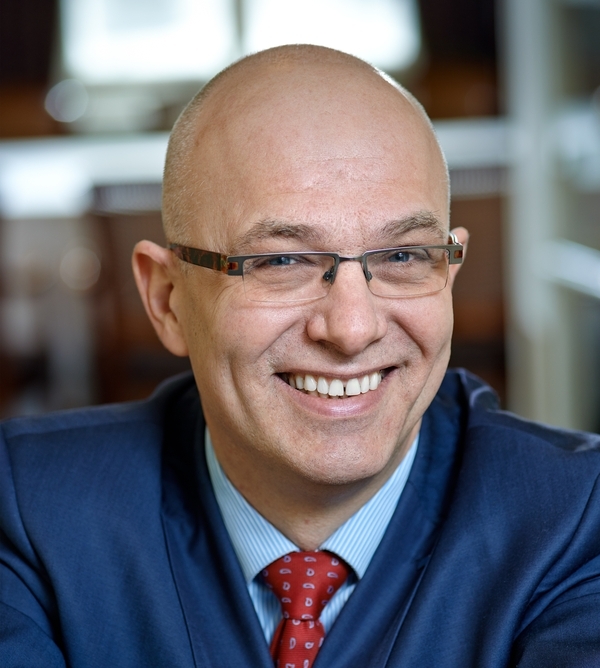
In today’s world, where one decade brings as much progress as several decades used to, we do not know what the future will look like, but it is certain that tomorrow will be completely different from today. If change is the only certainty, organizations must be flexible enough to use these changes – in the economy, social habits, and technologies – for their business goals. We invite you to read an interview with Grzegorz Lichocik, CEO of Dachser in Poland, conducted by Marta Szymborska, Head of Communications, PR and CSR at GS1 Poland.*
Marta Szymborska: This year you are celebrating your 10th anniversary at Dachser. A lot has changed in logistics during this time. In your opinion, what were the key changes?
Grzegorz Lichocik: There is a great deal that differentiates today’s logistics from that of ten years ago. The key factor that accelerated the development of the logistics industry was Poland’s accession to the European Union and entry into the Schengen Area. On one hand, cross-border traffic and trade were liberalized, and on the other, the level of investment by foreign companies in Poland increased significantly. Many global manufacturing corporations moved their factories to us, and with them came the demand for logistics and warehousing services. Poland became an ideal place to build regional distribution centers due to our large internal market and excellent location for distribution to other countries that joined the EU with us. Our country’s location is also the last stable and safe stop on the way to the East. At the same time, the logistics industry benefited greatly from the highway construction program, the accelerated implementation of which we also owe to our EU accession and Euro 2012. What is worrying is the current halt in the previous growth momentum in this regard. Our economy, including logistics, of course, is closely linked to the single market. Since joining the EU, our exports have quadrupled, and over 80% of our products go to EU markets.
Another impulse for the development of logistics was provided by digitalization and the spread of Internet access, which had and continues to have many consequences, such as the revolution in trade and changes in the supply chain. On one hand, the growing e-commerce industry opened up the prospect of foreign expansion for Polish companies, and on the other, it changed the role of traditional stores, which is well illustrated by the example of trade in high-volume products such as furniture, household appliances, or consumer electronics. The digital revolution in trade also goes hand in hand with technological changes in logistics companies themselves. The contribution of IT systems to logistics operations has never been as great as it is now, and I don’t think it will be a revelation if I say that this process will continue. At the same time, along with the changes that give logistics an increasing influence on companies’ operations and their business results, I also observe a gradual increase in its position in company structures. Logistics accounts for anywhere from a few to several dozen percent of a product’s price. Increasing supply chain efficiency and improving delivery times and reliability affect how a company is perceived by its customers. Therefore, departments coordinating logistics are undoubtedly gaining importance, especially compared to the standards that applied even ten years ago.
M.S.: New media and startups have changed the business reality. What should be done to avoid becoming the “Kodak of logistics”? Is there a chance to be the “Snapchat of TSL”?
G.L.: In today’s world, where one decade brings as much progress as several decades used to, we do not know what the future will look like, but it is certain that tomorrow will be completely different from today. If change is the only certainty, organizations must be flexible enough to use these changes – in the economy, social habits, and technologies – for their business goals. By perceiving them as an opportunity, companies have the chance to become leaders, even in markets that might seem to have been divided long ago. Of course, a change in attitude alone is not enough. It is necessary to dedicate a portion of the company’s resources to actively searching for new solutions, and in a long-term perspective. Given the degree of digitalization of today’s economy, this process will largely be based on the use of modern IT tools. This is exactly how it is at Dachser – advanced IT systems have been the foundation of all the group’s activities for many years. Today everyone is talking about digitalization – we at Dachser have had it for a long time. Most of our data is digital. If any documents (for example, accounting documents) must exist in paper form, they are still transferred by us to the digital world. Changes in this regard in our company do not happen in leaps, but are a constant element of everyday life. However, this does not mean that our relationships with customers are also virtual. Here we remain conservative and value direct contact very highly. This does not, however, eliminate the transfer of data and information needed by customers in digital form. The importance of the digitalization area is perhaps best illustrated by the fact that the Dachser IT team consists of over a thousand people, and 200 IT specialists are responsible for the development of systems for the group’s needs alone.
M.S.: Dachser is a family-owned company. What distinguishes such organizations from others, for example, typical corporations?
G.L.: Being a family-owned company translates into values that create our organizational and business culture. These are reflected primarily in our relationships with employees. We strive, successfully I believe, to make Dachser an open, friendly company where partnership relations are promoted and where a work-life balance is respected. On the other hand, we are a company that values the entrepreneurship of its employees. After all, Dachser is the realization of such commitment. The company, which is a global corporation today, started as a small local enterprise. The Dachser family also supports its employees in need, and in the event of difficult life situations, they can always count on the owners’ help. The owners understand very well that their success is the result of our employees’ work.
M.S.: What do customers value in working with Dachser?
G.L.: Dachser specializes in handling exports and international shipments, so by working with our company, customers primarily gain the opportunity for foreign expansion. Thanks to the densest network of connections in Europe and a large number of direct connections, we are able to ensure efficient delivery of goods – to neighboring countries in the same time standard as domestic shipments, to Italy within 48 hours, and to distant places like Spain – in as little as 3 days. At the same time, in all areas of our activity, with particular emphasis on customer relations, we pay attention to quality. This refers to the work of the team, IT, processes, the way work is organized in terminals and warehouses, the quality of transport connection networks, shipment safety, etc. The result? As many as 98% of the loads we handle reach their destination on time, regardless of whether it is a delivery to a neighboring country or to the other end of the continent… Attention to quality is deeply rooted in the corporate culture of the Dachser group, and our headquarters gives us the tools and motivates us to operate at the highest standards. Customer feedback is one of the elements determining the assessment of each of our branches and their place in the group’s internal rankings.
M.S.: Dachser uses and promotes logistics standards, including barcodes. What benefits do they bring to a TSL industry company and its customers?
G.L.: Introducing standards such as GS1 barcodes, with which we mark every transport package by giving it a unique number in the system, or a single consignment number for a shipment throughout the entire route, are – to say it without false modesty – milestones in our industry. By the way, a single number for a shipment is still a rarity in the industry so far. Besides us, only one other operator in Europe meets this standard. For a logistics company, such innovations provide a competitive advantage – we give customers something that others do not have. For customers, in turn, it also means a number of benefits that ultimately translate into better service, faster delivery, greater safety of shipped goods, certainty of meeting their obligations to contractors, and consequently – a better business result.
M.S.: Same-day delivery, drones, and unmanned trucks are no longer terms from science fiction novels. In your opinion, what will the next 10 years look like in the TSL industry?
G.L.: I expect that many changes in logistics will be related to ecology and the need to adapt business to changing conditions in this area. This means both using alternative energy sources in transport and organizing logistics processes differently – both on routes and in metropolises. The Dachser R&D segment has also been testing the possibility of implementing new solutions for some time. Examples include ideas such as photovoltaic panels on trailer roofs, the use of electric delivery vans, and electric cargo bikes in urban logistics. Customers are looking for a stable place for development, where neither the ruling party nor the opposition thinks about leaving the European Union, but rather will follow its mainstream.
Some of the future challenges will certainly be related to the further evolution of trade caused by widespread Internet access. On the other hand, we are observing local actions in an increasing number of cities that limit free access even for the delivery of goods. We will certainly continue to move in the direction of the growing requirements of customers who will expect delivery of a product immediately after purchase. The entry of logistics into the era of the fourth industrial revolution will, of course, be inextricably linked to the further development of innovative IT tools, including systems for advanced data analytics. On the other hand, coming down to a more practical and quite close ground – a big change for logistics operations in Europe will be Brexit. We are observing increasing interest from businesses in the UK in moving to Europe. These customers are looking for a stable place for development, where neither the ruling party nor the opposition thinks about leaving the European Union, but rather will follow its mainstream. For business, the Union is an integral organism that is one of the strongest economies. To tell the truth, I am sure that automation and autonomous distribution solutions will appear in our daily lives quite quickly. If only we do not fund ourselves at the same time with political changes that will set us back to the 19th century, and looking at our big and small local politics, we are just at a crossroads. I would like to believe that we will not waste our, after all, difficult and full of sacrifices, development of the last 28 years for the particular needs of a more active minority.
M.S.: Thank you for the conversation.
* The interview was also published in the magazine Logistyka (issue 3/2017).