








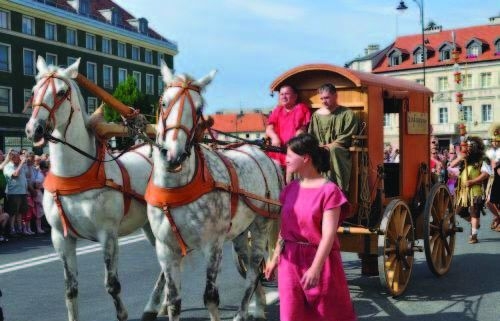
Means and infrastructure of transport
At its peak, the Roman Empire covered a territory of 3.5 million square kilometers, inhabited by approximately 100 million people. On the paved roads spanning the entire state, various means of transport were used, differing in construction and purpose (Table 1).
Road construction began by marking out straight sections, indicated on both sides by furrows. Then, the topsoil was removed down to the bedrock layer. On top of this, layers were laid sequentially: stones bonded with clay (about 30 – 60 cm), then crushed rock, brick, and pebbles (about 20 cm), followed by sand or gravel, which was compacted (about 30 – 50 cm), and finally a uniform, smooth surface made of stone slabs or evenly spread gravel (about 20 – 30 cm). The incredible durability of Roman roads was the result of the thickness of the layers (1.0 – 1.6 m) and a construction that naturally disposed of excess water, namely by having a higher central part and side ditches for rainwater.
A breakthrough in bridge construction was the use of cement, iron, and lead to consolidate the structure. The bridge surface (3 – 19 m wide) was generally made of stone blocks and had lanes designated for wheeled and pedestrian traffic, secured by a balustrade. The arch method borrowed from the Etruscans increased the strength of their structures.
Transport problems
The rapid development of land transport infrastructure and the establishment of military camps and colonies on the frontiers of the Empire opened up new trade markets. However, this did not lead to breakthrough consequences for the development of production and trade due to the high costs and limited capabilities of land transport. Cato calculated that each day of transporting an olive press (weighing about 1.8 tons) by an ox-drawn wagon caused its cost to increase by 2.5%. It was therefore more profitable to move the entire workshop than to produce goods intended for distant markets in the original location.
Land transport was slow and cumbersome. Horses would suffocate because the harness of the time went around the animal’s neck, compressing its trachea. The road surface was not suitable for horses, which were not shod at the time. Only later were leather hoof boots introduced. Two horses or mules could pull up to 0.5 tons of cargo on a wagon in such a harness. Oxen in a team performed better, but they moved at a speed of only about 3 km/h.
The article comes from the magazine “Logistyka” 3/2012.