








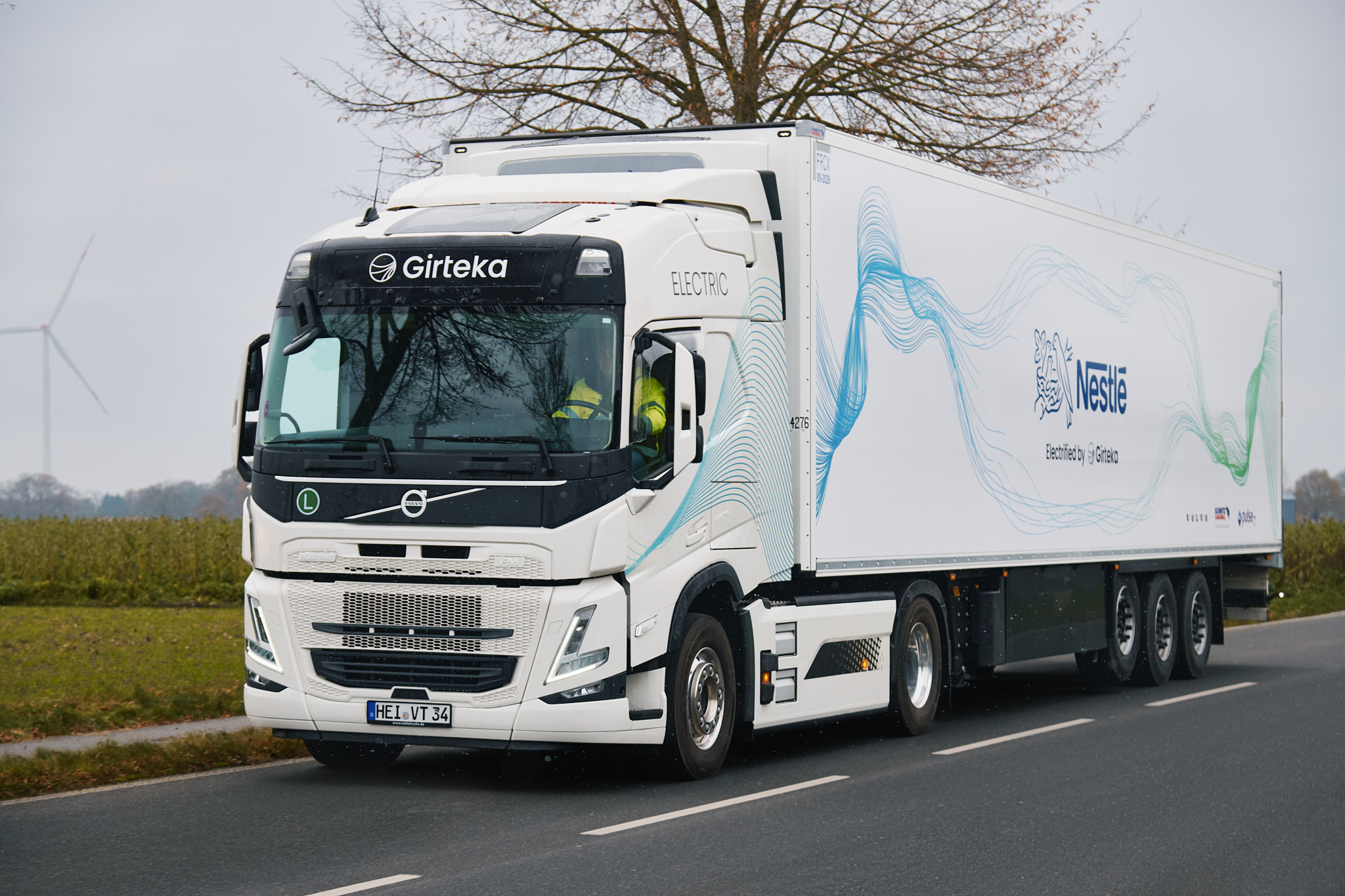
In response to environmental challenges, the logistics industry continues to seek sustainable solutions. The use of electric heavy-duty vehicles along with semi-trailers is essential here. As part of a joint initiative, Girteka and Nestle, Volvo, Schmitz Cargobull, and BP Pulse have conducted the first tests of a fully electrified truck combination – a tractor with a semi-trailer for short-haul deliveries. Now, the companies are sharing their findings.
The role of electric heavy-duty vehicles and semi-trailers in sustainable transport
In the pursuit of sustainable logistics, one of the most frequently mentioned solutions is the use of electric vehicles and semi-trailers. “Facing the most important challenges of today’s world, one of them particularly concerns logistics – it is decarbonization. Here, electric vehicles (BEVs – Battery Electric Vehicles) supported by electric semi-trailers may prove to be one of the solutions,” says Viktorija Terekė, Head of Sustainability at Girteka. The goal of the latest joint initiative by Nestle, Girteka, Volvo, Schmitz Cargobull, and BP Pulse is to test fully electric solutions for short-haul deliveries.
The initiative represents a key step towards zero-emission logistics, thereby highlighting the impact that the activities of industry leaders have on the environment. As Harry Baxter, EV Fleet Sales Director at BP Pulse in Europe, says: When it comes to e-mobility as a solution, we see that about 25% of global emissions come from transport. The fact that electric vehicles do not emit pollutants from the exhaust pipe makes them an obvious choice.
The discussion about where and how BEVs can be used is still ongoing. In the meantime, many companies are already conducting tests and trying to find a solution that combines customer needs, manufacturer capabilities, infrastructure availability, and enables logistics companies to coordinate and integrate key stakeholders.
– The path to decarbonization cannot be traveled alone. It requires an unprecedented level of cooperation – emphasizes Viktorija Terekė.
Challenges and advanced solutions
The use of electric vehicles and semi-trailers in road transport involves many challenges, especially in terms of infrastructure and technology. These are the subject of discussions held both during and after the tests. A key aspect of this transformation is infrastructure. A particularly urgent need is the necessity to build charging stations and service centers for electric and alternative fuel-powered vehicles.
In turn, Mathias Fleischer, Supply Chain Director at Nestle, points to the progress and obstacles in the development of electric transport – Electric transport has come a long way if we look back over the years to today. Currently, we can achieve ranges of up to 250 and 300 kilometers, significantly more than years ago. However, we still need to improve the charging infrastructure. We need to find a way to optimize charging and how to best utilize the vehicle’s payload.
The potential for the development of electromobility is also provided by today’s organization of goods transport.
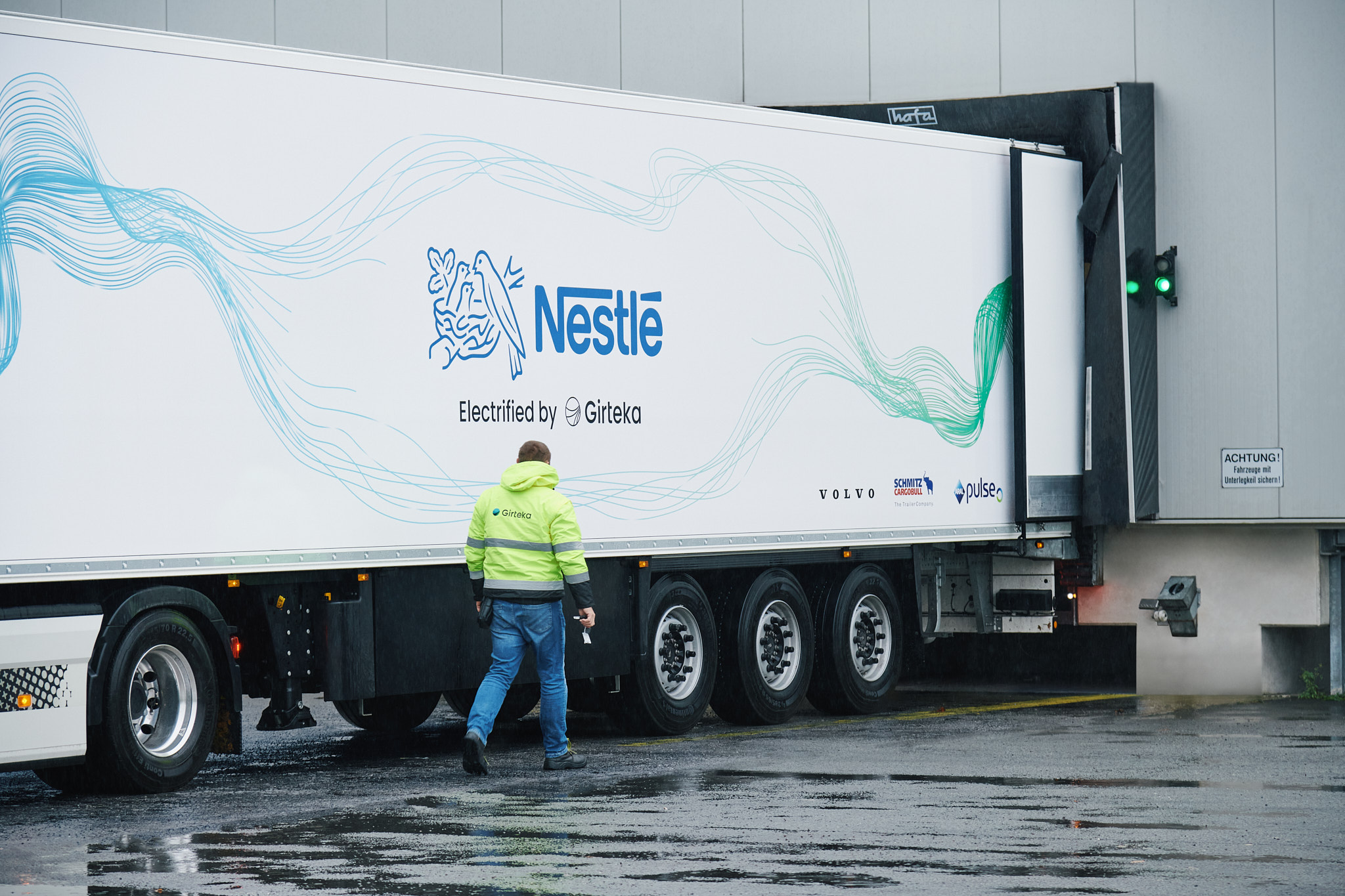
– If we look at all goods transported in Europe, 45% of them are moved over a distance of less than 300 km per day. This is also a range that we can easily handle today without charging. If we recharge, the range will increase significantly. As a result, we already have examples of our trucks traveling up to 640 km per day, with additional charging during the day. Charging from 0 to 80% takes 90 minutes, but in many cases, they only charge from 30 to 80% during the day. Which means it can be done during a scheduled 45-minute break – says Stefan Widlund, Electromobility Director at Volvo Trucks.
– The path to an extensive and efficient EV charging network is paved by cooperation – involving industries, innovators, and policymakers. Through strategic partnerships like this one, we are responding to the immediate need to launch more charging stations. We are building an extensive network of high-power charging stations. Trucks with 40-ton semi-trailers can pass through these bays without the need to disconnect them. This does not extend the downtime associated with disconnecting the semi-trailer and leaving it in an unsecured location. This makes operations much smoother and safer. The network also provides truck operators with flexibility and the certainty that they have access to charging. The second aspect is convenience. Not only charging in convenient locations but also providing comfortable options for drivers – explains Harry Baxter, BP Pulse.
A vision for the future of sustainable transport
Joint efforts to use BEVs and e-trailers are not limited to solving current challenges. It is not only infrastructure that is important, but also the opportunities provided by today’s solutions and their cost-effectiveness.
– Currently, the costs of electromobility are largely dependent on battery costs. The biggest question mark in any business is how much I have to invest in relation to what the result will be. If freight forwarders are not willing to pay more because goods are transported in an electric refrigerated trailer, then the situation becomes critical. Profitability must come from the operation itself. That is why we decided to reduce the battery capacity. It can guarantee safe operation for a minimum of 5 hours, but it does not cost as much as a larger battery set, which also reduces payload, where economics are key – explains Boris Billich, CSO at Schmitz Cargobull.
Despite the challenges associated with the partnership, as in this case, the use of electrified truck combinations can be one of the solutions that will allow for the achievement of ambitious goals. “Electric trucks have many advantages, many positive aspects. We don’t have diesel, we don’t have CO2, and the noise level is much lower than before. It is obvious as soon as we implement this technology. This is the best way we can move forward. It is important,” concludes Mathias Fleischer, Nestle.
The cooperation of partners such as Nestle, Volvo, Schmitz Cargobull, BP Pulse, and Girteka is crucial for the project. The involvement of different and at the same time complementary companies emphasizes the need for joint action.
– Open dialogue is fundamental to this cooperation. It ensures that all parties, from a global leader in the food and beverage industry like Nestle, to a pioneer in automotive and heavy transport like Volvo, an expert in semi-trailer production like Schmitz Cargobull, to energy specialists like BP Pulse and logistics service providers, are on the same page – concludes Viktorija Terekė.
Source: Girteka Group