








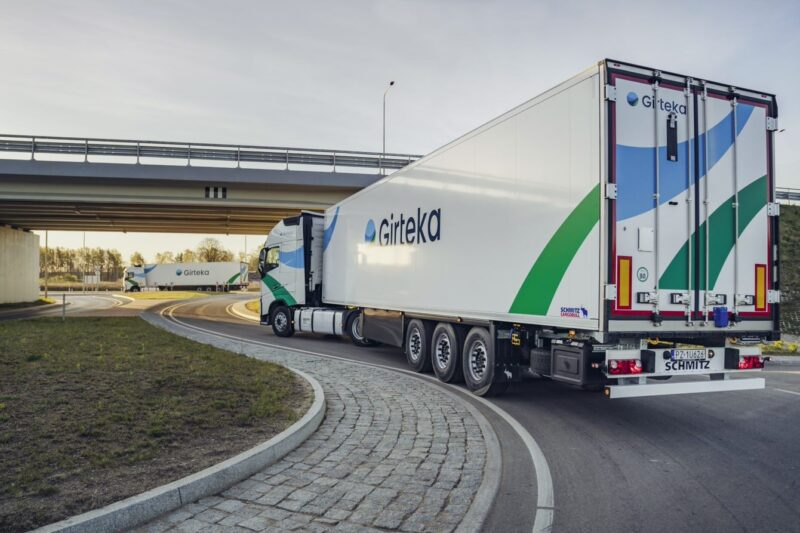
Cold chain logistics is one of the most complex and challenging areas of operation for road transport companies. Cargo that requires transport in refrigerated trailers (pharmaceuticals and food products) is highly sensitive to temperature changes, which is particularly significant during the summer season. What requirements must a road carrier meet, and what is shaping the future of cold chain logistics? Girteka, a leading European road carrier that has been organizing deliveries and preparing dedicated logistics solutions for food producers and major pharmaceutical companies for 27 years, answers this question.
Specialization, a modern fleet, and technology are the foundation
Cold supply chains are primarily used in the transport of pharmaceutical products. In the EU, if a transport company wants to participate in pharmaceutical supply chains, it must obtain appropriate certifications, such as Good Distribution Practice (GDP). In September 2021, Girteka passed the GDP audit for the fifth time with a score of 96.45%. This confirms that the company transports pharmaceutical products while maintaining the highest quality, possesses an appropriate fleet, and adheres to standards compliant with GDP requirements, including real-time temperature monitoring and an SOS emergency center.
Effective data recording is essential here, as it facilitates temperature monitoring and the receipt of feedback. This is supported by advanced Internet of Things (IoT) technologies, as well as mobile and cloud-based data analytics. Girteka utilizes artificial intelligence (AI)-based solutions for cold supply chains. When implementing them, it follows specific guidelines. First and foremost is reliable Real-Time Visibility (RTV). Thanks to this, customers can not only monitor the movement of goods but also plan warehouse capacity, ensuring the unloading of goods immediately upon the vehicle’s arrival. Furthermore, real-time temperature monitoring allows for the tracking of any deviations by both transport managers and customers, which facilitates taking actions to prevent cargo damage.
Changes in food cold supply chains
The European Union is the second-largest market for chilled and frozen food products, with an annual consumption of 11 million tons. This requires road carriers to apply non-standard solutions, especially when organizing the transport of goods with a short shelf life. Until recently, the main problem in cold supply chains was the lack of control over the processing of agricultural products and food. As a result of experiences related to the pandemic and the impact of the Russian invasion of Ukraine on global food supplies, work is currently underway in the EU to introduce solutions such as the “Farm to Fork” strategy or the CHILL-ON project, which will increase safety while making food supply chains more resilient and shorter, eliminating the risks of downtime. Their effects will be crucial for the further development of this segment of road transport services.
Climate change is important for the future
Climate change also has a key impact on cold supply chains in the short and long term, including in practical terms. According to a report by Transport Intelligence (TI), Upply, and the International Road Union on the development of road transport in Europe, weather changes (rising temperatures) affect the supply of food products and, consequently, translate into demand for road transport and its rates. In the context of climate change, there is also talk of shifting food production to the north, while the south of Europe, for example, may experience increasingly severe droughts. This will change the organization of the distribution of certain goods.
Transport companies will have to make appropriate investments in suitable eco-friendly actions so that the transport of goods requiring refrigerated conditions is carried out in a sustainable and environmentally friendly manner. This also means that the low rates for refrigerated transport, which until recently did not differ much from standard freight, are long gone.
Source: Girteka/PRlogistics