








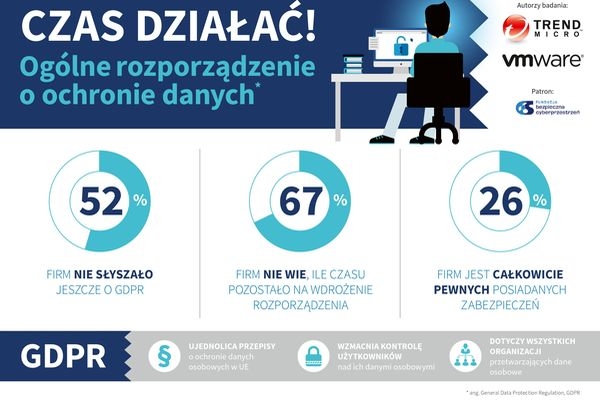
On May 25, 2018, new regulations regarding the protection of personal data of European Union residents will come into force. The GDPR (General Data Protection Regulation) will force changes in the rules for recording, storing, processing, and sharing the data of all natural persons. Consequently, all entities that process such data – not only large corporations but also small enterprises (e.g., online stores and other companies serving individual customers) – must implement appropriate technologies to adapt to the new requirements. Otherwise, they may be subject to heavy financial penalties.
Trend Micro and VMware, in cooperation with the research agency ARC Rynek i Opinia, have developed a report presenting the state of preparedness of Polish entrepreneurs for the introduction of the EU data protection regulation. The results of the study show that more than half of the respondents (52%) have not yet heard of the GDPR, and as many as 67% of entrepreneurs do not know how much time is left until the implementation of the new regulations. Many of those surveyed are unaware that the new regulation applies to all companies – regardless of size, including micro-enterprises and sole proprietorships.
The GDPR regulation applies to every entrepreneur processing personal data – it imposes an obligation on all companies to implement appropriate technical and organizational measures. The EU regulations will come into force in just over a year, so there is less and less time for changes.
In the area of personal data protection in Poland, no significant changes for entrepreneurs have been introduced for a long time – the Act on the Protection of Personal Data of August 29, 1997, remains in force. Its compliance is overseen by the GIODO (Inspector General for Personal Data Protection), an office authorized, among other things, to audit the compliance of data processing with the Act or to handle complaints regarding failures to comply with the regulations.
The General Data Protection Regulation (GDPR) is an attempt to unify the regulations protecting the data of over 500 million EU citizens. The legal act, in addition to changing formal requirements, brings with it a series of changes in the area of company operations – the way of recording, storing, processing, and sharing data of both customers and employees. The reform will introduce restrictive requirements for obtaining consent for data processing, grant citizens the right to be forgotten (to have data deleted), impose a requirement on enterprises to report all breaches within a maximum of 72 hours of detecting an incident, and introduce a comprehensive definition of data.
The GDPR regulation provides for financial penalties for violating the applicable regulations – in the case of, for example, a violation of the basic principles of processing, such as the conditions for expressing consent, penalties can reach up to 4% of a company’s annual turnover. For other violations specified in the legal act, the penalties amount to a maximum of 2% of the enterprise’s total turnover.
All companies that process personal data must take appropriate steps as soon as possible to ensure compliance with the GDPR act. The sooner entrepreneurs begin to adapt to the new directive, the more surely they will avoid high financial penalties for potential oversights.
Entrepreneurs must familiarize themselves with the current data processing system in the company – whose data is available in the system, where and how it is stored, and who has access to it. Based on the knowledge gained, a cybersecurity strategy and a data breach notification plan should be developed so that in the event of an incident, one can act quickly and efficiently, limiting damage to the company.
The full report from the study conducted on behalf of Trend Micro and VMware can be downloaded at: http://www.trendmicro.pl/enterprise/data-protection/eu-regulation/