








Fossil gas is still mistakenly perceived as an alternative, low-emission fuel that is cleaner than coal and oil. Over the last decade, the narrative regarding the usefulness of gas as a transition fuel has gained momentum rapidly. Investments in gas infrastructure and vehicles in the transport sector have also been growing.
In 2019, only a dozen or so new vehicles over 3.5 t powered by gas were registered in Poland; in 2020, the number of new gas trucks rose to over 600, and in 2021 it reached 1,346, and counting used vehicles, there are over 1,400 of them. However, the first half of 2022 brought a decline in registrations to 330 vehicles. Definitely fewer, but is it still not too many?
Poland imports about ¾ of the gas it consumes. Russia’s attack on Ukraine, the decisions of most EU countries to end gas imports from Russia, and the sharp rise in fuel prices show that choosing gas does not ensure stability and low costs. Rapidly reducing the demand for gas would increase the country’s energy security and sovereignty.
Some entities using gas have already started looking for alternative fuels and energy sources, but some only want to change the source of the raw material, importing it from other countries. The belief that gas can be part of the solution to the climate crisis and improve air quality still persists. Nothing could be further from the truth.
Does investing in gas-powered heavy transport and infrastructure still make sense?
Before making a decision to invest in gas vehicles and infrastructure, it is worth considering a few facts:
- By replacing diesel vehicles with gas ones, we are changing one fossil fuel for another. Scientists have no doubt that it is necessary to move away from all such fuels, including gas.
- We do not have time for transitional solutions. Our carbon budget is simply too small to switch first from oil to gas, and later from gas to electricity from renewable sources. The more effort and resources we put into the “transition phase”, the longer it will be and the later we will achieve climate neutrality.
- Manufacturers of gas vehicles and gas sellers argue that CO2 emissions from gas-powered trucks can be 15-20% lower compared to Euro 6 diesel vehicles. Even if this were the case, from the point of view of striving for climate neutrality, this is not a sufficient reduction.
- Moreover, the results of such comparisons differ depending on which trucks are tested, how, and on what routes. There are studies comparing CO2 emissions of vehicles of the same class under road conditions based on fuel consumption, showing that the actual reduction may be much smaller than manufacturers declare.
- The use of fossil gas is associated with emissions not only of carbon dioxide (CO2), but also of methane (CH4), which is much less abundant in the atmosphere than CO2 and stays in the atmosphere for a shorter time, but is also a more potent greenhouse gas affecting the climate. In the first 20 years after emission, the impact of its molecules is about 86 times greater, and over 100 years – 34 times greater. Stopping methane emissions can bring quick results and provide a little more time to deal with excess CO2, which is confirmed by the latest report of the Intergovernmental Panel on Climate Change (IPCC).
- When estimating emissions over the entire life cycle of fossil gas, we must take into account methane leakage during extraction, processing, and transport of the fuel. In this regard, there is a lack of reliable data. Those provided by companies are estimates and are often understated. According to the International Energy Agency (IEA), reported methane emissions from anthropogenic sources, especially from the energy and fuel sector, are deeply underestimated. There are studies comparing total life-cycle greenhouse gas emissions of LNG and diesel trucks showing that in the first 20 years, LNG vehicles are significantly worse than diesels due to the strong short-term impact of methane on the climate.
How do gas-powered trucks affect air quality?
Gas trucks pollute the air. Independent tests of gas and diesel-powered vehicles meeting the Euro 6 standard, tested under real road conditions, showed that on routes connecting urban roads, regional roads, and highways, the three tested LNG trucks emit 2 to 5 times more toxic NOx than the diesel truck with the lowest result in the test. Road tests also prove that switching to gas does not reduce particulate matter emissions.
What about biogas?
The assumption that it is worth investing in vehicles and infrastructure because fossil gas can be replaced by biogas is wrong. Using biogas on a scale larger than a few percent in road freight transport is unlikely because it will not be possible to produce enough biogas in a sustainable way without losing biodiversity, food production potential, and the ability of ecosystems to absorb CO2. The biogas we produce in a sustainable way will be more needed in air and sea transport.
Also from the point of view of air quality, switching to biogas will not help, because it has a chemical composition and properties similar to fossil gas, and its combustion generates similar pollutants.
Zero-emission solutions are available
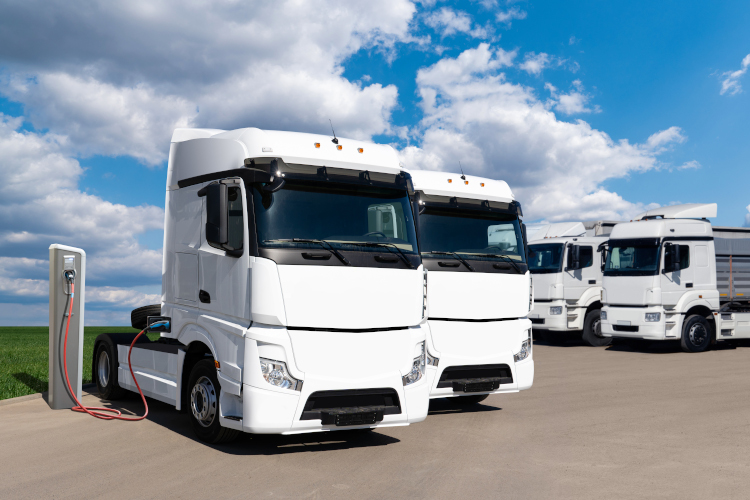
We do not need a transitional solution. We are ready for zero-emission solutions. We can gradually switch to electric trucks, which are already starting to be available on the market. Many companies are investing in technology development. The quality of batteries is constantly improving – capacity is increasing, and weight is decreasing. The range of vehicles is gradually increasing, and charging time is shortening thanks to the increasing efficiency of chargers. It is necessary to continue work on reducing the environmental impact of battery production and developing their recycling, as well as a gradual transition to energy from renewable sources – solutions in this regard already exist.
Although most zero-emission heavy-duty vehicles (HDVs) sold over the last decade are electric buses, the share of zero-emission trucks is increasing. In 2020, trucks accounted for 40% of all new zero-emission HDV registrations, compared to just 20% in 2017. More than 75% of all zero-emission trucks in Europe are used in countries such as Germany, France, and the Netherlands, but they are also starting to appear in others, including Poland.
Truck manufacturers announce that by 2025, 4-9% of the trucks they sell will be zero-emission. In 2023, more than 60 models of Battery Electric Trucks (BET) are to be introduced to the market. The first such vehicles with a range of 500 km are to be available in 2024.
The purchase cost of electric vehicles is relatively high compared to combustion trucks, but forecasts regarding the total cost of ownership (TCO) of trucks >16 tons with different types of drive are promising. It is highly probable that by 2025, battery-powered trucks will become economically competitive compared to conventional vehicles of this type.
Poland has the largest fleet of trucks in Europe and is a leader in international road freight transport in the EU. For this to remain the case, the industry must follow European trends, such as the pursuit of climate neutrality, and remain flexible in responding to changing circumstances. Recently, carriers have been facing many new challenges – the economic effects of the pandemic and the war, the shortage of drivers, and the sharp rise in fuel prices. In this context, caution is all the more advisable when making investment decisions that may have long-term consequences.
Source: Polish Ecological Club – Mazovian District