








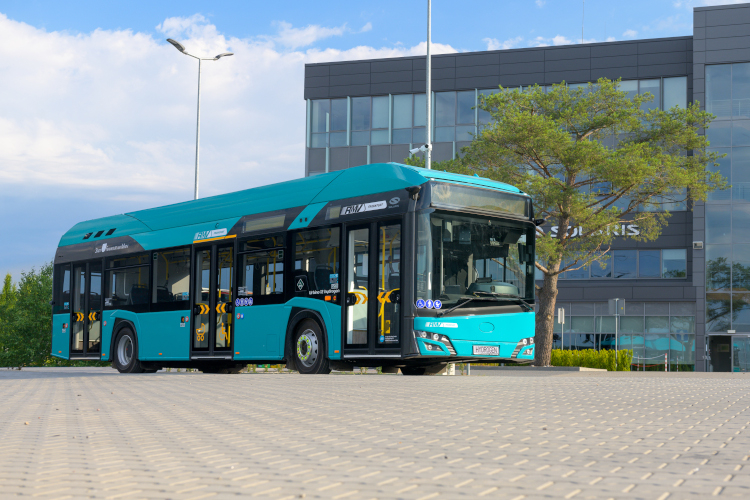
The bus operator In-der-City-Bus GmbH (ICB), which manages public transport in Frankfurt am Main, has ordered 10 hydrogen buses from Solaris. The metropolis has already been operating 13 Urbino hydrogen vehicles since 2022. The carrier also plans to launch its own hydrogen refueling station in the middle of this year. The vehicles from the new order will join the ICB fleet in the first quarter of 2024.
Frankfurt am Main is one of the largest cities in Germany. The municipal transport company In-der-City-Bus GmbH (ICB) operates three transport hubs in Frankfurt am Main, covering more than 50 percent of the city’s bus connections. The company manages 34 lines with a fleet of 228 vehicles, 24 hours a day, 365 days a year. ICB employs approximately 750 people: bus drivers, workshop staff, and administrative personnel. In line with the climate protection goals set by Frankfurt am Main, the carrier ICB aims to fully electrify its bus fleet by the early 2030s. Thanks to battery and hydrogen buses, as well as modern, low-emission diesel buses, the company is already a symbol of environmentally friendly and comfortable urban mobility. The carrier’s fleet already includes Urbino 12 electric battery vehicles, and hydrogen models have also been in service since last year.
In recent days, the carrier concluded a tender for the purchase of another 10 hydrogen buses, selecting Solaris as the supplier. ICB decided on the same hydrogen-powered model as before – the Urbino 12 hydrogen. The newly ordered buses will feature similar equipment to the hydrogen vehicles already known to the residents.
The vehicles will be powered by energy from a fuel cell. The only by-products of the chemical reaction occurring in the cell are heat and water vapor. The electricity generated in the process of reverse water electrolysis is then transferred directly to the drivetrain, which is an axle with electric motors. On board each of the ordered buses, there will be an additional Solaris High Power battery, which plays an auxiliary role in the hydrogen bus. During periods of high energy demand, the battery is also used in the recuperation process. Hydrogen will be stored in gaseous form in composite tanks placed on the roof, meeting the highest safety standards.
The Solaris Urbino 12 hydrogen buses will be equipped with a range of state-of-the-art ADAS solutions to support the driver’s work, including the MirrorEye system, a set of cameras installed in place of side mirrors, providing the driver with excellent visibility in various weather conditions.
Solaris will deliver the buses in the first quarter of 2024. The total value of the order is approximately 6.5 million euros. Hydrogen buses are increasingly serving regular urban traffic in cities and are enjoying undiminished interest from carriers. Solaris is currently the largest European manufacturer of hydrogen vehicles, having been developing this technology for almost a decade. The company has already delivered nearly 120 fuel cell-powered vehicles to 15 cities in Europe. Since last year, Solaris’s offer also includes an articulated model – the Urbino 18 hydrogen.
–