








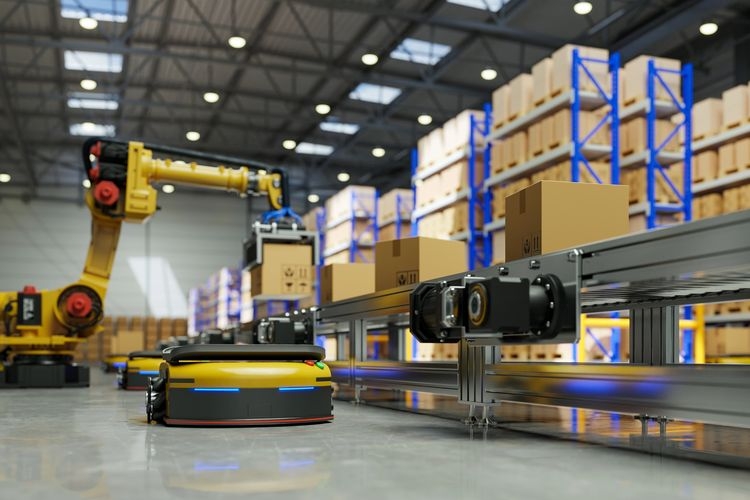
Regardless of whether companies are facing unexpected disruptions or expanding their operations on a global scale, they cannot afford to wait months or years to implement automation. To meet time pressures, speed and flexibility are key. This is also visible in the domestic market, when logistics is shaken by sudden events, but also during the expansion and scaling of warehouse space in enterprises.
When responding to critical logistics needs, time and the fluidity of the response are what count most. Companies may resort to temporary hiring or hasty implementation of automation technologies without ensuring their real capabilities. Unproven solutions often require months or years for full implementation, which prevents the achievement of set goals and generates unnecessary costs.
In times of supply chain fluctuations, when maintaining continuity and building a competitive advantage become a challenge, solutions must be not only effective but also flexible to meet real business needs. The ability to fully implement within weeks, without disrupting ongoing operations, is a hallmark of effective automation.
Invaluable support for growth…
As an organization grows, so do its logistics needs and warehouse network. The same happens with the successive increase in production in industrial or pharmaceutical companies. To achieve a strategic advantage, one must use intelligent solutions that can be adapted to needs and infrastructure, even if operating conditions evolve.
In this regard, artificial intelligence has brought a huge change. AI, as part of flexible automation, allows for task allocation based on priorities, locations, and order deadlines – even if they change over time or grow with the company. Autonomous Mobile Robots (AMRs) are an essential element of this system.
Combining these technologies means that automation can be adapted not only to increasing scale but also to changes in processes, team composition, or warehouse reorganization. AMRs can find routes and operate independently, without the need for costly facility modifications. This shows the contrast between real flexibility and rigid solutions.
With global company growth, the Robots-as-a-Service (RaaS) model is a sound choice, allowing for the fleet of robots to be increased or decreased in a few days, or moved between warehouses. Such a rapid response facilitates expansion, onboarding new clients, and opening new units. Once processes stabilize, the fleet can be reduced and costs optimized.
Flexibility also supports employees. Automation quickly takes over the most burdensome tasks, e.g., manual coordination or transport, delegating robots to move heavy goods based on changing priorities. In this way, a safer and more ergonomic work environment is created, managed by AI in real time. Such human-robot collaboration can even triple throughput without increasing headcount.
…key support in difficult moments
Flexible automation also proves invaluable when operations are under the pressure of unexpected events. These can be defective product batches, system failures, or accidents causing warehouse downtime. The effects vary in intensity, but they always involve additional staff burden and the risk of losses.
Traditional automation fails in such situations because it lacks adaptive capabilities. Today’s business needs are clear: automation must be scalable and deployable in a short time so that it can flexibly respond to sudden challenges. AMRs can be moved between warehouses almost instantly.
The RaaS model stands out here in particular. It allows companies to adjust operations without large capital investments. Global companies have tested this model, moving fleets of robots between countries in a matter of days – maintaining operational continuity and improving results. Thanks to this, flexible automation becomes a real tool for operational resilience.
Another hallmark is relieving employees and strengthening safety and ergonomics – even in difficult situations. Flexible automation gives them time for tasks related to exception handling, process optimization, or quality control. A work environment that supports employees even in demanding circumstances fosters their satisfaction and loyalty to the company.
A proven promise of productivity
Effective warehouse automation sounds good not only in theory. High scalability and flexibility should be available both to SMEs that cannot afford large investments and to global corporations. Examples of successful implementations already exist: a luxury brand uses it in 8 warehouses on 3 continents, having spent years moving parts of its operations along with its fleet of robots depending on business needs.
Locus Robotics solutions are used globally. They are utilized by more than 10 of the 15 largest 3PL providers, serving over 150 end customers. They are also used by companies from other industries – from the two largest sports brands in the world, through a med-tech leader, the largest American drug wholesaler, to the largest car manufacturer in the world.
Of course, not all warehouses are perfectly prepared for automation. However, the best, flexible solutions can adapt and scale without the need to redesign entire facilities and invest in rigid infrastructure. Today, when supply chains are uncertain and labor markets and consumer expectations are changing rapidly, the ability to adapt is essential to maintain a competitive advantage.
You can also listen about Locus Robotics solutions in our podcast.