









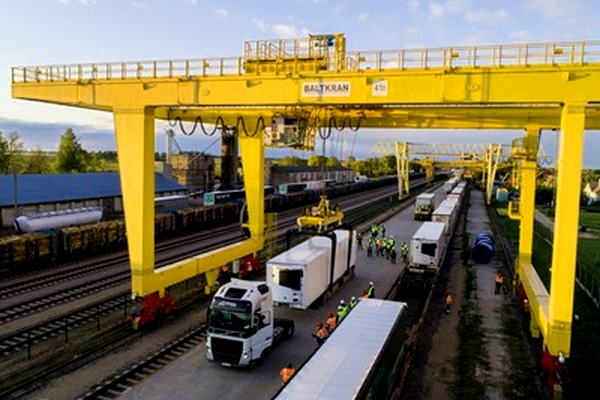
PKP CARGO, a rail freight operator in Poland, LG Cargo, a transport company from the Lithuanian Railways (Lietuvos Gelezinkeliai) group, and CargoBeamer, an intermodal transport operator, have partnered to launch a pilot train carrying semi-trailers.
The train, carrying 25 semi-trailers, arrived at the Šeštokai terminal near the Polish-Lithuanian border on May 14, 2020, after a two-day journey from the Kaldenkirchen intermodal terminal, located near the German-Dutch border. The pilot transport delivered semi-trailers from eight transport and logistics companies: Girteka, Vlantana, Hoptransa, A. Gricius’s, DSV, Arcese, Solotransa, and Nokvera. CargoBeamer provided the special rail wagons onto which the semi-trailers were loaded. The transport took place via the European Rail Baltica main line to Šeštokai. There, at the Lithuanian terminal, the semi-trailers were re-attached to trucks to complete the “last mile” to their unloading destination.
The venture was a breakthrough event in the logistics market. It is the first time in history that semi-trailers have been transported by freight train on the Germany – Poland – Lithuania route.
– This historic pilot transport of semi-trailers on wagons symbolizes a major turning point in the freight transport market, where synergy between different modes of transport guarantees fast and reliable goods delivery for all participants in the logistics chain. However, the greatest achievement of such transport is its environmental friendliness and the reduction of the negative impact of heavy vehicles on the environment. We hope that the new practice will strengthen the advantages of each mode of transport – the economy and environmental friendliness of rail transport for long-distance hauls, and the flexibility of road transport for door-to-door delivery – said Egidijus Lazauskas, CEO of LG Cargo.
PKP CARGO operated the train along the entire route between Germany and Lithuania.
– This pilot is of great importance to us, as it will allow us to test new possibilities for transporting cargo from Lithuania through Poland to Western Europe and in the opposite direction. This route is currently dominated by road transport, and we want to change this structure, which is unfavorable for rail. That is why, together with our partners, we are working on preparing a competitive transport offer – stated Czesław Warsewicz, CEO of PKP CARGO. – In addition to being a business project, the result of our action is also environmental protection. Rail is more ecological than road transport, as it emits far fewer harmful gases into the atmosphere, and the European Union expects member states to make efforts to gradually increase the share of rail in freight transport. Furthermore, trains provide safer transport of goods compared to trucks, as the accident rate on railways is many times lower than on roads.
– CargoBeamer has been interested in a connection between Lithuania and the Rhine-Ruhr region in Germany since our first visit to Kaunas ten years ago. This is an exciting opportunity, and thanks to the excellent cooperation with Lithuanian Railways, we can see how this initial vision is now becoming a reality. Lithuania is a hub for many large logistics players, and we see a future market for sustainable rail transport of semi-trailers from Central Europe to the Baltic states. We look forward to developing this business together with Lithuanian Railways – said Hans-Jürgen Weidemann, CEO of CargoBeamer.
The length of the Kaldenkirchen – Poznań – Warsaw – Šeštokai route is approximately 3,000 kilometers round trip, and a total of 45 semi-trailers will be transported in both directions. It has been calculated that this will contribute to reducing carbon dioxide emissions into the environment by up to 100 tons compared to transporting semi-trailers by road.
The European Union supports long-distance rail transport of semi-trailers precisely because it is eco-friendly. Another argument in favor of rail transport is road safety. It also brings benefits to logistics companies, which can save fuel and human resources. Furthermore, crossing borders between countries by rail is faster – this way, downtime resulting from customs clearance delays can be avoided.
The European Commission’s goal is for 30 percent of goods transported over distances exceeding 300 kilometers to be handled by rail or water transport by 2030. By 2050, such transport should account for more than half.
Source: PKP CARGO