









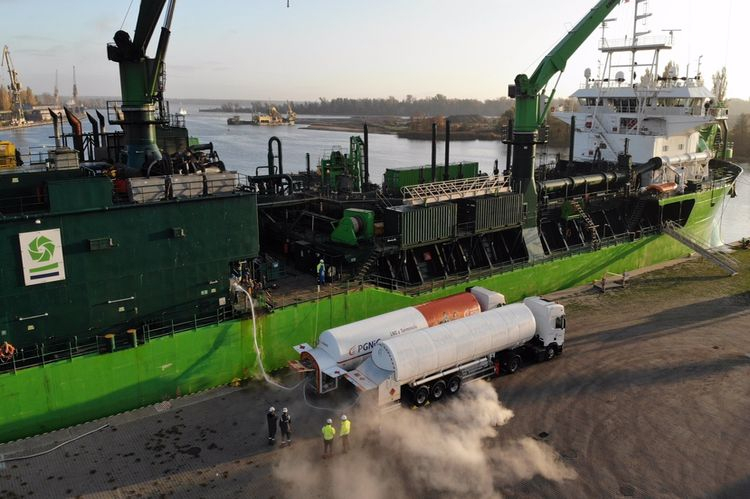
On November 5th, the first bunkering of a ship with liquefied natural gas (LNG) took place in one of the ports under the jurisdiction of the Maritime Office in Szczecin. With this, PGNiG Obrót Detaliczny and LOTOS Asfalt are expanding their cooperation, which strengthens the role of Polish ports and contributes to the popularization of LNG fuel in the Baltic Sea.
– Together with the LOTOS Group, we have already carried out several dozen bunkering operations, or colloquially speaking, refueling of ships with liquefied natural gas. We are pleased that the service is gaining popularity and that after Gdańsk and Gdynia, its implementation is now possible in other Polish ports. We are convinced that LNG fuel is the future of maritime transport in the Baltic Sea. The cooperation between PGNiG and the LOTOS Group in this area is a good example justifying the existence of a multi-energy concern, of which we will soon be a part – says Jarosław Wróbel, Acting President of the Management Board of PGNiG SA.
– Energy transformation motivates us to intensify our activities in the area of alternative fuels. One of the directions of our development is LNG – an ecological and safe fuel. To popularize this market segment, we need, among other things, the development of LNG logistics and bunkering infrastructure. The LOTOS Group is analyzing various projects in this regard. Recently, the company completed a feasibility study for the construction of a small-scale LNG transshipment terminal in Gdańsk, which is already at the final stage of internal corporate decisions – explains Paweł Jan Majewski, President of the Management Board of the LOTOS Group.
The LNG bunkering operation was carried out at the quay of the Port of Szczecin using cryogenic tankers. The LNG fuel was delivered to the tanks of the “Scheldt River” vessel, which is performing dredging works on the Świnoujście-Szczecin fairway, which will allow vessels up to twice as large as the current ones to call at Szczecin. This strategic investment worth over PLN 1.44 billion is financed from the Cohesion Fund and the state budget. The cooperation between the LOTOS Group and PGNiG in the area of LNG has been ongoing for several years. Furthermore, PGNiG is a supplier of natural gas to the LOTOS Group, where it is used in crude oil refining processes.
– We are observing growing interest in the bunkering service in Polish ports among shipowners. This is due to the growing awareness that LNG – as an alternative shipping fuel – is the only mature solution capable of meeting current and future emission standards, while remaining economically viable – emphasizes Henryk Mucha, President of the Management Board of PGNiG Obrót Detaliczny.
– The LNG bunkering service naturally complements the offer of low-sulfur marine fuels that LOTOS Asfalt provides to its customers. Shipowners are increasingly introducing dual-fuel ships into their fleets, and our goal, as a supplier, is to provide them with comprehensive bunkering services. Cooperation with PGNiG in this dimension brings mutual benefits to both companies. It should be assessed as developmental in the context of low-emission regulations worldwide – adds Cezary Godziuk, President of the Management Board of LOTOS Asfalt.
PGNiG Obrót Detaliczny, a company from the PGNiG Capital Group, already provides LNG bunkering services in five ports in Poland (Szczecin, Świnoujście, Police, Gdynia, Gdańsk). So far, it has carried out bunkering for 12 different ships, which places it as one of the most experienced entities in this part of Europe.
– I would like to strongly emphasize the model cooperation with the Maritime Office in Szczecin, the Szczecin and Świnoujście Seaports Authority, and the Police Nitrogen Plant. This is a very important step towards the development of this market in Polish seaports, which will significantly increase their competitiveness in the coming years – says Marcin Szczudło, Vice President of the Management Board of PGNiG Obrót Detaliczny.
LNG will also gain popularity due to the adoption of the so-called “Sulphur Directive”. For Central and Eastern Europe, this means more restrictive standards than in other parts of the world. The “Sulphur Directive” imposes on shipowners whose vessels sail in the SECA (Sulphur Emission Control Areas) zone, including the Baltic and North Seas, the obligation to use fuels with a sulfur content not exceeding 0.1%.
Source: PGNiG