









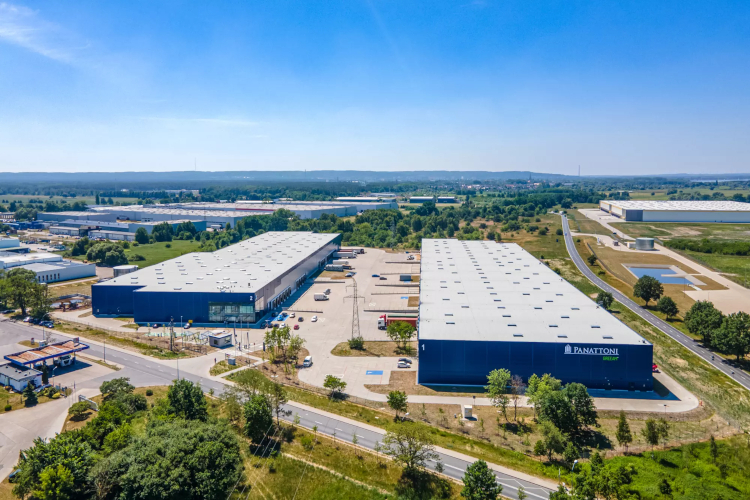
Panattoni has received an “Outstanding” rating in the BREEAM International New Construction system for Panattoni Park Szczecin III (halls A and B).
This is the first such high level of certification on the industrial real estate market in Poland for a newly constructed investment. Its implementation was preceded by detailed Life Cycle Cost (LCC) and Life Cycle Assessment (LCA) analyses of the facility for a 60-year period. During construction, energy and water consumption were closely monitored, and harmful CO2 emissions were reduced, while a thermographic survey was performed after the completion of construction. The halls were adapted to climate change and potential future changes in their use. The investment is located just 500 m from public transport and is adapted for people with disabilities.
Panattoni was the first developer to introduce BREEAM International New Construction building certification as a standard for its investments, becoming a leader in the green revolution in industrial construction.
– The Outstanding level confirms that a very wide range of pro-environmental and pro-social solutions have been applied in such a facility, which perfectly fits into our “Go Earthwise with Panattoni” policy. We managed to achieve it in just four years from implementing the BREEAM certification system into the standard of our projects. This is the result of the great commitment of many people, from the Panattoni team, through general contractors, to the assessors who guide us through the entire certification process. Mutual understanding of the idea of green building allows us to deliver increasingly sustainable facilities, which are also perfectly optimized in terms of operation – says Emilia Dębowska, Sustainability Director, Panattoni.
Implemented solutions. Panattoni Park Szczecin III is located in the capital of the West Pomeranian Voivodeship on Kniewska Street. The two certified halls cover a total of over 30,000 sqm.
The implementation of the investment was preceded by a detailed Life Cycle Cost (LCC) analysis, and the buildings were adapted to climate change. A plan for adapting their functionality was also prepared, covering both the buildings themselves and their systems for potential future changes in use. A flood risk assessment (low) and surface water runoff assessment were carried out for the investment. The construction process itself followed the concept of sustainable development – during construction works, the developer monitored electricity and water consumption as well as the impact of transport, tracking CO2 emissions. Certified materials and products were used, as well as those that are resistant to damage and will not degrade with climate change. Recycling at the construction site exceeded 95 percent. As much as 96.46 percent of the aggregate used at the construction site came from recycling. This was facilitated by the general contractor holding ISO 14001 and detailed policies regarding the environment, waste, and sourcing materials from sustainable sources.
A number of water-saving solutions were applied in the facility. Modern technologies – including devices preventing uncontrolled leaks, water-saving fittings, or motion sensors – allowed for a 57.6 percent reduction in water consumption. Its consumption was reduced by more than half compared to the baseline model. As a result of these actions, it was possible to reduce CO2 emissions by 50.8 percent.
Caring for well-being. In the office areas, increased access to daylight was ensured. The spaces were examined for thermal comfort and appropriate acoustics. Panattoni also ensured easier access for employees of varying physical abilities and ages, including a stair climber for people with disabilities. A safe movement plan for the facility was developed, which includes pedestrian crossings and separate paths for pedestrians and employee cars, which do not conflict with routes used by delivery trucks. The developer also focused on sustainable transport, providing, among other things, infrastructure for charging electric cars and bicycles. At the same time, the bus stop is only 500 meters away. Employees of the facilities also gained access to hot food, can withdraw cash from an ATM, and use a gym and recreation areas.
Green areas were also taken care of around the investment, increasing the biodiversity of the local ecosystem. Among other things, 21 maples and rowans, 8 pedunculate oaks, over 200 various shrubs such as dogwood or elderberry were planted, and grasses were sown. These plantings do not require watering and rely solely on rainfall, at any time of the year, which is confirmed by a report from a qualified ecologist. The pro-ecological meadows and pocket parks created by Panattoni retain moisture, prevent soil erosion, lower air temperature, and are also one of the most effective oxygen producers and carbon dioxide absorbers. Proper selection of plants also allows for providing food and shelter for local fauna.
Certificates are increasing. It is worth noting that while Panattoni Park Szczecin III remains the first facility certified at the Outstanding level in Poland, it is not the only one in Panattoni’s European portfolio. In 2020, the developer obtained BREEAM certification at the Outstanding level for its facility in Cheb, Czech Republic. Currently, further investments are being implemented there, which are also intended to reach this level. Similarly in Poland. So far, Panattoni has completed environmental certification for facilities in Europe with a total area of over 10 million sqm, and another 6.5 million are awaiting assessment.