








It turns out that phasing out internal combustion engine cars faster is a better prospect for the European automotive industry and the jobs associated with it. A financial analysis of six car manufacturers has shown that by switching to electric vehicles faster than their current plans suggest, they face the opportunity to increase their market value and profit. It turns out that abandoning a business model based on the production of internal combustion engine cars within this decade could result in an increase in company share value by an additional 800 billion euros. The results of the analysis contradict the narrative of the automotive industry, which claims that the European push to sell only zero-emission cars by 2035 would hit company profitability and mean job losses.
Manufacturers face the prospect of declining profits from internal combustion engine cars towards the end of this decade, caused by the competitiveness of cheaper electric vehicles and stricter environmental standards hitting sales and reducing their economies of scale. In developing its cash flow model analysis for the future, the research firm Profundo looked at the financial data of six car manufacturers and separated the production of electric vehicles from internal combustion engines for each of them into two separate companies. The analysis showed that:
- within 3-5 years, margins from electric vehicle manufacturers’ operations may exceed those of internal combustion engine manufacturers.
- by the end of this decade, margins for internal combustion engine manufacturers may not only decrease but even show a negative value on balance sheets.
– From a financial point of view, the decision to slowly phase out internal combustion engines is a suicidal step for car manufacturers. A transformation planned in this way lowers value for shareholders and even exposes entire companies to the risk of disappearing from the market. The only path that makes business sense here is to act in a ‘fast and furious’ model. – said Luca Bonaccorsi, Director of Sustainable Finance at Transport & Environment (T&E), which commissioned the study.
Declining profits from the sale of internal combustion engine cars will begin to discourage investors from supporting companies where electrification proceeds too slowly. To assess the potential market value achievable by each of the analyzed car manufacturers in a scenario of fast and slow electrification, Profundo applied a standard sum-of-the-parts methodology. It showed that:
- the share capital of the six car manufacturers could increase by an average of 316% compared to today’s state if they decide to switch to electric vehicles in 2025-2030 faster than their current plans assume.
- conversely, a transformation slower than planned in the same period will lead to the lowest growth in market value, and in the case of Toyota – one of the car manufacturers “electrifying” the slowest so far – even to a decline in value compared to today’s state.
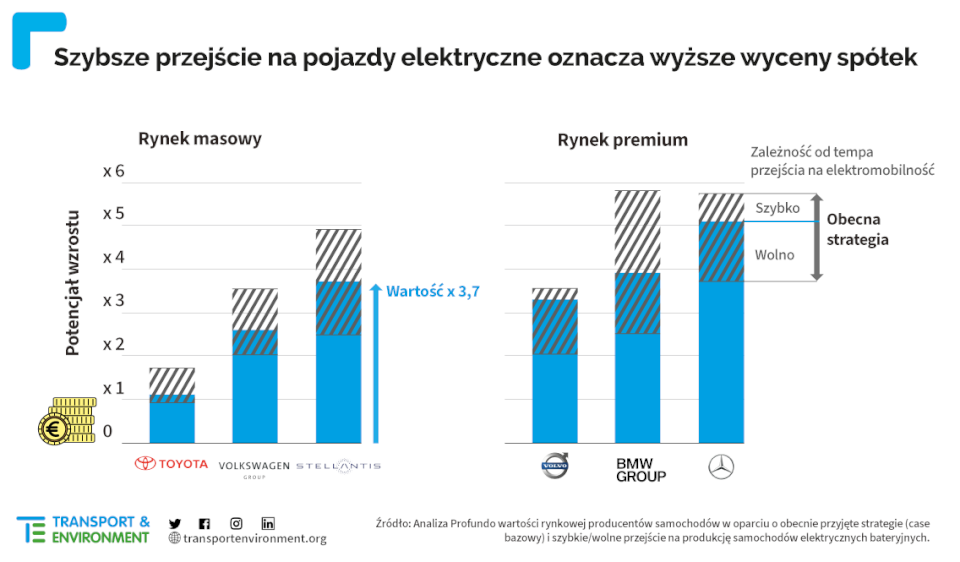
Assuming a faster-than-planned transformation, Volkswagen could more than triple its market value (253%), and Stellantis could increase it almost fivefold (388%) compared to today’s state. Toyota, as a company operating more slowly in this field, has a lower growth potential (70%).
In the premium market, the opportunities are even greater: Mercedes-Benz has the chance to add 471% to its value within a decade, as does BMW (472%). Even Volvo Cars, which is currently valued on the market twice as high as its competitors precisely because of its advantage in the electrification process, could see a 245% increase in value if it accelerates its actions in this area.
EU regulations on reducing emissions from new cars are the main driver of electrification in Europe, however, the current proposal to introduce more ambitious standards would not cause significant changes by 2030. Meanwhile, research conducted by Profundo shows that – if European car manufacturers want to avoid financial consequences and potentially dramatic consequences for jobs in the automotive industry – by 2030 it will already be too late for changes.
– A faster transition to electric vehicles is not only in the interest of the climate and consumers, but is also essential for the financial profitability of European car manufacturers. Therefore, supporting a timely transformation is the duty of EU legislators towards companies and employees in the automotive industry. And stricter CO2 emission standards for cars than those currently planned for 2025 and 2030 are the key to accelerating this process. – said Rafał Bajczuk, Senior Policy Analyst at the Electric Vehicle Promotion Foundation.
Source: European Federation for Transport and Environment AISBL