








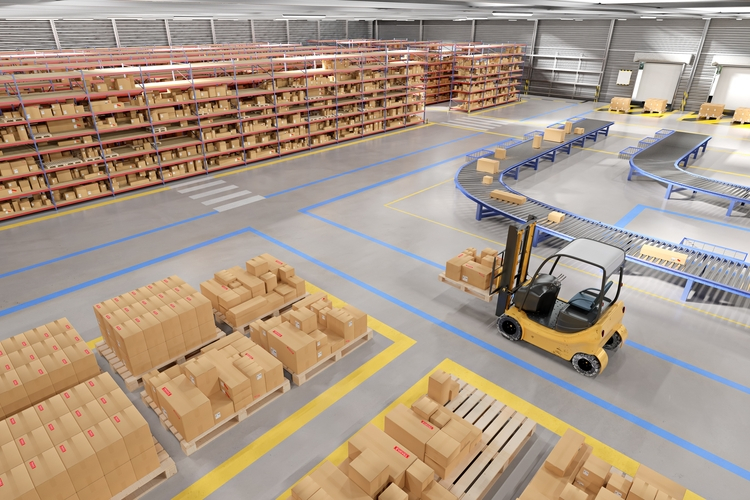
After a successful 2021, the warehouse market is not slowing down. Alongside the big five, new, well-connected locations are appearing on developers’ radars. The development of the e-commerce sector continues to drive the construction of new facilities that are more ecological and employee-friendly. However, rising construction costs, shrinking land banks, and difficult access to warehouse workers may become challenges for the market.
– Throughout 2021, we recorded record demand in Poland at a level exceeding 7.3 million sqm of modern industrial and warehouse space, which means an increase of over 40 percent compared to 2020 and almost 80 percent compared to 2019. At the same time, we are observing a clear decline in vacant space. At the end of last year, the vacancy rate reached 3.9 percent, and we are recording the most vacant warehouse meters in Silesia, Masovia, and Central Poland – says Agnieszka Giermakowska, Director of Research and Advisory at Newmark Polska.
Last year (according to preliminary estimates), developers delivered over 3 million sqm of warehouses to the market, which is more than in the record-breaking year of 2019 (2.7 million sqm). The largest investments completed last year include: a 200,000 sqm BTS facility in Świebodzin, built for Amazon by Panattoni, Hillwood Rokitno (112,000 sqm), GLP Lędziny Logistics Centre (111,500 sqm), and a 108,000 sqm BTS warehouse for DHL Supply Chain at Panattoni Park Poznań in Żerniki.
Another good year ahead
In 2022, Newmark Polska analysts expect further records on the warehouse market.
– Demand will remain at a high level, primarily due to the permanent change in the shopping habits of Poles, as well as improvements in supply chains and the increasingly frequent expectations from online store consumers for short delivery times, preferably on the same day – says Jakub Kurek, Head of Industrial and Warehouse Department at Newmark Polska.
Developers will continue to be very active – at the end of last year, over 4.6 million sqm of warehouses were under construction, of which about 2.8 million sqm were in Panattoni investments. Newmark Polska analysts estimate that in total, over 80 percent of the meters under construction will be delivered to the market by the end of December 2022. This is also confirmed by investor declarations. Panattoni, with a portfolio of over 10.3 million sqm delivered in the country, signed lease agreements for 3.2 million sqm in 2021, and the largest transactions include: 146,000 sqm for Zalando in Bydgoszcz, 105,000 sqm for Zalando near Poznań, 82,000 sqm in Gorzyczki, 78,000 sqm for ID Logistics in Wrocław for e-commerce operations, and over 134,000 sqm for LPP in two locations. 7R announces the construction of almost 1 million sqm this year, which would be a 150 percent increase compared to the space delivered last year (in total, the developer has over 4 million sqm in the investment process). White Star Logistics will start the construction of three projects this year, of which it will finalize a total of 175,000 sqm by December, and SEGRO will deliver another 100,000 sqm this year. Meanwhile, MLP Group assumes an increase in the annual level of signed lease agreements to 300,000 sqm per year.
New locations on developers’ radars
Among the locations on the warehouse market, the big five – Masovia, Upper Silesia, Central Poland, Lower Silesia, and Greater Poland – have been leading for years; these regions contain a total of about 77 percent of the country’s total warehouse resources. However, as Newmark Polska analysts note, this dominance is slowly melting, and new, well-connected locations are appearing on developers’ radars.
– We are observing significant interest in Western Poland, and in particular in the Lubusz and West Pomeranian voivodeships. In addition, the Tri-City is gaining more and more importance. Other regions are not lagging behind either. Currently, there are almost 800,000 sqm of warehouses in the Podlaskie, Podkarpackie, Świętokrzyskie, and Lubelskie voivodeships – informs Jakub Kurek.
Bolder and without pre-lets
At the same time, quite systematically, for two years now, the percentage of space built speculatively has been growing. This is caused, among other things, by a slight extension of the waiting time for a new warehouse (from 6-8 to 8-10 months) and a simultaneous increase in the demand for “ready-to-use” warehouses. Last year, about 55 percent of the emerging warehouse space was secured by lease agreements, with 20 percent of all meters being halls built in the BTS (build-to-suit) system.
– The macroeconomic situation and excellent prospects for the warehouse industry allow for a slightly larger share of speculative projects than three or four years ago. The proportions in our portfolio look more or less 70 to 30, where the smaller part concerns speculative space – says Bartłomiej Krawiecki, Vice President of the Management Board of 7R, Chief Operating Officer.
The demand for ad hoc space is also noticed by MLP Group.
– In addition to investments supported by pre-let agreements, we also plan to build more on speculative terms. Our goal is to maintain the occupancy rate at a stable level, averaging about 97 percent of the current total portfolio, with a share of speculative construction of up to 20,000 sqm per project – informs Agnieszka Góźdź, Director of Sales Department at MLP Group.
– The demand for logistics space is at a record high, and the number of newly started investments, led by build-to-suit facilities, is growing. Rents are going up because the pool of available vacant space is shrinking, and customers are trying to increase the resilience of their supply chain. Thanks to our global scale and focus on innovation, technology, and data, we provide high-quality real estate in the most desirable markets. We ended the past year with a record-low vacancy rate in Poland. Thanks to the successful purchase of the Łódź portfolio of warehouse facilities, we have significantly strengthened our position in Central Poland. In 2021, we completed the construction of 9 warehouse facilities with an area of over 216,000 sqm in four Central European countries. And most importantly, we continue to grow and have the potential for even more – summarized Paweł Sapek, Senior Vice President and Head of Prologis in Central Europe.
Online retail and warehouses
One of the most important driving forces of the modern warehouse space market will continue to be the development of e-commerce services.
– Along with the dynamic development of the sector, customer expectations regarding faster and more effective delivery of goods are also growing. Most consumers declare that they would like the products ordered online to reach them within a maximum of 48 hours. To meet this, it is necessary to optimize the entire supply chain, especially last-mile transport, an important element of which has become urban warehouses offering the possibility of renting warehouse space in the Small Business Units format – explains Agnieszka Giermakowska.
It is therefore not surprising that urban warehouses account for as much as 67 percent of the total value of SEGRO’s European portfolio.
– Due to the popularity of online retail and the increased demand for SBU, we also want to continue to develop this element of our offer in Poland. An example of a facility located within the city limits is the newly emerging building in SEGRO Business Park Warsaw Żerań, which offers typical SBU modules – says Magdalena Szulc, Managing Director Central Europe at SEGRO, and adds that thanks to the growing role of e-commerce, 2022 will undoubtedly be another period full of success for the warehouse industry. Warehouses must get closer to the end customer, which is why acquiring excellent locations for new investments within city limits will become key.
In turn, Prologis has opted for a flexible SBU format in its Warsaw location. The warehouse currently being built in Prologis Park Żerań will offer tenants tailor-made solutions known from BTS implementations, and the ability to combine warehouse modules will allow customers to increase the occupied space without having to move.
Another major player on the market – 7R – notices increased interest in production buildings. In the last quarter of 2021, Valeo Siemens eAutomotive, a leading supplier of engines and technology for electric and hybrid cars, launched its factory in the 7R Park Beskid II complex. Last year, 7R also strengthened its competencies in the field of data center construction, which is also one of the important points on the company’s agenda for the current year.
– These are facilities built in the build-to-own (BTO) formula, designed to measure, according to customer requirements, and implemented in locations that guarantee business continuity and maximum security against all external threats – explains Bartłomiej Krawiecki. He also points to changes in the market forced by automation. – Automation in logistics means that older warehouses often turn out to be ill-suited to the current needs of tenants. A new market is being created here because companies are looking for modern, innovative buildings where technologies will play an increasingly important role.
Activity in most warehouse formats currently being created on the market is declared by Panattoni:
– For us, the goal and plan have always been simple – to follow the client and their needs. And that is exactly what we are doing – says Marek Dobrzycki, Managing Director at Panattoni. – That is why we are delivering not only warehouse facilities where we deal with product logistics or production, but also data center facilities – we are currently implementing buildings with a capacity of nearly 30 MW, and we have further investments in the pipeline. We are also focusing on, among other things, brownfield investments, the share of which in Panattoni’s European portfolio is increasing. In Poland alone, in 2020 and 2021, these types of investments accounted for 35 percent of the space we delivered. We are mindful of rational land management and following the principle of sustainable development through revitalization and remediation activities, especially since these investments form the backbone of urban logistics.
Ecologically, economically, and with care for the employee
The creation of new warehouse formats is closely related to the evolution, and sometimes even a revolution, of the standard in which halls are built. Panattoni, as the first developer in Poland, introduced BREEAM certification at the Excellent level to the standard of its investments and already has successes. In accordance with these strict requirements, the company obtained the first certificates for the industry on the domestic market – at Panattoni Park Sosnowiec I and BTS Świebodzin with an area of over 200,000 sqm. Raising the certification level from Very Good to Excellent in the standard was associated with numerous improvements in the field of building energy efficiency, employee wellbeing, but also the introduction of LCA (Life Cycle Assessment) or LCC (Life Cycle Cost) analyses.
– Our facilities are friendly to their users and the environment, thanks to the innovative design of aluminum-glass facades in office parts, which harmonizes with the new concept of greenery in the investment area. As part of the project, relaxation zones equipped with ecological urban furniture, flower meadows, beehives, and houses for invertebrates are being created – explains Marek Dobrzycki.
In turn, the developer Prologis is changing the technical specification of its buildings, taking into account three main factors: reducing the carbon footprint, maximizing cost-efficiency for customers, and increasing work comfort in warehouses.
– Every newly built facility is subject to BREEAM accreditation at the Very Good level or higher. Our standard is already a clear height of at least 11.5 – 12 meters. We are also increasing the fire resistance of our buildings and modernizing lighting by introducing LED systems equipped with motion and daylight sensors, which provide significant savings in bills and increase safety and work comfort in the warehouse – says Michał Czarnecki, Vice President, Head of Capital Deployment & Leasing at Prologis.
Additionally, the developer offers tenants and their employees a number of amenities in its facilities – from bicycle shelters and electric vehicle charging stations to green areas for relaxation – all as part of the Prologis PARKLife project.
In turn, MLP Group intends to commonly install photovoltaic systems on the roofs of facilities in its logistics centers. As part of the launched project, installations in Poland will cover a total of about 120,000 sqm, and their total capacity in the first stage will reach 6.4 MWp. The investment implemented in 10 logistics parks is to be ready in the first quarter of 2023. Modern technologies in warehouses serve not only savings and optimization of performed tasks. An equally important area is solutions related to the sustainable development policy, and as Newmark Polska experts claim, the trend for green warehouses will be one of the leading ones in 2022 and in the following years. – The standard of our latest projects, created in accordance with the requirements of the BREEAM certificate at at least the Very Good level, includes, among other things, roofs reinforced for the installation of photovoltaic panels. Thanks to the use of LED lighting, tenants use less electricity, while healthier working conditions in the dock zone are ensured by twice as many skylights as usual (skylights occupy an area of 4 sqm for every 100 sqm of roof). Uncontrolled heat loss is excluded by thermal insulation control using thermal imaging cameras. A standard in our warehouses is also so-called intelligent media control, i.e., smart metering – says Jarosław Czechowicz, Country Manager at GLP.
This is also confirmed by the activity of the developer SEGRO: – We have been directing the bulk of our activities recently towards the zero-emission of facilities, to achieve which we committed by 2030. From a technical point of view, this means for our customers more ecological, but also more ergonomic materials from which warehouses are built. One of the elements of the zero-emission strategy is the installation of photovoltaic panels in selected buildings. Consistently for years, all our newly emerging buildings have also been subject to rigorous BREEAM certification, and several will soon obtain an Excellent rating. We are also a pioneer in implementing PropTech solutions; practically all our parks are already equipped with modern license plate reading systems, media monitoring, or chargers for electric and hybrid vehicles – adds Magdalena Szulc, Managing Director Central Europe at SEGRO.
Opportunities and problems, or heading into 2022
According to Newmark Polska experts, 2022 will be another record year on the warehouse market.
– In the current year, e-commerce and all industries indirectly or directly related to online retail, i.e., logistics operators (3PL sector) and courier companies, will continue to develop very strongly – claims Jakub Kurek. – In a situation of disruptions in the functioning of global supply chains, the phenomenon of so-called nearshoring, securing supply chains, and locating production and warehouses closer to sales markets is gaining importance. One of the beneficiaries of these decisions will certainly be Poland, which will further mark its position as one of the key industrial and warehouse markets in Europe.
In 2022, apart from successes, developers will also face challenges.
– For a long time, we have been observing an increase in the prices of building materials. Maintaining the level of profitability will be a challenge for the entire market – claims Dominik Buczkowski, Industrial Development Director at White Star Real Estate.
According to Prologis, one of the more serious challenges will also be the situation on the labor market – difficult access to warehouse workers and the level of retention. Another problem that developers will have to face is the insufficient amount of available land for new investments.
– Both of these factors, in the case of growing demand for warehouse space, are a challenge for the entire market. As for the labor market, we try to provide our clients with support in acquiring and retaining employees – we emphasize ensuring good access to the park and increasing work comfort in warehouses. The answer to the labor market is also greater automation in warehouses, which is why our investments are designed in such a way as to make it easier for tenants to implement modern technologies automating logistics – summarizes Michał Czarnecki.

In the photo (from left): Jakub Kurek, Head of Industrial and Warehouse Department at Newmark Polska; Marek Dobrzycki, Managing Director at Panattoni; Magdalena Szulc, Managing Director Central Europe at SEGRO; Bartłomiej Krawiecki, Vice President of the Management Board of 7R, Chief Operating Officer; Jarosław Czechowicz, Country Manager at GLP; Paweł Sapek, Senior Vice President and Head of Prologis in Central Europe; Michał Czarnecki, Vice President, Head of Capital Deployment & Leasing at Prologis; Agnieszka Góźdź, Director of Sales Department at MLP Group; Dominik Buczkowski, Industrial Development Director at White Star Real Estate; Agnieszka Giermakowska, Director of Research and Advisory at Newmark Polska.