








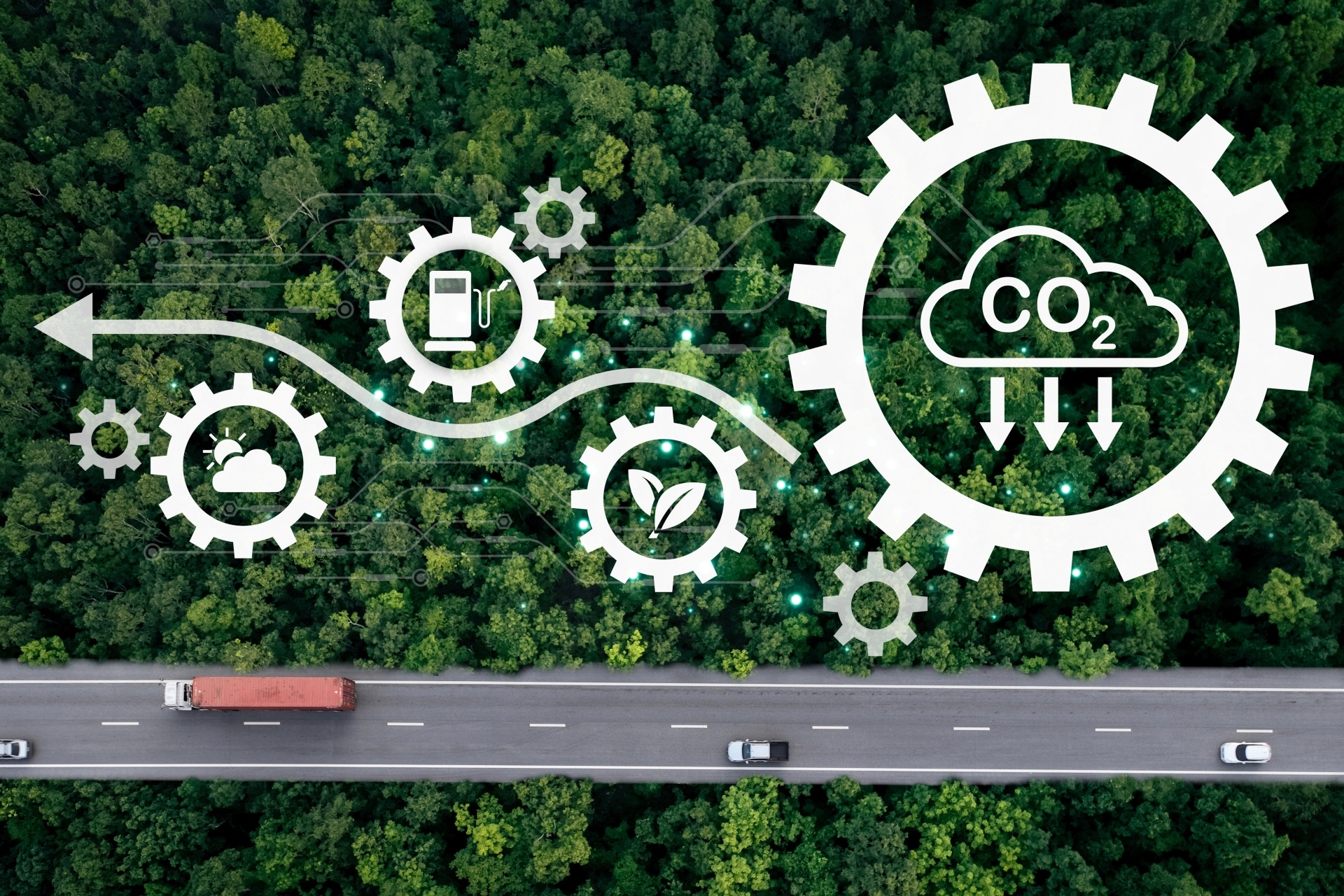
Already about one-third of European principals include sustainability goals as a hard condition in contracts with supply chain partners[1], and over 70% include environmental criteria in tender processes[2]. The second edition of the “Transforming Transportation in 2026” report indicates that pressure from large clients will be one of the key factors shaping the road transport sector in the coming years. The publication includes an analysis of seven markets and presents companies distinguished in the Market Leader, Tech Trailblazer, and Sustainability Star categories. Among them is LOGIUS – an operator developing its fleet and transport processes based on low-emission solutions, data, and preparation for upcoming ESG requirements.
LOGIUS was founded in 2010 as a sole proprietorship in the freight forwarding sector. A few years later, the company transformed into a limited liability company, and the management decided to invest in its own fleet. This was a step that paved the way for further development.
We realized that if we want to build credibility and grow in the market, we must have our own vehicles. Clients expect not only efficient service but also control over the transport process, and we wanted to be able to provide that.
– says Mateusz Gromanowski, CEO of LOGIUS.
The purchase of the first trucks was the beginning of a dynamic transformation. The company gradually built competencies in transport and logistics, which allowed it to acquire clients from sectors such as paper, steel, and automotive, as well as enter the rapidly growing e-commerce industry. LOGIUS attracted the attention of a German investor – the Reinert Logistics group, which has several hundred BioLNG-powered vehicles in its fleet and acquired a majority stake in 2022.
Today, it is transport, not freight forwarding, that definitely dominates our business. This is a natural direction – both from the point of view of the company’s development and client expectations.
– emphasizes Mateusz Gromanowski.
Green transport as a company strategy
The increasing requirements of contractors result primarily from European Union regulations. The management quickly understood that the community’s climate goals – including reducing CO₂ emissions by 40% by 2030 and achieving climate neutrality by 2050 – are ceasing to be a distant perspective and are becoming a business criterion. Global corporations, adapting to new reporting obligations, have begun to demand concrete actions from their partners as well. That is why the company decided to invest in technologies that reduce CO₂ emissions. Currently, the company’s parking lot features vehicles running on HVO100 and BioLNG, and electric trucks are in the testing phase. The company’s CEO sees potential in a mixed powertrain model and testing various solutions to be ready for the future.
If we are able to present a client with a certificate confirming a CO₂ emission reduction of 80–90%, we gain a real competitive advantage – including access to fixed transport lines and the most attractive contracts. Investments in low-emission solutions are no longer just a matter of image – they are increasingly becoming a condition for participating in tenders and cooperating with the largest companies. Our strategy assumes consistent development of a fleet powered by alternative fuels – HVO100 and BioLNG – and testing electric vehicles so that we can gain experience and be ready for future regulatory requirements. Cooperation with Eurowag helps us in implementing this plan, thanks to which we can refuel BioLNG or renewable diesel at over 400 LNG stations in Europe.
– explains Gromanowski.
LOGIUS is already preparing for upcoming ESG reporting obligations. Although the regulations do not yet require it, the company is implementing processes that allow it to report its environmental impact in a reliable and measurable way.
One of the pillars of these activities is the systematic modernization of the fleet. Vehicles are replaced with great regularity – the average age is currently 1-2 years. The company orders new trucks compliant with the latest emission standards and adjusts purchases to the results of environmental analyses.
Currently, our fleet consists of 50 vehicles – tractor units, semi-trailers, and BDF sets, which we use to transport swap bodies for the largest logistics operators, such as DHL or UPS. Investing in new vehicles is an important part of our business strategy. Thanks to it, we not only reduce harmful exhaust emissions by up to several dozen percent compared to older vehicles, but we also have lower truck operating costs and a better chance of winning new contracts. We are also open to electric vehicles and have already taken the first steps in this area to know how this technology functions, test it, and perhaps gradually implement it permanently. In my opinion, the future of transport in terms of sustainable development will be based on mixing available technological solutions, and not on one direction, which is fleet electrification.
– comments Mateusz Gromanowski.
Technologies in the service of driver education
LOGIUS uses data from the telematics system and the eco-driving module – not only to control current fleet parameters but primarily to optimize routes, reduce costs, suggest to drivers which driving moments need changing, and better respond to client needs. Analyses are conducted together with ESG experts, and their results support both internal activities and transparent communication with business partners.
Drivers play an important role in this process – many environmental indicators that LOGIUS wants to measure and constantly improve depend on their daily decisions behind the wheel.
What we are doing is changing driver habits.We teach them to use predictive cruise control, braking with anticipation, and taking care of tire pressure. Thanks to this, we get lower fuel consumption and less wear on tires, brake pads, and discs. Everything translates into lower emissions and costs – We regularly organize training in cooperation with vehicle manufacturers and Eurowag. The eco-driving module and the GBox system provide data on driver behavior, which are discussed individually to support their development and motivate them to drive more efficiently. Without telematics in a company like ours, it is simply impossible to function. Data on driving style or driver ratings is our starting point. We can compare this data between drivers, send them reports, and show them what they are doing well and what still needs improvement.
– says Mateusz Gromanowski
All data at hand
Using solutions from a single provider is a great convenience for LOGIUS in daily company management. The tools the company uses, such as GBox telematics or the 4Trans driver working time accounting software from Eurowag, are integrated with each other, which allows them to quickly analyze data and handle transport orders, and also ensures better information flow and more efficient communication between employees. Thanks to this, the company saves time and avoids errors that could result from scattered, unconnected systems.
Having access to fuels, including alternative ones, telematics, driver working time accounting, and other services in one place is a huge convenience because it allows for efficient transport management on many levels. We also value the transparent portal where everything is organized. Moreover, we also use the knowledge of OCRK (National Center for Driver Accounting) experts on a daily basis, who advise us on the correct accounting of drivers. Thanks to this, we have greater peace of mind that their salaries are calculated in accordance with the latest legal regulations.
– adds Mateusz Gromanowski.
Conscious management and readiness for change can ensure success even in difficult times for the transport industry. From a small business, the company has traveled the path to a modern company with a fleet of several dozen vehicles, attracting the attention of a German logistics giant. Thanks to investments in green technologies and modern fleet management, LOGIUS shows that sustainable development provides a competitive advantage.
[1] European Logistics & Supply Chain Sustainability Report 2024, https://www.hfw.com/app/uploads/2024/10/006212-REPORT-European-Logistics-Supply-Chain-Sustainability-2024-5mb.pdf
[2] AMCS Group, https://www.amcsgroup.com/resources/blogs/the-most-important-sustainability-trends-in-the-european-transport-industry-in-2024/
Source: Eurowag